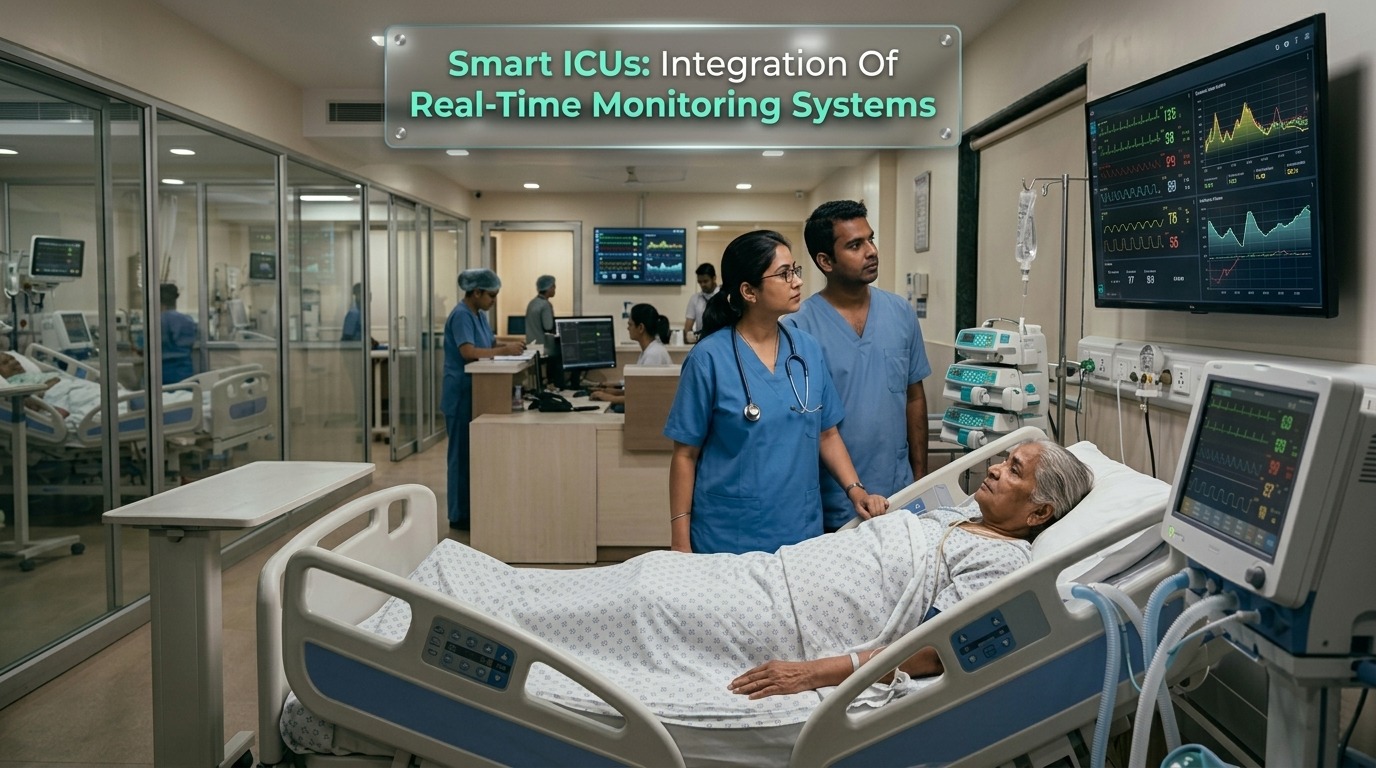
Smart ICUs: Integration Of Real-Time Monitoring Systems
Smart ICU systems transform critical care by integrating real-time monitoring, connected devices, and AI-driven insights to detect early deterioration, enable predictive decision-making, and support faster clinical responses, improving patient outcomes and reducing risks from delayed intervention.
Critical care has always been about timing. A few seconds can change outcomes, and a small delay can complicate recovery. In traditional ICU settings, monitoring depends heavily on staff attention, periodic checks, and manual interpretation of data. While effective, this approach leaves gaps, especially when patient conditions change rapidly.
This is where the idea of a smart icu patient monitoring system begins to redefine care. Instead of reacting to changes, systems now aim to detect, predict, and respond in real time. The ICU is no longer just a place with machines. It is gradually becoming a connected environment where data flows continuously and decisions are supported by intelligent systems.
What Makes An ICU “Smart” In Today’s Healthcare
A smart ICU is not defined by a single device or software. It is built through integration. Multiple systems work together to create an Intelligent environment where patient data is constantly monitored, analyzed, and acted upon.
At the center of this setup are Real-time monitoring systems, which collect data from vital signs, ventilators, infusion pumps, and other critical equipment. This data is not just displayed. It is processed to identify patterns, trigger alerts, and support clinical decisions.
The inclusion of Artificial intelligence adds another layer to this environment. Instead of relying only on thresholds, AI can recognize subtle changes that may indicate early deterioration. This allows clinicians to intervene earlier, often before visible symptoms appear.
A well-designed smart icu project connects these components into one unified workflow, ensuring that information does not remain isolated within devices but contributes to a broader clinical picture.
Why Real-Time Monitoring Matters In Critical Care
In an ICU, patient conditions can change within minutes. Relying on periodic observation increases the risk of delayed response. Continuous monitoring changes this dynamic.
With Real-time monitoring systems, data is captured and analyzed without interruption. This creates a continuous stream of information that reflects the patient’s current state rather than a snapshot from a few minutes ago.
The benefits of this approach become clearer when you look at how it impacts daily care:
- Early detection of complications before they become critical
- Faster response to sudden changes in vital signs
- Reduced dependency on manual checks
- Better coordination between care teams
These systems do not replace clinicians. They support them by ensuring that no important signal goes unnoticed.
How Smart ICU Systems Actually Work
The functioning of a smart ICU is not complicated in concept, but it is powerful in execution. It involves connecting devices, data, and decision-making into one continuous flow.
Data Collection Across Devices
Patient monitors, ventilators, and infusion systems continuously send data into a central platform. This forms the foundation of the smart icu patient monitoring system.
Continuous Analysis Using AI
With the help of Artificial intelligence, this data is analyzed in real time. The system looks for patterns, deviations, and early warning signs.
Alert Generation And Prioritization
Instead of overwhelming staff with alarms, the system prioritizes alerts based on urgency and relevance. This reduces noise and improves response quality.
Integration Into Clinical Workflow
The system ensures that all relevant information is accessible in one place, supporting faster and more informed decision-making.
Feedback And Adaptation
Over time, the system adapts based on patient data and clinical inputs, improving its accuracy and usefulness.
Where Smart ICU Solutions Make The Biggest Impact
The shift toward smart icu solutions becomes more visible in high-pressure scenarios where precision and timing matter the most. These systems are particularly effective in environments with high patient volumes and limited staff.
Key areas of impact include:
- Managing critically ill patients with unstable conditions
- Monitoring post-surgical recovery in real time
- Supporting ventilator management with continuous data
- Reducing alarm fatigue through intelligent alert systems
- Improving coordination across ICU teams
These are not isolated improvements. Together, they create a more stable and responsive care environment.
Case Studies: Real-World ICU Transformation
Case Study 1: Detecting Deterioration Before It Becomes Visible
In a tertiary care hospital, ICU staff often relied on standard monitoring systems that triggered alerts only when thresholds were crossed. While effective, these alerts sometimes came after the patient had already begun to deteriorate.
After implementing a smart icu patient monitoring system supported by Real-time monitoring systems, the hospital noticed a shift. Subtle changes in patient data were identified earlier through continuous analysis. Instead of reacting to sudden alarms, clinicians began responding to early indicators.
This changed how care was delivered. Interventions started happening sooner, often before the condition became critical.
Case Study 2: Reducing Alarm Fatigue In Busy ICUs
A multi-specialty ICU faced a common problem. Too many alarms, many of which were not clinically urgent. Staff became desensitized, increasing the risk of missing critical alerts.
By introducing smart icu solutions integrated with Artificial intelligence, the system began filtering and prioritizing alerts. Only meaningful signals were highlighted.
The environment became quieter, but more focused. Staff could respond more effectively because the noise was reduced without compromising safety.
Case Study 3: Creating A Connected ICU Environment
In another hospital, devices operated independently, making it difficult to get a complete picture of patient status. Data existed, but it was fragmented.
A structured smart icu project brought these systems together into one Intelligent environment. All devices were connected, and data flowed into a centralized platform.
This allowed doctors and nurses to access a unified view of the patient. Decisions became faster, and coordination between teams improved significantly.
Challenges In Implementing Smart ICU Systems
Despite the benefits, adopting these systems comes with challenges that hospitals need to address carefully.
- Integration with existing infrastructure can be complex
- High initial investment in technology and training
- Data security and privacy concerns
- Need for continuous system maintenance and updates
Understanding these challenges is important for ensuring that implementation is both effective and sustainable.
FAQs
1. What is a smart ICU patient monitoring system?
A smart icu patient monitoring system continuously tracks patient data using connected devices and real-time analysis.
2. What are smart ICU solutions?
Smart icu solutions combine monitoring, AI, and system integration to improve critical care efficiency.
3. What is a smart ICU project?
A smart icu project involves implementing connected systems that enable real-time monitoring and intelligent decision support.
4. How does artificial intelligence help in ICUs?
Artificial intelligence analyzes patient data to detect patterns and predict potential complications early.
5. What are real-time monitoring systems in healthcare?
Real-time monitoring systems continuously track patient vitals and provide instant updates for faster response.
6. What is an intelligent environment in an ICU?
An Intelligent environment is a connected system where devices and data work together to support clinical decisions.
7. Do smart ICU systems replace doctors and nurses?
No, they support clinical teams by reducing manual workload and improving decision-making.
8. What are the main benefits of smart ICU solutions?
They improve response time, reduce errors, and enhance patient monitoring accuracy.
9. Are smart ICU systems expensive to implement?
They require investment initially but can improve efficiency and outcomes over time.
10. What is the future of smart ICUs?
The future involves deeper AI integration and more advanced real-time monitoring capabilities.
Conclusion
The evolution of ICUs into connected, intelligent environments is not a sudden shift but a steady transformation. With the integration of Real-time monitoring systems, Artificial intelligence, and structured smart icu solutions, critical care is becoming more proactive and precise. Over time, this approach is expected to improve outcomes while reducing the burden on clinical teams.
 Team Healthvoice
#SmartICU #CriticalCareInnovation