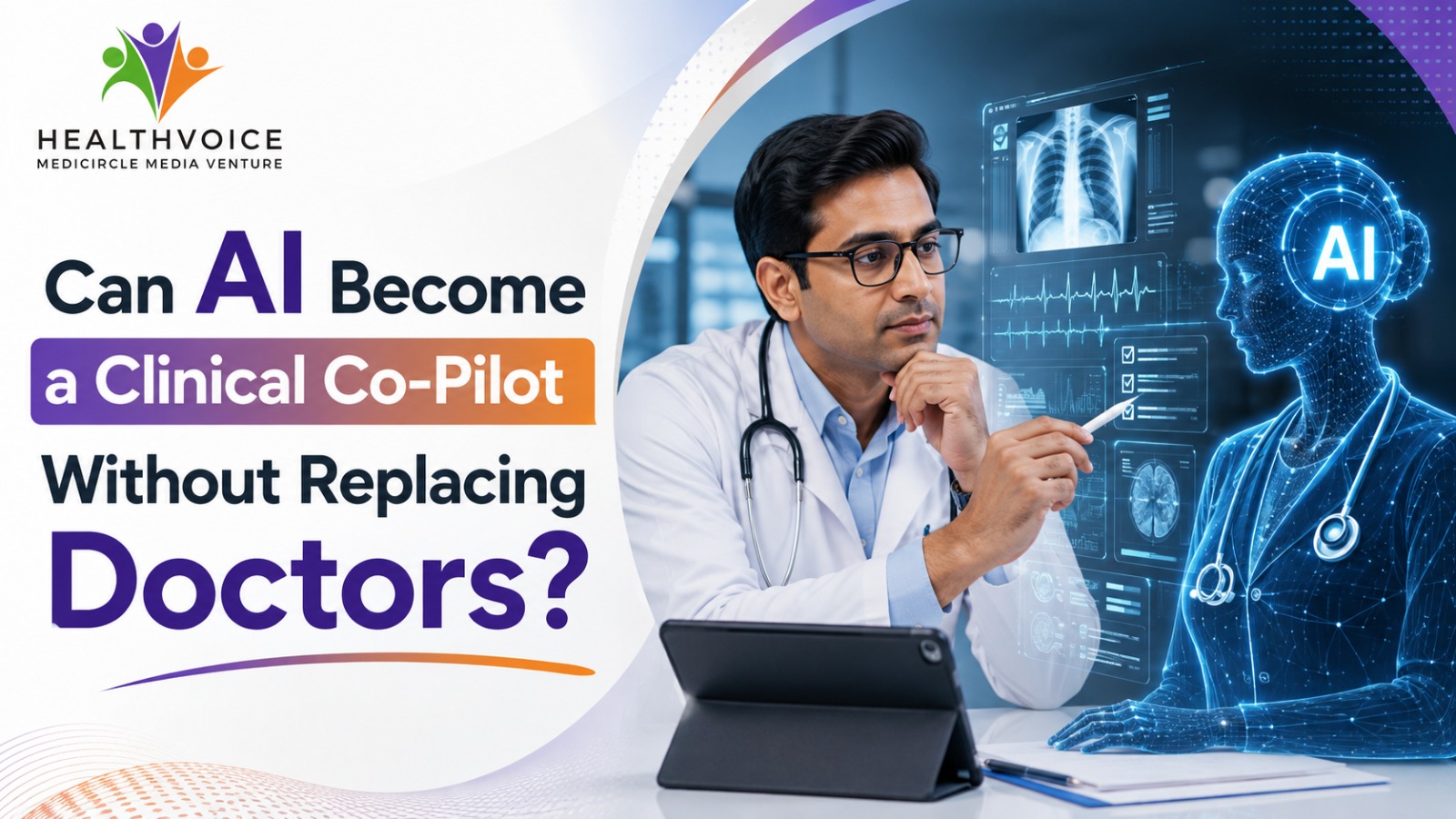
Can AI Become a Clinical Co-Pilot Without Replacing the Doctor?
AI can support Indian doctors as a clinical co-pilot through diagnostics and decision support but cannot replace human judgment, empathy, and ethical accountability in medicine.
Introduction
The conversation around artificial intelligence in medicine has shifted dramatically over the last few years. What once felt like a distant futuristic proposition is now an active, sometimes contentious, debate inside hospital corridors, medical colleges, and policy boardrooms across India. Radiologists in Mumbai are using AI-assisted tools to flag abnormalities in chest X-rays. Cardiologists in Delhi are receiving algorithmic alerts about irregular ECG patterns. Dermatologists across Tier 2 cities are experimenting with image-recognition software to assist with early skin condition screening.
But as these tools become more capable and more widespread, one central question persists: can artificial intelligence genuinely function as a clinical co-pilot, a trusted assistant that supports the doctor without displacing the doctor? And more importantly, should it?
For the Indian medical community, this question carries particular weight. India faces a severe shortage of medical professionals, with the World Health Organization estimating that the country has approximately one doctor for every 1,000 patients in several states. In this context, the promise of AI as a force multiplier for clinical capacity is genuinely exciting. Yet the risks of premature over-reliance on automated systems in a healthcare environment with wide quality variation are equally real. The answer, as most experienced clinicians will tell you, lies in finding the right balance.
Understanding the Clinical Co-Pilot Concept
The term "clinical co-pilot" has emerged as a useful framework to describe AI systems that work alongside a physician rather than in place of one. Just as an aircraft co-pilot supports the captain with navigation data, instrument readings, and situational alerts while the captain retains final authority and judgment, a clinical AI system is designed to process large datasets, surface relevant patterns, and present decision-relevant information to the doctor, who then applies clinical reasoning, patient context, and ethical judgment to make the final call.
This framing is important because it sets clear expectations. A co-pilot does not fly the plane alone. Similarly, a clinical AI tool does not diagnose, prescribe, or treat patients independently. It informs. It flags. It suggests. The physician decides.
Current AI applications in clinical settings include the following core categories:
- Clinical decision support systems (CDSS): These analyze patient data and alert clinicians to potential drug interactions, missed diagnostic possibilities, or guideline-based treatment deviations.
- Medical imaging AI: Tools trained on millions of radiology and pathology images to detect anomalies with high accuracy, particularly in oncology, cardiology, and ophthalmology.
- Predictive analytics: Algorithms that analyze electronic health records to predict patient deterioration, hospital readmission risk, or sepsis onset.
- Documentation and ambient AI: Voice-enabled tools that transcribe clinical conversations and auto-populate structured notes, freeing physicians from administrative burden.
Each of these categories represents a different dimension of support, and none of them, even in their most advanced form, replaces the core competency of the doctor.
The Indian Healthcare Landscape and AI Readiness
India's healthcare system presents a unique and complex backdrop for AI integration. On one hand, the country has a rapidly growing health technology sector, a large pool of data science talent, and an urgent need to extend quality care to underserved populations. On the other hand, healthcare delivery remains highly fragmented across public and private sectors, digital health infrastructure is still maturing, and trust in technology among both clinicians and patients varies widely across regions.
The Ayushman Bharat Digital Mission (ABDM) has laid the foundational architecture for a unified health record system that could, over time, generate the kind of structured longitudinal patient data that AI systems need to learn from and operate effectively. The National Medical Commission has begun to engage with questions around digital health competency, and medical institutions such as AIIMS and CMC Vellore have initiated AI-driven research programs in diagnostics and clinical outcomes.
Private sector adoption is accelerating faster. Startups such as Niramai, Qure.ai, and SigTuple have developed AI tools for cancer screening, chest X-ray analysis, and blood cell examination respectively, several of which have been validated in Indian clinical settings with meaningful accuracy outcomes. These are not fringe experiments. They are operational tools being used in clinical workflows today.
However, several readiness gaps remain. Rural and semi-urban public health facilities often lack the digital infrastructure needed to run AI systems effectively. Clinicians in these settings may have limited exposure to interpreting AI-generated outputs. And without robust data governance frameworks, the risk of biased or poorly validated AI tools entering Indian clinical practice remains a legitimate concern.
What AI Can Do Well in Clinical Settings
Proponents of clinical AI are not wrong to highlight its genuine strengths. In specific, well-defined tasks, AI systems have demonstrated performance that is comparable to and in some cases exceeds that of individual clinicians working in isolation.
In ophthalmology, deep learning models trained to detect diabetic retinopathy from fundus photographs have shown sensitivity and specificity rates that rival those of trained ophthalmologists. Given that India has one of the world's highest burdens of diabetes and a critical shortage of eye specialists in rural areas, this is not a trivial capability. AI-assisted screening in this domain can meaningfully extend the reach of expert-level detection.
In radiology, AI tools trained on chest CT scans have demonstrated the ability to detect early-stage lung nodules with accuracy that surpasses standard radiological reads in time-pressured environments. When radiologists work long shifts and handle high volumes, diagnostic fatigue is a documented clinical risk. AI serves as a consistent, non-fatiguing second reader in these scenarios.
In cardiology, AI-enhanced electrocardiogram interpretation has proven particularly powerful. Studies published in journals including The Lancet and Nature Medicine have shown that AI models can detect structural heart disease from a standard ECG with accuracy that previously required echocardiography, a far more resource-intensive test.
The common thread across these successes is specificity. AI performs exceptionally well when the problem is clearly defined, the data is structured and sufficient, and the output is a probability or pattern rather than a clinical decision.
Where AI Falls Short and Why the Doctor Remains Irreplaceable
The limitations of AI in clinical settings are as important to understand as its strengths, and this is where the case for the human physician becomes non-negotiable.
Medicine is not simply a pattern recognition exercise. It is a deeply human endeavor that involves communication, trust, empathy, contextual reasoning, ethical judgment, and the ability to navigate ambiguity in ways that no current AI system can replicate.
Consider the complexity of a patient presenting with fatigue, weight loss, and vague abdominal discomfort. The differential diagnosis is wide. The clinical story, gathered through a skilled patient interview, the patient's tone, their anxiety, the socioeconomic context of their life, and the nuances of their physical examination, shapes the diagnostic pathway as much as any lab value or imaging finding. AI systems today cannot conduct a patient interview. They cannot observe the patient's affect. They cannot hold a patient's hand during a difficult conversation about a terminal diagnosis.
There are also significant concerns around algorithmic bias. Most AI systems in medicine have been trained predominantly on datasets from Western populations, which limits their direct applicability to Indian patients who may present with disease phenotypes, comorbidity patterns, and social determinants of health that differ substantially from those in the training data. Applying an AI model validated in the United States to a patient in a district hospital in Bihar without careful local validation is not just ineffective. It is potentially harmful.
Furthermore, clinical decisions carry moral weight. When a treatment recommendation goes wrong, accountability matters. India's legal and regulatory framework for AI-induced medical errors is still in early development, and assigning liability in cases where an AI system contributed to a flawed clinical decision remains deeply unresolved.
Building a Responsible Framework for AI and Doctors in India
For AI to function effectively as a clinical co-pilot in India, the framework around its adoption must be as carefully designed as the technology itself.
Medical education must evolve. Future doctors need foundational literacy in data science, AI interpretation, and the critical appraisal of algorithmic outputs. This does not mean making clinicians into data scientists. It means equipping them to be intelligent users of AI tools rather than passive consumers of automated outputs. Curriculum reform at Indian medical colleges, guided by the National Medical Commission, should incorporate this dimension.
Regulatory clarity is equally essential. The Central Drugs Standard Control Organisation (CDSCO) has begun to develop guidelines for software as a medical device, but the pace of regulatory development has not matched the pace of AI deployment. Clear standards for clinical validation, bias testing, post-market surveillance, and incident reporting for AI medical tools must be established and enforced.
Trust must be built collaboratively. When clinical AI tools are developed with active participation from Indian clinicians rather than handed down as pre-packaged solutions, adoption is higher, use is more intelligent, and outcomes are more reliable. Platforms and communities that facilitate this kind of dialogue between healthcare technology developers and practicing physicians serve a genuinely important function in the ecosystem.
The Indian medical community, including its professional associations, premier institutions, and frontline practitioners, has both the right and the responsibility to shape how AI enters clinical practice. Passive acceptance or reflexive rejection are both inadequate responses. Active, informed engagement is what the moment demands.
Conclusion
Artificial intelligence will not replace doctors. That declaration, while reassuring, is not particularly useful on its own. The more important and more demanding question is whether India's medical community will engage with AI thoughtfully enough to realize its genuine potential while protecting against its real risks.
The clinical co-pilot model offers a productive and honest framework. AI can process data faster than any human. It can maintain consistency across millions of analyses without fatigue. It can extend the reach of diagnostic expertise to populations that would otherwise go unserved. But it cannot replace clinical wisdom, human compassion, contextual judgment, or moral accountability.
Doctors who understand AI tools, who know when to trust them and when to question them, and who can translate algorithmic outputs into meaningful patient care will be more capable physicians, not redundant ones. The future of medicine in India will be shaped not by the most powerful AI system but by the quality of the partnership between that system and the trained, empathetic, accountable clinician standing at the patient's bedside.
HealthVoice, as a platform dedicated to amplifying the voices of India's medical community, recognizes that this conversation is too important to happen only in academic journals or boardrooms. It belongs in every clinical community, every professional association, and every space where doctors gather to think about the future of their practice and their profession.
Frequently Asked Questions
Q1: Is AI currently being used in Indian hospitals for clinical decision-making?
Yes. Several Indian hospitals and health technology companies are actively using AI tools in radiology, pathology, ophthalmology, and cardiology. Companies such as Qure.ai and Niramai have developed AI systems validated in Indian clinical settings and deployed them in both public and private healthcare facilities.
Q2: Can AI tools in medicine make diagnostic errors?
Yes, AI tools can and do make errors. These errors are often linked to limitations in training data, algorithmic bias, or the application of tools in clinical contexts that differ from those in which they were validated. This is one of the key reasons why AI is designed to support rather than replace physician judgment.
Q3: What is a clinical decision support system and how does it work?
A clinical decision support system is a software application that analyzes patient data, including medical history, lab results, and medications, and provides physicians with evidence-based recommendations or alerts. It works by cross-referencing patient data against clinical guidelines and flagging potential concerns such as drug interactions or diagnostic possibilities that may warrant attention.
Q4: Will AI reduce the demand for doctors in India?
Most healthcare economists and medical technology researchers do not anticipate that AI will reduce the demand for doctors, particularly in India where the doctor-to-patient ratio is already far below recommended levels. AI is more likely to help existing doctors manage higher patient volumes more effectively rather than substitute for clinical professionals.
Q5: How should Indian medical students prepare for AI in clinical practice?
Indian medical students should develop a foundational understanding of how AI tools work, how to interpret algorithmic outputs critically, and how to identify the limitations of automated systems. Medical councils and institutions are increasingly expected to incorporate digital health and AI literacy into curriculum frameworks to prepare future clinicians for technology-integrated practice environments.
Resources
- World Health Organization (WHO) India Country Office: Health workforce data and digital health strategy reports
- Indian Council of Medical Research (ICMR): Research publications on AI applications in Indian clinical settings
- Ayushman Bharat Digital Mission (ABDM): National digital health ecosystem framework and policy documentation
- National Medical Commission (NMC): Regulatory frameworks and curriculum guidelines for medical education in India
- PubMed, National Library of Medicine: Peer-reviewed research on AI in clinical decision support and diagnostic imaging
Interlinking Keywords:
clinical decision support systems, AI in radiology India, Ayushman Bharat Digital Mission, doctor patient relationship, future of medical education India, AI diagnostic tools, health technology India
Last medically reviewed by:
HealthVoice Editorial and Medical Advisory Team on 31 August 2026
Medical Disclaimer:
This article is intended for informational and educational purposes only. It does not constitute medical advice, clinical guidance, or a substitute for professional medical consultation. Readers are advised to consult a qualified and registered medical professional for any health-related concerns or decisions. HealthVoice does not endorse any specific AI product, technology platform, or clinical tool mentioned in this article.
 Team Healthvoice
#AIinHealthcare #ClinicalCoPilot