₹2,300 Crore on Chemistry: Blue Jet’s Big Bet on Specialty Pharma
The ₹2,300-crore commitment shows belief in a future where India is not merely a volume supplier, but a strategic contributor to high-value pharmaceutical segments
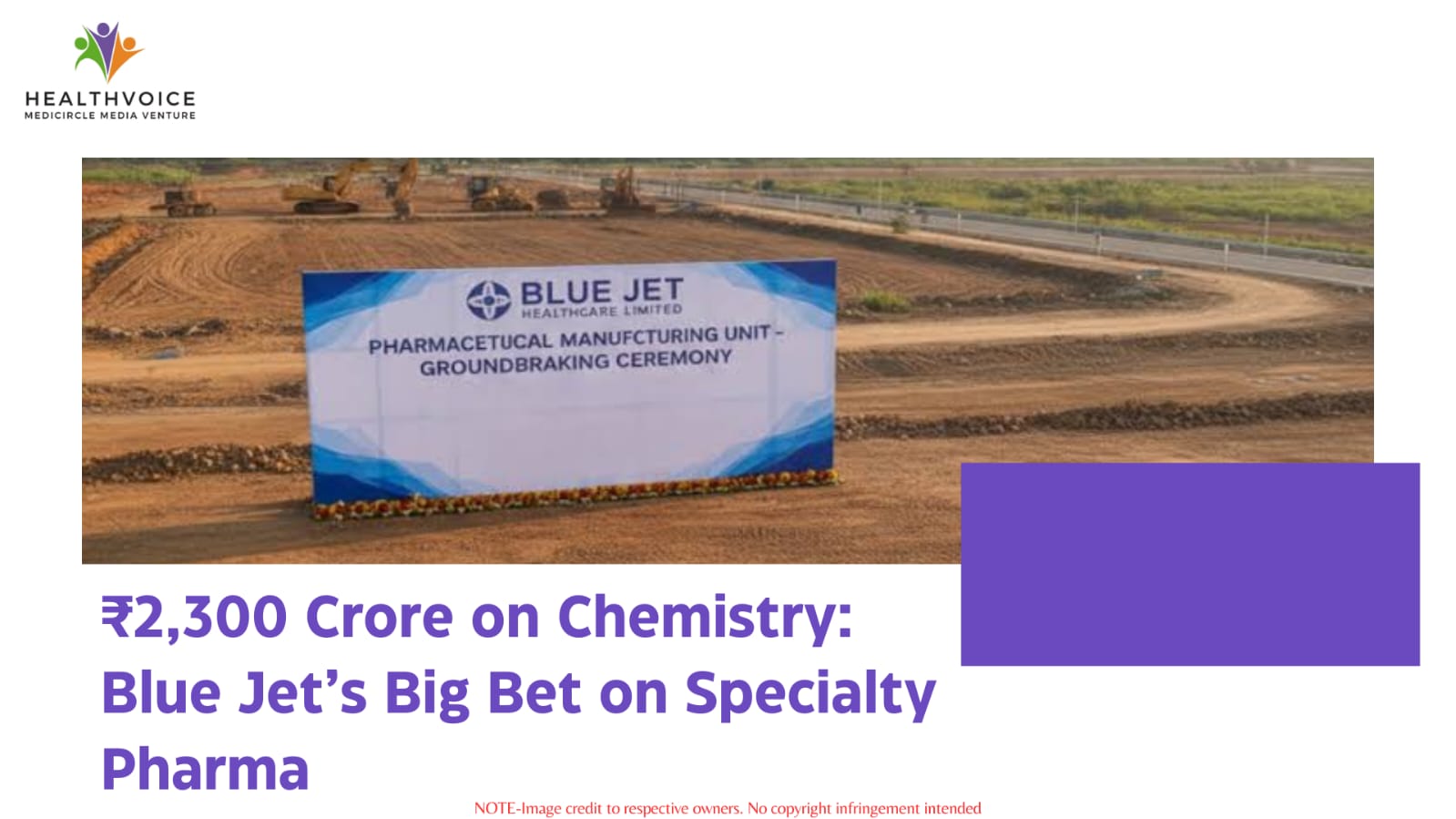
India’s pharmaceutical story has long been associated with affordable generics, large-scale active pharmaceutical ingredient production, and a reputation as the pharmacy of the developing world. But the global healthcare economy is shifting. Multinational drug makers are diversifying supply chains, regulatory standards are tightening, and demand for complex intermediates and specialty chemistry is rising. Against this backdrop, Blue Jet Healthcare Ltd is preparing to lay the foundation stone for a ₹2,300-crore greenfield pharmaceutical manufacturing facility at Rambilli Industrial Park in Andhra Pradesh’s Anakapalli district.
Spread across 102 acres, the upcoming plant is designed to manufacture contrast media intermediates, high-intensity sweeteners, and multipurpose specialty chemistry products. The development will unfold in phases, with operations expected to commence by the financial year 2028–29. Once functional, the project is projected to generate approximately 1,750 direct jobs and an additional 250 indirect employment opportunities, adding significant economic momentum to the Visakhapatnam industrial corridor.
For doctors, particularly radiologists and cardiologists, contrast media may appear as routine tools of practice. Whether in CT scans, angiography, or interventional radiology, these agents enable diagnostic clarity that shapes life-saving decisions. But behind each vial lies a sophisticated chain of chemical synthesis, purification, regulatory validation, and quality assurance. Contrast media intermediates demand stringent manufacturing standards, given their role in critical diagnostic procedures. India’s capacity to produce such intermediates domestically strengthens both supply security and cost competitiveness.
Blue Jet Healthcare traces its origins to 1968, when it began as Jet Chemicals Pvt Ltd. Over decades, it has evolved into an integrated Contract Development and Manufacturing Organisation, or CDMO, supplying advanced pharmaceutical intermediates and active pharmaceutical ingredients to markets across India, Europe, and the United States. The company built its reputation in contrast media intermediates and was among the early pioneers of saccharin manufacturing in India. This trajectory reflects a broader shift in Indian pharma from bulk commodity production towards specialised, high-value chemistry.
The concept of a CDMO has gained prominence in recent years. Global pharmaceutical companies increasingly outsource process development, scale-up, and manufacturing to specialised partners capable of meeting stringent regulatory norms. The CDMO model allows innovators to focus on research and clinical development while leveraging external expertise for commercial production. For India, strengthening CDMO capabilities means deeper integration into global pharmaceutical supply chains.
The Rambilli facility represents a strategic leap in that direction. By investing ₹2,300 crore in a greenfield project, Blue Jet Healthcare signals confidence in India’s long-term potential as a hub for specialty pharma manufacturing. The choice of Andhra Pradesh aligns with the state’s industrial policy emphasis on cluster-based development, particularly in pharmaceuticals and bulk drugs. Rambilli Industrial Park is being positioned as a high-value chemical and pharma manufacturing zone along India’s eastern seaboard, benefiting from port connectivity and infrastructure planning.
Environmental sustainability forms a central pillar of the project. The proposed plant will incorporate Zero Liquid Discharge technology and an advanced effluent treatment system with marine discharge connectivity. According to company disclosures, the system is engineered to reduce energy consumption by approximately 70 percent and recover up to 90–95 percent of wastewater. In an era when Environmental, Social, and Governance metrics influence global procurement decisions, such commitments are no longer optional. Multinational pharmaceutical buyers increasingly assess suppliers on carbon footprint, water stewardship, and waste management practices.
The investment also arrives at a time when geopolitical considerations are reshaping pharmaceutical sourcing. Global companies are reassessing overdependence on single geographies. India’s push towards complex intermediates, specialty chemicals, and advanced manufacturing technologies positions it as a viable alternative in diversified supply networks. The Rambilli project deepens domestic capacity in high-value segments that were once dominated by limited global players.
Strengthening domestic production of specialty intermediates has downstream implications. Local manufacturing can reduce import dependency, stabilise pricing, and enhance supply resilience. For contrast media, which are integral to diagnostic imaging, cost stability benefits both public and private hospitals. As cardiac interventions, oncology diagnostics, and interventional radiology volumes grow, demand for high-quality contrast agents will expand correspondingly.
The facility’s multipurpose chemistry capability suggests flexibility to adapt to evolving pharmaceutical needs. Multipurpose plants allow production of diverse intermediates without extensive reconfiguration, supporting agility in responding to market demand. In an environment where drug pipelines shift and therapeutic focus areas change, adaptability is valuable.
India’s pharmaceutical value chain historically emphasised finished formulations and generic APIs. Moving upstream into complex intermediates requires mastery of advanced synthesis pathways, regulatory documentation, and global audit readiness. Facilities catering to US and European markets must comply with Good Manufacturing Practice standards enforced by agencies such as the US FDA and the European Medicines Agency. Building such compliance infrastructure demands capital investment and technical expertise.
Blue Jet’s decision to invest in a greenfield facility rather than incremental brownfield expansion indicates long-term vision. Greenfield projects allow integration of modern process automation, digital manufacturing systems, and environmental safeguards from inception. Retrofitting older plants often imposes constraints. For a CDMO serving multinational clients, demonstrating state-of-the-art capabilities enhances credibility.
In the long run, the success of such projects will depend on execution discipline. Timely construction, regulatory approvals, workforce training, and operational scale-up are complex undertakings. Financial planning must accommodate phased development. Market demand must align with capacity creation. Yet the underlying trajectory appears aligned with macroeconomic and healthcare trends.
As the ceremonial coconut is broken at Rambilli, the act will symbolise more than construction commencement. It represents a calculated wager on India’s chemistry capabilities, on the resilience of global pharmaceutical supply chains, and on the country’s progression from generics leadership to specialty pharma sophistication. The ₹2,300-crore commitment shows belief in a future where India is not merely a volume supplier, but a strategic contributor to high-value pharmaceutical segments.
In the end, the story unfolding on 102 acres of Andhra soil is intertwined with broader healthcare aspirations. When contrast media illuminate coronary arteries or oncological lesions, they reflect intricate chemistry crafted far from the hospital ward. Strengthening that chemistry at home reinforces national healthcare security. For India’s pharmaceutical journey, this expansion signals a deliberate step beyond generics towards complexity, capability, and global confidence.
 Team Healthvoice
#SpecialtyChemicals #CDMO #PharmaManufacturing #MakeInIndia #PharmaceuticalIndustry #AndhraPradesh #RambilliIndustrialPark #greenfieldproject #HealthcareInnovation #IndustrialGrowth #IndianEconomy #ManufacturingExcellence #healthvoice