Augmented Reality In Surgical Planning
Augmented reality in surgical planning enhances traditional imaging by overlaying interactive 3D anatomical models directly onto the patient, improving spatial understanding and precision. It reduces reliance on mental visualization, enabling surgeons to make more accurate decisions and increasing confidence before and during procedures.
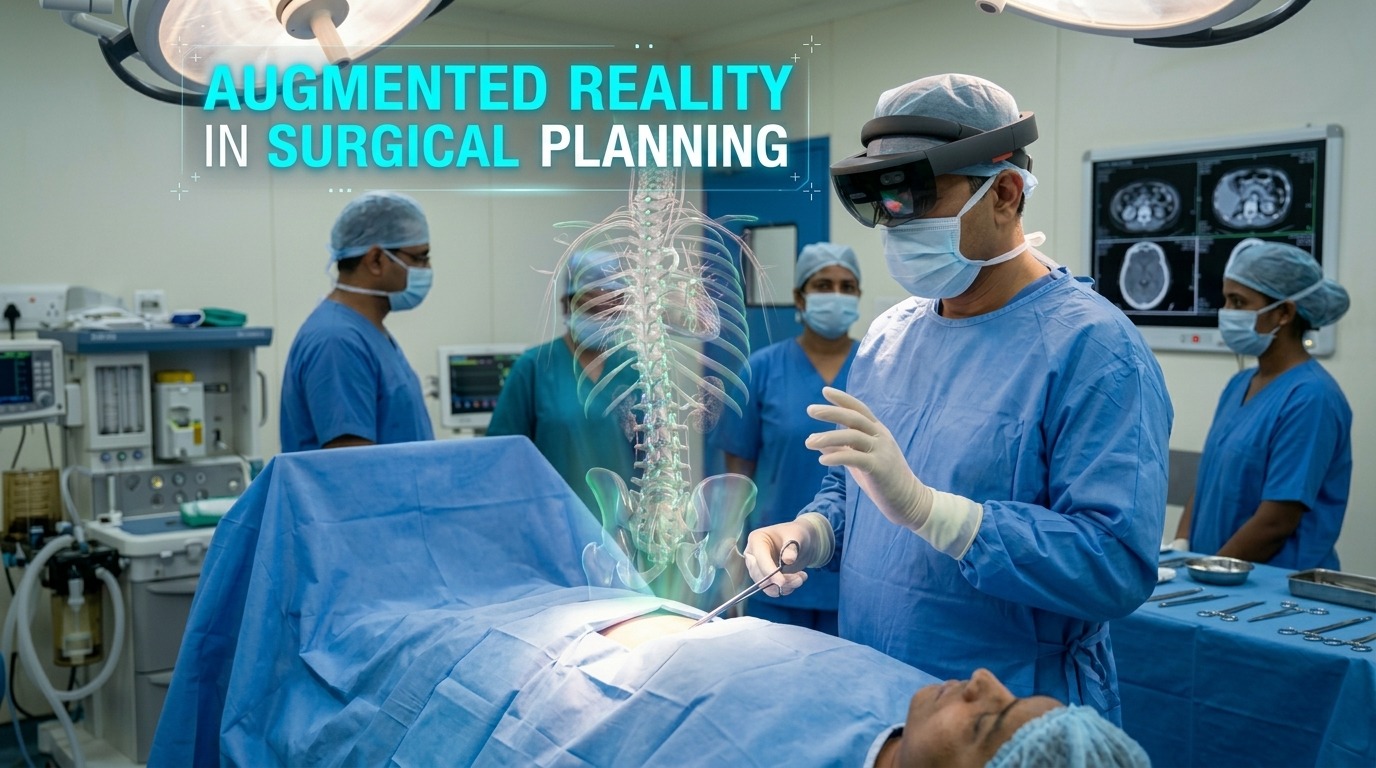
Surgical planning has always depended on experience, imaging, and careful interpretation. Surgeons study scans, visualize anatomy mentally, and prepare for multiple possibilities before entering the operating room. But even with advanced imaging, there has always been a gap between what is seen on a screen and what is encountered during surgery. That gap is now beginning to narrow with the rise of augmented reality in healthcare.
Instead of imagining structures in three dimensions, surgeons can now interact with them. Layers of anatomy can be visualized in real space, overlaid directly onto the patient, creating a more intuitive and precise understanding before and during procedures.
What Augmented Reality Means In Surgical Context
To understand the impact of AR in surgery, it helps to look at how it differs from traditional tools. Augmented reality does not replace the physical environment. It enhances it by overlaying digital information onto real-world views.
The AR surgery full form stands for Augmented Reality, and in clinical use, it allows surgeons to see beyond the surface. Imaging data such as CT scans or MRIs are converted into interactive 3D models that align with the patient’s body.
This is different from virtual reality in healthcare, where the user is fully immersed in a simulated environment. In contrast, augmented reality keeps the surgeon grounded in the real setting while adding layers of information that improve spatial awareness.
Why This Matters In Surgical Planning
Surgical procedures often involve navigating complex anatomical structures where even small miscalculations can affect outcomes. Traditional imaging requires interpretation, and that interpretation can vary depending on experience and perspective.
With augmented reality in surgical platforms, the interpretation becomes more direct. Surgeons can visualize exact positions of organs, vessels, or tumors before making an incision. This reduces uncertainty and improves confidence during planning.
At the same time, technologies like virtual reality for surgeons are being used alongside AR to rehearse procedures in simulated environments. While AR supports real-time visualization, VR allows for practice without risk.
This combination is gradually redefining how preparation happens before surgery begins.
Clinical Applications In Real Surgical Settings
The use of augmented reality in healthcare is becoming more visible in areas where precision and visualization are critical. It is not limited to one specialty but is expanding across multiple surgical domains.
Some of the most practical applications include:
- Preoperative planning, where surgeons study patient-specific anatomy in 3D
- Intraoperative guidance, where AR overlays assist during procedures
- Minimally invasive surgeries, where visibility is otherwise limited
- Training and simulation, supported by virtual reality for surgery environments
- Specialized procedures such as AR surgery colon, where detailed visualization of internal pathways improves navigation
These applications show how AR is not just an add-on but an evolving part of surgical workflows.
From Imaging To Action: How AR Supports Surgeons
The process behind AR-assisted planning connects imaging with real-time decision-making. It transforms static data into something interactive and usable.
The workflow typically includes:
- Data acquisition, using CT, MRI, or other imaging techniques
- 3D reconstruction, where anatomical structures are converted into digital models
- Alignment with patient anatomy, ensuring accuracy during use
- Real-time visualization, allowing surgeons to interact with overlays during procedures
This process allows surgeons to move from interpretation to direct visualization, reducing reliance on mental mapping alone.
The Role Of Virtual Reality Alongside AR
While AR enhances the real environment, virtual reality in healthcare plays a complementary role. It allows surgeons to step into a fully simulated space where procedures can be practiced repeatedly.
Technologies such as surgical vr create immersive environments where surgeons can refine techniques, understand spatial relationships, and prepare for complex cases. This is particularly useful in training and preoperative rehearsal.
The use of virtual reality for surgeons is not limited to beginners. Even experienced professionals use VR to explore unfamiliar cases or rehearse rare procedures. Combined with AR, it creates a more complete preparation system that supports both planning and execution.
Case Studies: How AR Is Changing Surgical Preparation
Case Study 1: Improving Precision In Complex Tumor Surgery
In an oncology center, surgeons began using augmented reality in surgical platforms to prepare for tumor removal procedures. Traditional scans provided detailed images, but translating those images into real-time surgical decisions required interpretation.
With AR, the tumor and surrounding structures were visualized directly over the patient’s body. Surgeons could see the exact boundaries and plan incisions more accurately. During surgery, the overlays helped maintain orientation, especially in areas where visibility was limited.
The shift was not dramatic in appearance, but it changed how confidently decisions were made during critical moments.
Case Study 2: Enhancing Training Through Simulation
A teaching hospital introduced surgical vr tools to support surgical training. Instead of observing procedures alone, trainees could enter a simulated environment and perform steps repeatedly.
The use of virtual reality for surgery allowed them to understand depth, positioning, and movement in a way that traditional learning methods could not provide. When combined with AR-assisted planning, the transition from training to real procedures became smoother.
The learning curve did not disappear, but it became more structured and less uncertain.
Case Study 3: Navigating Minimally Invasive Procedures
In procedures such as AR surgery colon, visibility is often limited due to the nature of minimally invasive techniques. Surgeons rely heavily on indirect imaging and experience.
By integrating AR overlays, internal pathways became easier to interpret. The system provided a clearer sense of direction, reducing the need for repeated adjustments. Over time, procedures became more efficient, and navigation felt more controlled.
Challenges And Current Limitations
Despite its potential, the adoption of augmented reality in healthcare still faces practical challenges.
Some of the key limitations include:
- High setup and implementation costs
- Need for precise calibration and alignment
- Dependence on high-quality imaging data
- Learning curve for surgical teams
At the same time, continuous improvements in hardware and software are addressing these issues, making the technology more accessible.
FAQs
1. What is augmented reality in surgical planning?
Augmented reality in healthcare allows surgeons to overlay digital anatomical models onto real patients to improve planning and accuracy.
2. What is the AR surgery full form?
The AR surgery full form stands for Augmented Reality surgery, where digital visuals assist real surgical procedures.
3. How is AR different from virtual reality in healthcare?
Virtual reality in healthcare creates a fully simulated environment, while AR enhances the real environment with digital overlays.
4. What is surgical VR used for?
Surgical vr is used for training, simulation, and preoperative practice in a risk-free virtual environment.
5. How does virtual reality for surgeons help in training?
Virtual reality for surgeons provides immersive simulations that improve skill development and spatial understanding.
6. What is virtual reality for surgery?
Virtual reality for surgery refers to using VR environments to rehearse procedures before performing them in real life.
7. What are augmented reality in surgical platforms?
Augmented reality in surgical platforms are systems that integrate AR technology into surgical workflows for better visualization.
8. Where is AR used in surgery today?
AR in surgery is used in oncology, orthopedics, neurosurgery, and minimally invasive procedures.
9. What is AR surgery colon?
AR surgery colon refers to the use of augmented reality in colon-related procedures to improve navigation and precision.
10. What is the future of AR in surgery?
The future involves deeper integration with imaging and AI, making augmented reality in healthcare more precise and widely adopted.
Conclusion
The integration of AR into surgical planning is not about replacing traditional methods. It is about enhancing them. By combining real-time visualization with advanced imaging, augmented reality in healthcare is helping surgeons move from interpretation to clarity. Over time, this shift is expected to improve precision, reduce risk, and make surgical care more predictable.
 Team Healthvoice
#AugmentedReality #DigitalHealth