Beyond Bonds and Bureaucracy: A Courtroom Reality Check on Rural Medical Service
Rural healthcare cannot depend indefinitely on bonds and penalties. It must rest on trust, structure, and shared purpose.
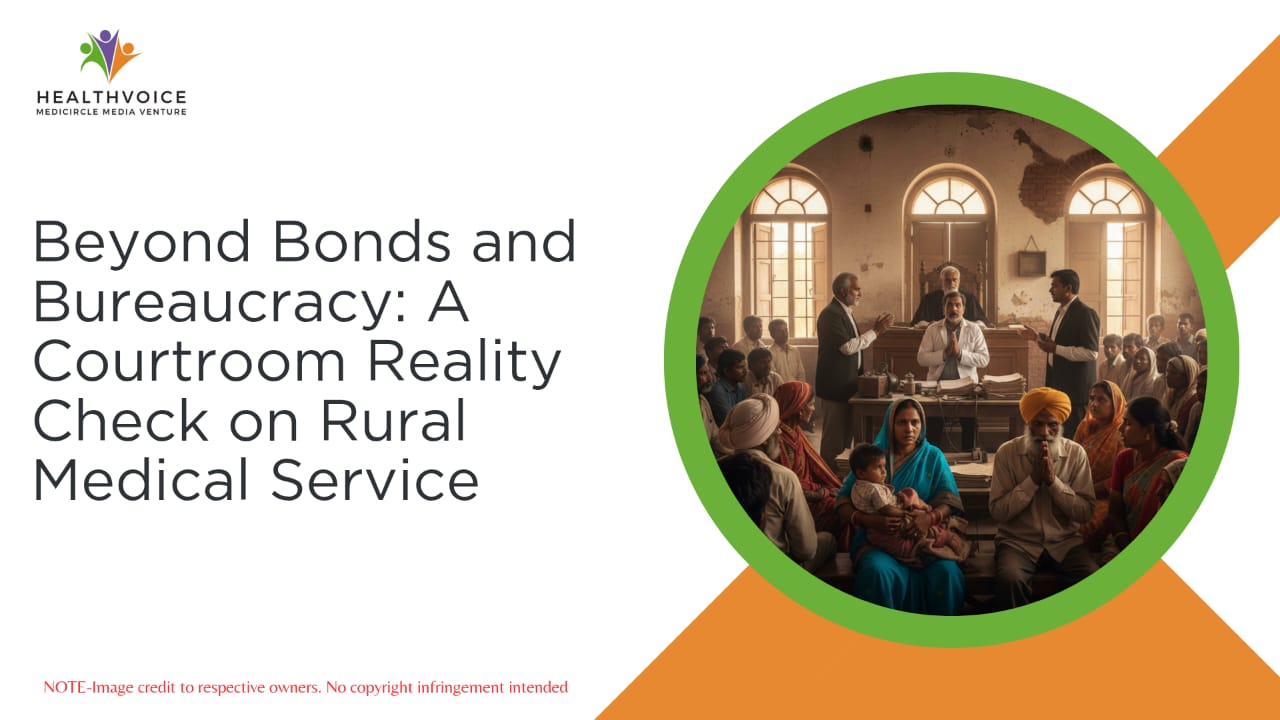
India’s public healthcare system survives largely on the endurance of its doctors, especially those posted far from cities, away from comfort, recognition, and often even basic infrastructure. Rural service bonds were designed with this reality in mind i.e. to ensure that government-funded medical education translates into healthcare access for underserved populations. Yet, when policy intent collides with administrative rigidity and legal ambiguity, the result is often confusion, litigation, and professional uncertainty. A recent judgment by the Madhya Pradesh High Court has brought this tension into sharp focus, offering clarity on one crucial question: are in-service doctors required to execute a separate rural service bond after completing a postgraduate medical course?
The answer, delivered with legal precision but layered with broader implications, is no, at least not under the rules currently governing medical postgraduate admissions in Madhya Pradesh. The ruling may appear technical at first glance, but its effects extend into policy design, workforce planning, and the everyday realities faced by government doctors who pursue higher education while remaining in service.
The case emerged from a petition filed by a government doctor who had completed her postgraduate diploma in anaesthesia while already employed as a medical officer in the state health services. After finishing her course, she sought release from a rural service bond and the return of her original certificates, arguing that no rural posting order had been issued within the stipulated time frame. Her contention rested on earlier admission rules that suggested such bonds lose validity if postings are delayed beyond a specific period. On paper, the argument seemed procedural. In reality, it raised a fundamental issue about how in-service doctors are viewed within the larger framework of compulsory rural service.
The state government countered by pointing to the No Objection Certificate granted to the doctor before her postgraduate admission. This certificate clearly stated that she would be required to perform rural service after completing her studies. The government also highlighted that she had already been in service during her postgraduate training and that certain administrative lapses, including unapproved leave, complicated her case. The courtroom thus became a space where intent, interpretation, and omission were all examined under judicial scrutiny.
What ultimately shaped the verdict was the court’s interpretation of Rule 11 of the Madhya Pradesh Autonomous Medical and Dental Postgraduate Courses Admission Rules, 2017. The bench made a clear distinction between fresh postgraduate candidates and in-service doctors. Rule 11, the court observed, applies to selected candidates entering service after their education, not to doctors who are already part of the government health system when they pursue higher studies. An in-service doctor, the court reasoned, does not step out of the system upon enrolling in a postgraduate course; they remain bound to their parent cadre. As such, asking them to execute an additional rural service bond would amount to duplicating an obligation that already exists.
This clarification is significant because it addresses a long-standing grey area that has troubled doctors and administrators alike. Across India, rural service bonds vary widely in structure and enforcement. Some states mandate compulsory service before postgraduate admission, others after completion, and a few impose hefty financial penalties for non-compliance. In this maze of rules, in-service doctors often find themselves unsure whether their existing service commitments shield them from additional bonds or expose them to further obligations.
The Madhya Pradesh High Court’s ruling offers a measure of relief, but it also carries a warning. While the court held that a separate rural bond was not required for an in-service doctor, it did not absolve her of the responsibility to serve in rural or remote areas upon rejoining duty. The obligation to serve remains intact; what changes is the legal mechanism enforcing it. The emphasis shifts from punitive bonds to service continuity within the health department.
Equally important is the court’s observation on the principle of clean hands. The bench noted that the petitioner had failed to disclose material facts, including her existing employment as a medical officer, when approaching the court. This omission weighed heavily against her. The plea was ultimately dismissed, reinforcing the idea that legal relief cannot be sought selectively, especially in matters involving public service and state policy. Transparency, the judgment suggests, is as essential in law as it is in medicine.
Beyond the specifics of this case, the ruling invites a broader conversation about how India treats its in-service doctors. These professionals often juggle clinical duties, administrative responsibilities, and academic aspirations, all while working within resource-constrained settings. Encouraging them to pursue postgraduate education strengthens the public health system by creating specialists who understand grassroots realities. Burdening them with unclear or overlapping service obligations risks discouraging precisely the workforce India needs most.
The judgment also exposes the need for policy coherence. Rural service bonds were never meant to be traps laid by bureaucracy. Their purpose is public good, ensuring equitable healthcare delivery. When rules are interpreted inconsistently or applied without regard to existing service structures, they create resentment rather than compliance. Doctors begin to view rural postings as penalties rather than professional responsibilities, undermining morale and retention.
The court’s interpretation aligns with a more sustainable approach. In-service doctors are already part of the government ecosystem. Their postings, transfers, and promotions can be managed administratively to meet rural healthcare needs. This approach reduces reliance on legal bonds and financial deterrents, instead integrating rural service into career progression. It recognises service as duty, not debt.
There is also a human dimension to this debate that often gets lost in legal language. Rural postings are not merely lines in a rulebook; they involve real challenges such as limited diagnostic facilities, staff shortages, professional isolation, and personal sacrifices. When doctors feel that the system acknowledges their service and treats them fairly, they are more likely to commit wholeheartedly. When they feel trapped by ambiguous rules, trust erodes.
The Madhya Pradesh ruling arrives at a time when India is struggling with an uneven distribution of medical professionals. Urban centres continue to attract specialists, while rural and remote areas struggle to retain even basic medical staff. Policymakers frequently turn to compulsory service as a solution, but compulsion without clarity rarely works. What this judgment demonstrates is that legal clarity can support policy goals rather than weaken them.
It also sets a persuasive precedent for other states wrestling with similar disputes. While healthcare is a state subject and rules differ across regions, the reasoning adopted by the court could inform future challenges elsewhere. In-service doctors across the country will likely view this judgment as recognition of their unique position which is neither students awaiting placement nor outsiders to the system, but integral components of public healthcare delivery.
The ruling is a reminder to draft and communicate rules with precision. Admission guidelines, NOCs, and service conditions must align, leaving little room for contradictory interpretations. It is an opportunity to rethink how rural service is integrated into workforce planning, moving away from reactive enforcement towards proactive deployment.
A system that treats its doctors fairly is more likely to retain skilled professionals where they are needed most. Legal battles over bonds do little to improve healthcare access. Clear rules, respectful administration, and predictable career pathways do.
We should view this judgment as more than a legal footnote. It is a mirror held up to India’s healthcare governance, reflecting both its intentions and its inconsistencies. The court has spoken with clarity, but the responsibility now lies with policymakers to translate that clarity into action. Rural healthcare cannot depend indefinitely on bonds and penalties. It must rest on trust, structure, and shared purpose.
As India continues to reform its medical education and public health systems, rulings like this serve as critical course corrections. They remind us that laws are not merely instruments of control but frameworks meant to balance public interest with professional dignity. When that balance is achieved, the system moves closer to delivering what it promises i.e. healthcare that is accessible, equitable, and sustained by doctors who feel valued rather than constrained.
The Madhya Pradesh High Court has drawn a clear line. In-service doctors are already serving the state; their commitment does not need to be reaffirmed through redundant bonds. What it needs is recognition, rational policy, and a system that places healthcare delivery above administrative rigidity. In that clarity lies the possibility of a stronger, fairer public health system where service is guided by purpose, not paperwork
 Team Healthvoice
#PublicHealthcare #RuralHealthcare #DoctorsOfIndia #MedicalEducation #HealthcarePolicy #HealthGovernance #MedicalLaw #HealthcareReforms #DoctorLife #PolicyMatters #HealthcareJustice #IndianHealthcare #HealthSystems #DoctorRights #healthvoice
