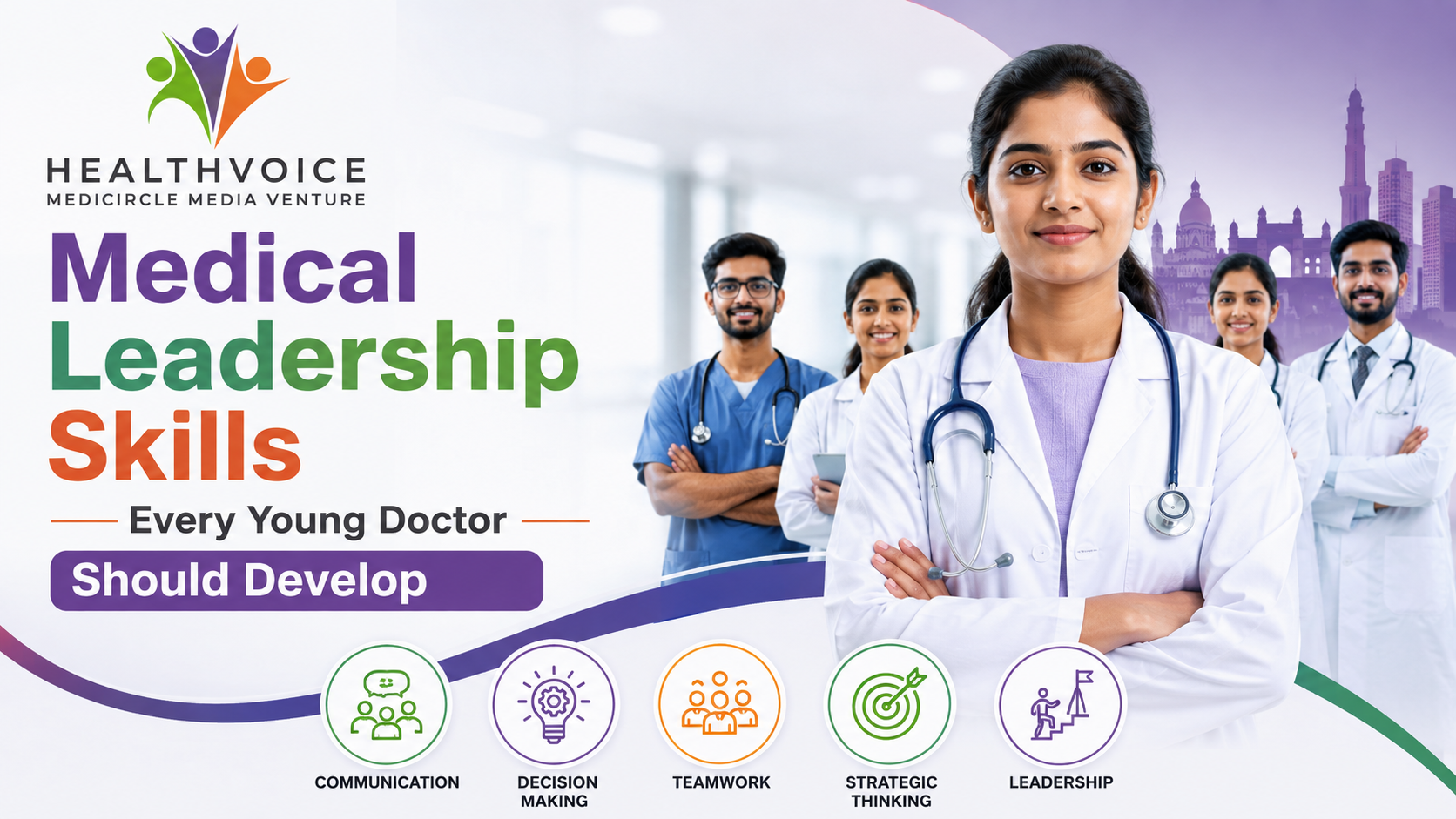
Medical Leadership Skills Every Young Doctor Should Develop
This article explores essential medical leadership skills young Indian doctors must develop, including communication, emotional intelligence, ethics, teamwork, and digital adaptability, for impactful healthcare careers.
Introduction
Medical education in India prepares doctors to diagnose diseases, understand pharmacology, and manage clinical cases. What it does not always prepare them for is the reality of leading a team, navigating institutional politics, communicating difficult news to families, or managing a department under resource constraints. These are not soft add-ons to a medical career. They are the very foundation upon which sustained professional growth is built.
India is home to one of the largest healthcare workforces in the world. With over 13 lakh registered allopathic doctors under the National Medical Commission and a growing demand for quality care across both urban hospitals and rural primary health centres, the need for medically competent and professionally capable doctors has never been greater. Clinical excellence alone is no longer sufficient. The most impactful doctors of this generation are those who combine sound medical knowledge with the ability to lead, communicate, collaborate, and inspire.
Medical leadership is not a title reserved for department heads or hospital administrators. It is a set of competencies that every young doctor can and should begin building from the first year of postgraduate training or even during internship. The earlier these skills are developed, the stronger the foundation for a meaningful and influential medical career.
Understanding What Medical Leadership Really Means
Many young doctors in India associate leadership with seniority. The assumption is that leadership comes with years of experience, a senior consultant position, or an administrative role. This assumption is worth challenging.
Medical leadership, as defined by global institutions including the Royal College of Physicians and the Indian Medical Association, refers to the ability to influence patient outcomes, improve healthcare systems, guide clinical teams, and contribute meaningfully to the broader medical community. A resident doctor who advocates for a vulnerable patient is exercising leadership. A junior doctor who suggests a more efficient ward workflow is demonstrating leadership. A fresh MBBS graduate who mentors a junior batch-mate is practicing leadership.
In the Indian context, medical leadership also carries a social dimension. Doctors in India often serve as trusted community figures, especially in smaller towns and rural areas. The ability to lead community health initiatives, guide local health literacy programs, and collaborate with government schemes like Ayushman Bharat or ABDM requires a broader understanding of healthcare than clinical training alone provides.
Core Medical Leadership Skills Every Young Doctor Must Build
Clinical Decision-Making Under Pressure
The first and most fundamental leadership skill is the ability to make sound clinical decisions in high-pressure situations. Emergency medicine, critical care, and complex multi-system cases demand that doctors remain calm, analytical, and decisive even when time, information, and resources are limited.
Young doctors should actively seek opportunities to participate in clinical case discussions, grand rounds, morbidity and mortality reviews, and simulation exercises wherever available. Developing a structured approach to clinical reasoning, such as problem representation, differential diagnosis generation, and evidence-based decision frameworks, builds the kind of judgment that forms the backbone of clinical leadership.
In India, where doctors frequently work under significant resource constraints and high patient loads, the ability to triage effectively, prioritize interventions, and make pragmatic decisions is a critical leadership competency that cannot be overlooked.
Communication Skills in Clinical Settings
Communication is arguably the single most important non-clinical skill a doctor can develop. Research published across multiple healthcare journals consistently shows that poor communication is a leading contributor to medical errors, patient dissatisfaction, and medico-legal complaints.
Effective clinical communication includes:
- Delivering bad news with empathy and clarity
- Explaining diagnoses and treatment plans in language that patients and families can understand
- Documenting clinical notes accurately and completely
- Communicating effectively with nursing staff, paramedics, and allied health professionals
- Presenting cases confidently during ward rounds and academic sessions
In India, communication carries additional cultural complexity. Patients often come with large family groups, communication happens in regional languages, and health literacy varies widely across socioeconomic groups. Young doctors who invest in building multilingual communication awareness and culturally sensitive counseling skills will find that these abilities significantly strengthen their professional credibility and patient trust.
Emotional Intelligence and Empathy
Emotional intelligence, often abbreviated as EQ, refers to the ability to recognize, understand, and manage one's own emotions while also being attuned to the emotions of others. In clinical settings, this translates to empathy, patience, self-awareness, and the ability to remain composed in emotionally charged situations.
A patient who has just received a cancer diagnosis, a family grieving in the ICU waiting area, a colleague dealing with burnout, a nurse facing workplace stress. These are everyday realities in Indian hospitals. The doctor who responds to each of these situations with emotional intelligence earns something that no qualification or award can substitute: genuine human trust.
Emotional intelligence also plays a critical role in team dynamics. Doctors who are aware of their own communication style, who can manage frustration constructively, and who demonstrate respect for every member of the healthcare team tend to lead more cohesive and high-performing units.
Teamwork and Interprofessional Collaboration
Modern healthcare delivery is fundamentally a team sport. No doctor, however brilliant, treats a patient in isolation. Nurses, pharmacists, physiotherapists, radiologists, lab technicians, social workers, and hospital administrators all play essential roles in patient outcomes. The ability to function effectively within this interprofessional ecosystem is a non-negotiable leadership competency.
Young doctors in India often enter hospitals with a hierarchical mindset inherited from their training environments. While respecting experience and seniority is important, leadership today demands collaborative thinking. A doctor who listens to the concerns of a bedside nurse may prevent a medication error. A doctor who communicates clearly with a radiologist may accelerate a critical diagnosis.
Building genuine respect for every professional in the care team is not just ethically sound. It is practically effective and professionally advantageous.
Healthcare Ethics and Medico-Legal Awareness
India's healthcare landscape is increasingly shaped by regulatory oversight, patient rights awareness, and medico-legal scrutiny. The Consumer Protection Act 2019 extended its scope to include medical services, and the National Medical Commission has outlined clear professional conduct guidelines for registered practitioners.
Young doctors who develop a strong foundation in medical ethics, informed consent practices, documentation standards, and patient confidentiality are far better equipped to navigate their professional responsibilities with confidence. This is not about being defensive in practice. It is about practicing medicine with integrity, transparency, and accountability.
An understanding of India-specific frameworks, including the NMC Code of Medical Ethics, the Clinical Establishment Act, and the rights of patients under various government health schemes, gives young doctors an important professional edge.
Research Aptitude and Evidence-Based Practice
Medical knowledge evolves rapidly. A treatment considered standard practice five years ago may have been superseded by newer evidence. The ability to read, critically appraise, and apply current medical literature is a genuine leadership competency in today's clinical environment.
Young doctors should cultivate the habit of engaging with journals such as the Journal of the Association of Physicians of India, The Lancet, the New England Journal of Medicine, and databases like PubMed. Participation in clinical research, case report writing, and academic conference presentations builds not only knowledge but also professional visibility.
In the Indian academic ecosystem, research output through ICMR grants, institutional projects, and medical college thesis work offers structured pathways for young doctors to develop their research identity.
Adaptability and Technology Integration
The Indian healthcare system is undergoing a significant digital transformation. From ABHA health IDs under the Ayushman Bharat Digital Mission to telemedicine regulations issued by the Board of Governors of the NMC in 2020, technology is reshaping how medicine is practiced and delivered.
Young doctors who embrace digital health literacy, who are comfortable navigating electronic health records, telehealth platforms, and digital diagnostic tools, will be far better positioned to lead in this evolving landscape. Adaptability to change, a willingness to unlearn outdated habits, and a curiosity toward innovation are leadership traits that will define the most successful Indian medical professionals of the next decade.
Building Leadership Through Professional Visibility and Community
Individual skill development is only one part of the leadership equation. Young doctors also grow as leaders through the communities they engage with. Medical associations, alumni networks, hospital committees, academic societies, and online healthcare communities all provide valuable platforms for professional learning, mentorship, and visibility.
Platforms like HealthVoice offer young doctors in India a purposeful space to share their professional perspectives, connect with senior leaders, engage with association activities, and build a credible professional identity in the healthcare ecosystem. For a generation of doctors who are digitally active and professionally ambitious, having a trusted community platform that amplifies their voice is a meaningful professional advantage.
Prevention of Leadership Failure: What Young Doctors Should Avoid
Leadership development is as much about avoiding pitfalls as it is about building strengths. Some of the most common leadership mistakes young doctors make include:
- Avoiding difficult conversations with patients or team members
- Dismissing feedback from nurses and junior staff
- Neglecting documentation as a non-priority
- Failing to seek mentorship or guidance from senior colleagues
- Allowing burnout to go unaddressed
India's medical training environment can be demanding, and the culture of endurance is deeply embedded in postgraduate training. However, sustainable leadership requires self-care, boundaries, and the ability to recognize when additional support is needed.
Conclusion
The doctors who will shape Indian healthcare over the next two decades will not be those who only excel in their clinical specialty. They will be the ones who communicate with compassion, make decisions with integrity, lead teams with respect, and engage with the broader healthcare community with purpose.
Medical leadership is not a destination. It is a continuous practice that begins with the first patient interaction and evolves through every ward round, every difficult conversation, every research paper, and every moment of mentorship offered to a junior colleague. Young doctors in India have the talent, the training ground, and the professional opportunity to become the healthcare leaders their patients and communities deserve. The journey begins with a conscious choice to grow not only as a clinician but as a leader.
Frequently Asked Questions
Q1: What are the most important medical leadership skills for young doctors in India?
The most important medical leadership skills include clinical decision-making under pressure, effective communication, emotional intelligence, interprofessional collaboration, medical ethics awareness, research aptitude, and adaptability to digital health technologies.
Q2: How can a young doctor develop leadership skills during postgraduate training?
Young doctors can develop leadership skills by actively participating in clinical case discussions, seeking mentorship from senior consultants, engaging in research activities, joining medical associations, and practicing empathetic patient communication consistently.
Q3: Is medical leadership only relevant for doctors who want to become administrators?
No. Medical leadership is relevant for every doctor regardless of their career path. Whether working in clinical practice, academics, research, or public health, leadership skills improve patient outcomes, team performance, and professional growth.
Q4: How does the Indian healthcare system benefit when doctors develop leadership skills?
When doctors develop leadership skills, healthcare teams function more cohesively, patient safety improves, medical errors reduce, community health initiatives become more effective, and the overall standard of care across both public and private healthcare settings improves.
Q5: What role do medical associations and professional communities play in doctor leadership development?
Medical associations provide structured platforms for continuing medical education, peer learning, mentorship, advocacy, and professional networking. Engaging with association communities helps young doctors build a credible professional identity and stay connected to evolving standards in their field.
Resources
- National Medical Commission (NMC): Official regulatory guidelines for medical professionals in India, including professional conduct standards and ethics regulations.
- Indian Council of Medical Research (ICMR): Research publications, funding opportunities, and evidence-based clinical guidelines relevant to Indian healthcare.
- World Health Organization (WHO) India: Reports and frameworks on healthcare workforce development, patient safety, and health system strengthening in India.
- Ayushman Bharat Digital Mission (ABDM): Information on India's digital health transformation, ABHA health ID, and telemedicine integration for healthcare professionals.
- Journal of the Association of Physicians of India (JAPI): Peer-reviewed research and clinical updates relevant to practicing doctors in India.
Interlinking Keywords
medical leadership skills, young doctors career growth, doctor professional development India, interprofessional collaboration in healthcare, clinical communication skills, healthcare team leadership, medical ethics India, evidence-based practice for doctors
Medical Disclaimer:
This article is intended for informational and professional development purposes only. It does not constitute clinical advice, legal guidance, or regulatory direction. Doctors are advised to refer to the National Medical Commission, their respective state medical councils, and institutional policies for official professional conduct guidelines.
Last reviewed by:
HealthVoice Editorial and Medical Advisory Team on 29 August 2026
 Team Healthvoice
#MedicalLeadership #YoungDoctorsIndia