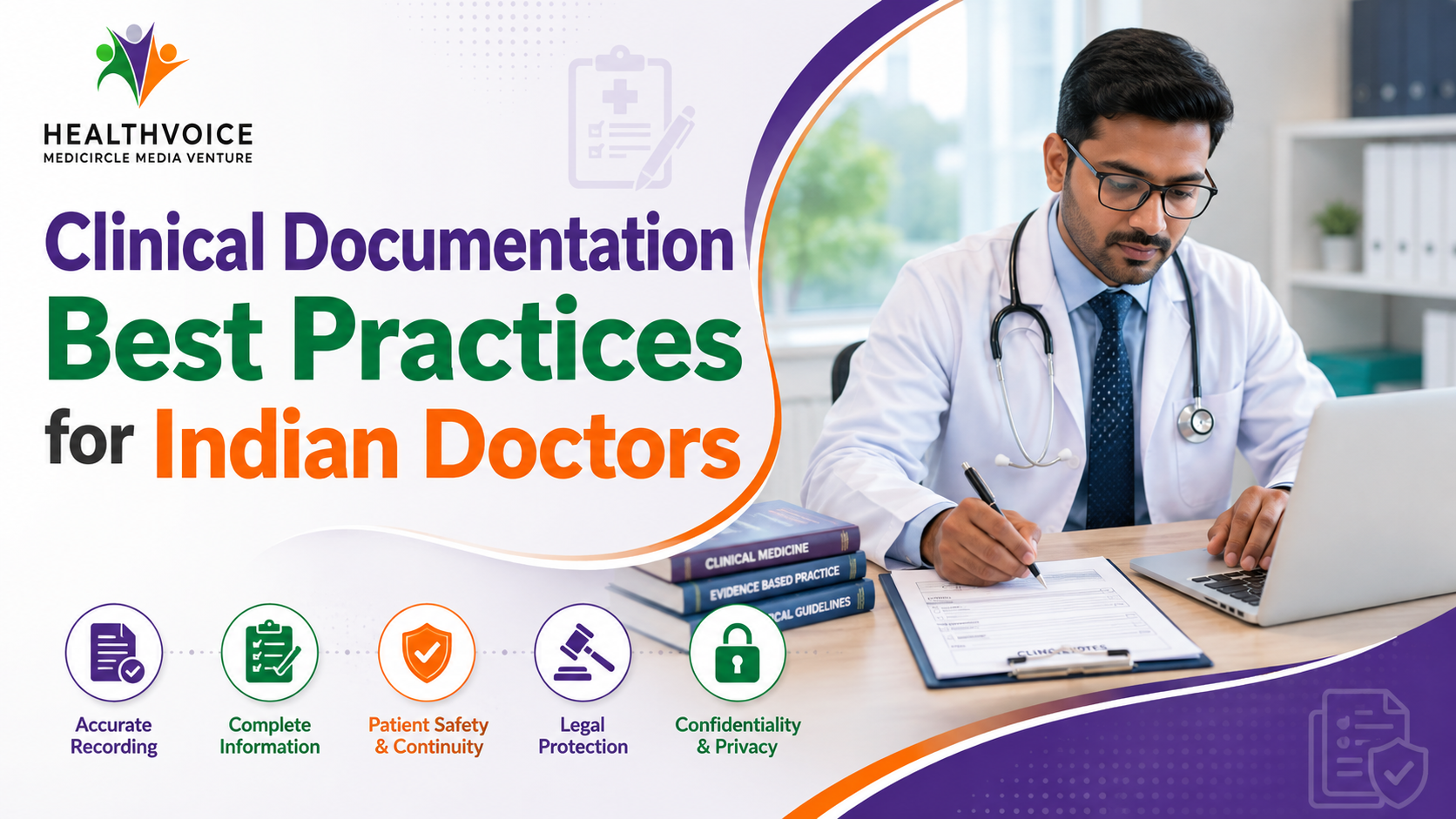
Clinical Documentation Best Practices: A Comprehensive Guide for Indian Healthcare Professionals
Clinical documentation best practices are essential for Indian healthcare professionals to ensure patient safety, regulatory compliance, accurate coding, and medico-legal protection across all care settings.
Introduction
Clinical documentation is the backbone of every responsible medical encounter. Whether a doctor works in a busy government hospital in Lucknow, a private multispecialty centre in Bengaluru, or a community health clinic in rural Rajasthan, the quality of clinical records shapes patient outcomes, legal protection, institutional credibility, and the overall efficiency of the healthcare system.
Yet, documentation remains one of the most underappreciated skills in medical practice across India. Many healthcare professionals view it as a bureaucratic obligation rather than a clinical responsibility. This perspective needs to change, and it needs to change urgently.
India's healthcare landscape is undergoing a fundamental digital transformation. The Ayushman Bharat Digital Mission (ABDM) is creating a nationwide digital health infrastructure. Ayushman Bharat Pradhan Mantri Jan Arogya Yojana (AB-PMJAY) is linking reimbursements directly to documented diagnoses and procedures. The National Medical Commission (NMC) continues to hold medical professionals accountable for the quality of their records. In this rapidly evolving environment, clinical documentation is no longer an afterthought. It is a professional obligation with direct consequences for patient safety, institutional revenue, legal standing, and regulatory compliance.
This guide brings together the most important clinical documentation best practices that Indian doctors, nurses, and healthcare administrators need to understand and apply in their daily work.
Understanding the Foundations of Clinical Documentation
What Clinical Documentation Actually Means
Clinical documentation refers to the systematic recording of all relevant information about a patient's medical condition, the clinical assessments performed, the decisions made, the treatments administered, and the outcomes observed. This includes history and physical examination notes, progress notes, discharge summaries, medication records, investigation reports, and consent documentation.
Good clinical documentation serves multiple purposes simultaneously. It communicates vital patient information to other members of the care team. It creates a legal record of the care provided. It supports accurate medical coding and billing. It enables quality improvement and clinical audit. And in the Indian context specifically, it underpins eligibility for reimbursement under government health insurance schemes.
The World Health Organization defines quality clinical records as those that are accurate, complete, timely, organized, accessible, and compliant with applicable standards. These six characteristics remain the universal benchmark, regardless of the healthcare setting.
The Indian Documentation Landscape
India presents a unique documentation environment. The country has approximately 1.3 million registered allopathic doctors, thousands of hospitals ranging from single-practitioner clinics to 2,000-bed tertiary centres, and a healthcare system that blends public and private service delivery. Documentation standards and practices vary enormously across this spectrum.
Tier 1 cities like Mumbai, Delhi, Hyderabad, and Chennai have seen significant adoption of Electronic Health Records (EHR) systems, particularly in corporate hospital groups. However, Tier 2 and Tier 3 cities, along with most government hospitals and rural facilities, still rely heavily on paper-based records, handwritten notes, and informal documentation practices.
The ABDM is working to bridge this gap by promoting a federated digital health record ecosystem. As ABDM infrastructure expands, more healthcare providers across India will be required to maintain structured, interoperable digital records using standardized terminologies and coding systems.
Core Principles That Define High-Quality Clinical Documentation
Accuracy, Completeness, and Objectivity
Every clinical note must accurately reflect what the doctor actually found, assessed, and decided during the patient encounter. It must not overstate, understate, or omit clinically relevant information. Completeness requires that all key elements of the encounter are recorded, including the presenting complaint, relevant history, examination findings, differential diagnoses considered, investigations requested, management plan, and patient counselling provided.
Objectivity is equally critical. Clinical notes should record observable facts and clinical assessments, not assumptions, biases, or value judgements about the patient. Person-first and stigma-free language must always be used, reflecting both ethical responsibility and the evolving standards of respectful medical communication that platforms like HealthVoice consistently advocate for within the Indian medical community.
Timeliness and Authentication
Documentation should be completed as close to the time of the clinical encounter as possible. Delayed notes introduce the risk of memory errors, missed details, and potential medico-legal vulnerability. In inpatient settings, progress notes should be written on the same day. Discharge summaries should ideally be completed on the day of discharge.
Authentication means that every clinical entry must be clearly signed and dated by the responsible clinician, with their designation legibly noted. In digital systems, this is achieved through verified electronic signatures and secure login-based access. Authentication establishes accountability and ensures that the record is legally attributable to a qualified professional.
Standardized Terminology and Safe Abbreviation Use
The use of standardized medical terminology ensures that clinical information is understood consistently by all members of the healthcare team. In India, this is particularly important given the multilingual and multi-institutional nature of patient care, where patients often move between facilities and providers from different educational backgrounds.
Abbreviations should be used cautiously. Certain abbreviations carry different meanings in different specialties or regional contexts. Non-standard abbreviations create ambiguity and can lead to serious clinical errors, particularly in medication orders. The governing principle is straightforward: if an abbreviation is not universally understood within the clinical team, it should not be used.
Essential Note Types and What They Must Contain
History and Physical Examination Notes
The History and Physical (H and P) is the foundational clinical document. It must include the chief complaint, history of present illness, relevant past medical and surgical history, family and social history, allergy documentation with reaction type, a complete medication list, and a structured physical examination with findings recorded by system. The assessment and plan should clearly reflect the clinical reasoning process, not simply a list of diagnoses.
This is a critical and often neglected point: the assessment should demonstrate that the doctor considered differential diagnoses, weighed clinical evidence, and arrived at a reasoned conclusion. This kind of cognitive documentation is what distinguishes a legally defensible, professionally sound clinical record from a template-filled checklist.
Progress Notes and Their Structure
Daily progress notes in inpatient settings should provide a focused, structured update on the patient's condition. The SOAP format (Subjective findings, Objective data, Assessment, Plan) or its variations remain widely used and are well-suited to Indian clinical practice. Progress notes should not simply repeat yesterday's note. They must reflect genuine daily clinical assessment and any changes in the patient's condition or management plan.
Discharge Summaries
A discharge summary is often the most critical document in a patient's entire hospital episode. It is the primary communication tool between the hospital and the patient's subsequent care providers, whether a family physician, specialist, or community health worker. A complete discharge summary must include the reason for admission, significant findings, diagnoses with ICD-10 codes where applicable, procedures performed, treatment provided, condition at discharge, follow-up instructions, and medications prescribed at discharge with clear dosing instructions.
In the context of AB-PMJAY and other government insurance schemes, the discharge summary is also the primary document used for claim processing and reimbursement. Incomplete or inaccurate discharge summaries directly affect institutional revenues and patient access to entitled benefits.
Consent Documentation
Informed consent is both a legal requirement and an ethical obligation under Indian law and the NMC Code of Ethics. The documentation of consent should record that the patient or their legal guardian received adequate information about the diagnosis, proposed treatment, alternatives, risks, and benefits in a language they understood, and that they agreed to proceed voluntarily. For surgical procedures and invasive investigations, written consent must be obtained and preserved as part of the medical record.
Electronic Health Records and Best Practices for Indian Clinicians
Adopting EHR Systems Responsibly
The adoption of Electronic Health Records is accelerating across Indian hospitals, supported by ABDM guidelines and growing market availability of hospital management systems. EHRs offer significant advantages: legible records, structured data capture, built-in coding support, and easier retrieval for audits and medico-legal purposes.
However, EHR adoption also introduces specific risks if used poorly. The most common pitfall is copy-paste documentation, sometimes called "note bloat." When clinicians copy previous notes into new entries without reviewing and updating them, the record quickly becomes inaccurate, repetitive, and potentially dangerous. Medication lists show drugs that have been discontinued. Allergies listed for one patient end up in another's record. Clinical notes state that a patient is ambulatory when they are actually bedbound.
Indian hospitals transitioning to EHR systems need robust training programmes, departmental champions, and regular audits of documentation quality to prevent these failures.
Metadata, Timestamps, and Audit Trails
In digital documentation environments, every entry automatically generates metadata, including the time of entry, the user who made it, and any subsequent modifications. These audit trails are legally significant. They can demonstrate when a note was written relative to a clinical event, whether records were altered after the fact, and whether documentation policies were being followed consistently.
Healthcare administrators in Indian hospitals should ensure that their EHR systems have proper audit trail functionality enabled and that staff understand the legal implications of tampering with or backdating electronic records.
Coding Alignment: ICD-10 and the Indian Context
India transitioned to ICD-10 coding as part of its commitment to the global disease classification system promoted by the WHO. Accurate clinical documentation is the foundation of accurate coding. When a clinician documents "fever with thrombocytopenia and a positive NS1 antigen test," the medical coder can assign the correct dengue fever code with confidence. When the note simply reads "fever," the coding becomes a guessing exercise with revenue and reporting consequences.
For hospitals empanelled under AB-PMJAY, accurate ICD-10 coding linked to precise clinical documentation determines which Health Benefit Package the claim falls under and the reimbursement amount the hospital receives. Documentation gaps translate directly to revenue loss and, more importantly, to a distorted picture of disease burden that undermines public health planning at the national level.
Compliance, Privacy, and the Medico-Legal Dimension
Documentation as Medico-Legal Protection
India has seen a significant rise in medico-legal cases over the past decade. Consumer courts, criminal complaints, and civil suits against hospitals and individual doctors often hinge on the quality of clinical records. Incomplete, illegible, altered, or absent documentation is frequently the deciding factor in adverse judgements against healthcare providers.
A well-maintained clinical record is the doctor's strongest defence. It demonstrates that a thorough assessment was performed, that the standard of care was met, that the patient was appropriately counselled, and that all decisions were made in the patient's best interest based on available clinical evidence.
Key documentation practices for medico-legal protection include the following:
- Never alter or delete any part of an existing clinical record. If a correction is needed, draw a single line through the incorrect entry, add the correct information, and sign and date the correction.
- Document all conversations regarding serious diagnoses, treatment refusals, or patient decisions against medical advice.
- Record all adverse events, near-miss incidents, and unexpected clinical deteriorations clearly and factually, without defensive or self-protective language.
- Ensure that discharge-against-medical-advice forms are properly completed and signed.
Patient Privacy and Data Security
The Personal Data Protection framework in India continues to evolve, and healthcare data carries the highest sensitivity. Clinical records must be stored securely, accessed only by authorised personnel, and shared only with appropriate consent and legal justification. In digital environments, access controls, encryption, and regular security audits are essential safeguards.
ABDM's federated architecture places the patient in control of their own health records through the Health ID and consent management system. This represents a significant shift from the traditional model where records belong to the institution. Indian healthcare providers must understand and prepare for this evolving regulatory landscape.
Quality Assurance and Continuous Improvement in Documentation
Regular Audits and Peer Review
Documentation quality cannot be assumed. It must be measured. Indian hospitals and clinics should establish regular documentation audits as part of their clinical governance framework. These audits should assess completeness, timeliness, accuracy of diagnoses, coding alignment, consent documentation, and adherence to institutional documentation policies.
NABH-accredited hospitals are already required to maintain documentation standards as part of accreditation criteria. Even non-accredited facilities benefit enormously from periodic internal audits and peer review of clinical records. The findings should feed into structured educational sessions and policy updates rather than punitive actions, creating a culture of continuous improvement rather than fear.
Training and Competency Building
Clinical documentation competency is rarely taught systematically in Indian medical education. MBBS and postgraduate curricula cover clinical skills extensively, but documentation practices are often left to be learned informally during residency, with highly variable results.
Medical institutions, hospital administrations, and associations have a responsibility to address this gap. Structured training on documentation principles, EHR use, ICD-10 coding basics, consent documentation, and medico-legal implications should be offered to all clinical staff. HealthVoice, as a platform dedicated to the professional development and visibility of Indian doctors, recognizes that knowledge sharing on such foundational clinical practices is as important as sharing the latest research or clinical guidelines.
Conclusion
Clinical documentation is not paperwork. It is a clinical skill, a professional responsibility, and in the modern Indian healthcare environment, a strategic necessity. Accurate, complete, timely, and compliant clinical records protect patients, protect providers, support institutional revenues, enable accurate public health reporting, and build the foundation of trust between doctors, their patients, and the wider healthcare system.
As India advances its digital health infrastructure through ABDM, expands health coverage through Ayushman Bharat, and raises the bar for clinical accountability through NMC regulations, the importance of documentation best practices will only grow. Indian doctors and healthcare professionals who invest in mastering clinical documentation today will be better equipped to deliver excellent care, withstand regulatory scrutiny, and lead their institutions in the years ahead.
Frequently Asked Questions
Q1: What are clinical documentation best practices for Indian doctors?
Clinical documentation best practices include writing accurate, timely, and complete patient records using standardized terminology, avoiding copy-paste errors, aligning documentation with ICD-10 coding, obtaining and recording proper informed consent, and adhering to ABDM and NMC guidelines applicable in India.
Q2: Why is accurate clinical documentation important in Indian hospitals?
Accurate clinical documentation ensures patient safety, supports continuity of care across providers and facilities, facilitates correct insurance reimbursement under schemes like Ayushman Bharat, and protects healthcare providers from medico-legal risks in an increasingly litigious environment.
Q3: What is the role of ABDM in clinical documentation in India?
The Ayushman Bharat Digital Mission is building a unified digital health infrastructure across India. It promotes structured electronic health records, Health ID-based patient data management, and a consent-based health record sharing system. Compliance with ABDM standards is becoming essential for all enrolled healthcare providers.
Q4: How does clinical documentation affect medical coding and billing in India?
Clinical documentation directly determines ICD-10 code assignment. Incomplete or inaccurate notes lead to coding errors, insurance claim rejections, and revenue loss for hospitals and clinics. Precise documentation ensures correct reimbursement from insurers, third-party administrators, and government health schemes.
Q5: What are common clinical documentation errors that Indian healthcare professionals should avoid?
Common errors include incomplete patient histories, use of non-standard abbreviations, delayed record entries, copy-paste of outdated information into new notes, missing or incomplete informed consent documentation, and failure to record medication reconciliation details during admission or discharge.
Resources
- Indian Council of Medical Research (ICMR): Guidelines and publications on clinical research documentation, medical record standards, and data management in Indian healthcare settings.
- World Health Organization (WHO): India Country Office Reports and ICD-10 clinical coding guidelines, applicable to documentation and disease classification in Indian hospitals.
- Ayushman Bharat Digital Mission (ABDM): Official documentation framework, Health ID guidelines, and electronic health record standards for Indian healthcare providers.
- National Board of Examinations and Medical Council Guidelines (NMC): Standards of professional conduct, medical ethics, and documentation obligations for registered medical practitioners in India.
- National Accreditation Board for Hospitals and Healthcare Providers (NABH): Accreditation standards covering clinical documentation requirements, patient record management, and quality assurance in Indian hospitals.
INTERLINKING KEYWORDS:
clinical documentation standards, electronic health records India, ICD-10 coding guidelines, Ayushman Bharat documentation, informed consent documentation, NABH accreditation standards, medical record management, patient safety in hospitals, discharge summary best practices, ABDM digital health
Last medically reviewed by:
HealthVoice Medical Editorial Team on August 13, 2025
Medical Disclaimer:
The information provided in this article is intended for general educational and informational purposes for healthcare professionals and is not a substitute for professional medical judgement, institutional legal advice, or regulatory guidance from applicable statutory bodies. Doctors and healthcare administrators should consult current NMC regulations, ABDM guidelines, and their institutional legal counsel for decisions regarding documentation practices and compliance obligations.
 Team Healthvoice
#ClinicalDocumentation #HealthcareIndia