Eliminating Lymphatic Filariasis: Overcoming MDA Compliance Fatigue
Eliminating Lymphatic Filariasis in India requires overcoming MDA compliance fatigue through community awareness, clear communication, and sustained participation. Building trust and encouraging preventive treatment can help reduce disease transmission and support elimination efforts.
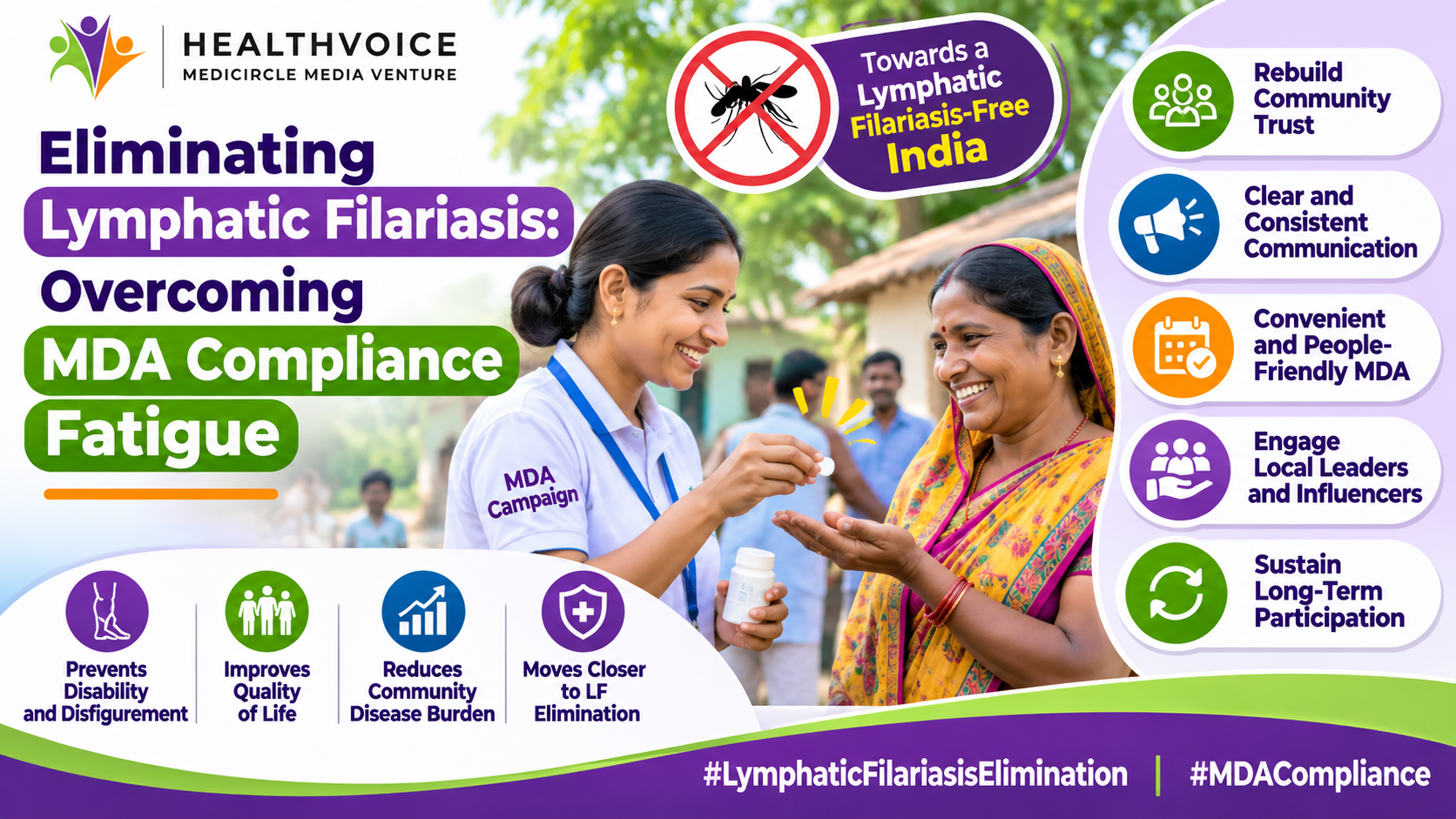
Executive Overview: The Last-Mile Paradox in Helminthic Elimination
Lymphatic Filariasis (LF), commonly manifesting in its chronic debilitating forms as elephantiasis (profound lymphedema of the limbs) and hydrocele (scrotal swelling), is a mosquito-borne parasitic infection caused by tissue-dwelling nematodes: Wuchereria bancrofti, Brugia malayi, and Brugia timori. Recognized by the World Health Organization as a high-burden Neglected Tropical Disease (NTD), LF inflicts severe physical disfigurement, lifelong disability, profound economic impairment, and intense social stigmatization across endemic regions of South Asia, Southeast Asia, Sub-Saharan Africa, and parts of the Americas.
The core strategy for interrupting global transmission relies on Preventive Chemotherapy through periodic Mass Drug Administration (MDA):
- The Epidemiological Threshold: Microfilariae (the microscopic larval forms circulating in human peripheral blood) must be cleared below a critical transmission breakpoint (typically a community microfilaremia prevalence below one percent) to starve the mosquito vector population (Culex, Anopheles, Mansonia) of infective blood meals.
- The Multi-Year Mandate: Adult filarial worms (macrofilariae) nest within human afferent lymphatic channels, surviving and reproducing for six to eight years. Consequently, traditional annual MDA regimens require at least five to six continuous rounds of high therapeutic coverage to outlast the reproductive lifespan of adult worms.
- The "Secondary Round" Breakdown: The primary vulnerability of large-scale elimination initiatives occurs during the secondary, fourth, fifth, and consolidation rounds of MDA. While initial rounds benefit from community curiosity, political mobilization, and early donor momentum, mature programs encounter widespread compliance fatigue.
Compliance fatigue manifests as an increasing disparity between reported drug distribution (tablets delivered to households) and actual ingested consumption (tablets swallowed). Healthy, asymptomatic individuals avoid successive rounds due to perceived lack of personal risk, fear of post-treatment adverse events, pill burden, and pervasive misinformation. When systemic non-compliance clusters in endemic communities, residual human microfilarial reservoirs persist, enabling vector transmission to rebound and extending transmission cycles by years.
Achieving definitive elimination demands replacing passive distribution with a restructured public health architecture:
- Upgrading therapeutic regimens to the accelerated Triple-Drug Therapy (IDA: Ivermectin, Diethylcarbamazine, and Albendazole).
- Transitioning from door-to-door drug delivery to enforced, empathetic Directly Observed Therapy (DOT).
- Institutionalizing proactive, field-based Adverse Event Management Protocols to dismantle post-clearance systemic fear.
- Deploying micro-targeted social and behavioral change communication (SBCC) and digital tracking registries to eliminate hidden community refusal pockets.
1. Parasitological Kinetics and the Pharmacological Superiority of IDA
Understanding why repeated rounds of mass treatment trigger community exhaustion requires examining the differential activity of anthelmintic agents against microfilariae versus adult macrofilariae.
The Pharmacological Mechanism of Anthelmintic Regimens
- Diethylcarbamazine Citrate (DEC): A piperazine derivative possessing potent microfilaricidal properties and partial macrofilaricidal activity. DEC alters the microfilarial surface membrane, exposing the parasite to host immune-mediated destruction. However, its clearance of adult worms is variable, necessitating multiple annual cycles.
- Albendazole: A benzimidazole carbamate that binds to parasite beta-tubulin, inhibiting microtubule polymerization and blocking glucose uptake. While primarily effective against soil-transmitted helminths (STHs), prolonged exposure contributes to gradual adult filarial sterility.
- Ivermectin: A macrocyclic lactone that binds glutamate-gated chloride channels in invertebrate nerve and muscle cells, causing hyperpolarization, neuromuscular paralysis, and death of microfilariae.
The Two-Drug vs. Triple-Drug (IDA) Transition
- The Legacy Two-Drug Regimen (DA): The historical backbone of LF elimination paired Diethylcarbamazine with Albendazole (DA) administered annually for five to six consecutive years. Because this combination primarily targets microfilariae with minimal rapid clearance of adult worms, communities were subjected to indefinite annual cycles, fostering widespread public fatigue.
- The Triple-Drug Paradigm (IDA): Combining Ivermectin (200\ \mu\text{g/kg}), Diethylcarbamazine (6\text{ mg/kg}), and Albendazole (400\text{ mg} fixed dose) delivers a synergistic biocidal strike.
- Accelerated Macrofilaricidal and Sterilizing Efficacy: IDA achieves near-complete clearance of circulating microfilariae within twenty-four hours and maintains sustained microfilarial suppression for up to twenty-four months. Furthermore, it exerts profound macrofilaricidal killing and permanent reproductive sterility on adult female worms.
- Compressing the Elimination Timeline: Large-scale community trials confirm that two annual rounds of IDA achieve the transmission interruption endpoints that previously required five to seven rounds of DA, drastically shortening the programmatic window and mitigating long-term public compliance fatigue.
- Geographic Exclusion Warning: Triple-drug therapy (IDA) is strictly contraindicated in regions co-endemic with Loa loa (due to fatal encephalopathy risks secondary to massive microfilarial lysis) and in areas co-endemic with Onchocerciasis (river blindness), where DEC can provoke severe ocular Mazzotti reactions and permanent blindness.
2. Deconstructing Compliance Fatigue: The Anatomy of Community Resistance
Compliance fatigue in secondary and late-stage MDA rounds is driven by a convergence of physiological, behavioral, and sociodemographic factors.
The Mazzotti Reaction and Adverse Event Aversion
- The primary clinical driver of drug refusal in rounds two, three, and four is the fear of systemic adverse reactions.
- Anthelmintic drugs do not directly induce toxicity; rather, the rapid, immune-mediated destruction of millions of circulating microfilariae releases foreign helminthic antigens and secondary endosymbionts (Wolbachia bacteria) into the bloodstream.
- This acute systemic release triggers a classic Mazzotti-type immunological reaction: low-grade fever, chills, throbbing headache, muscle ache, nausea, vomiting, dizziness, and localized tender lymphadenitis (secondary to dying adult worms within regional nodes).
- Although transient and resolving within 48 to 72 hours, untreated adverse events confirm local fears that "the government pills cause sickness." An individual who experienced severe shivering during Round 1 frequently refuses all medication in Round 2 and actively discourages family members from participating.
The Asymptomatic Perception Void
- Lymphatic filariasis has an incubation period spanning years. Tens of thousands of microfilaremic individuals appear healthy, feeling zero physical pain or limitation.
- Once early-round public health campaigns raise awareness about advanced elephantiasis and hydrocele, asymptomatic individuals look at their normal limbs and conclude they do not have the condition.
- Concurrently, patients who already possess irreversible, fibrotic lymphedema discover that swallowing MDA pills does not reverse their swollen legs (as MDA clears microfilariae to halt new transmission, but cannot repair scarred, damaged lymphatic vasculature).
- Both cohorts—asymptomatic individuals and advanced lymphedema patients—disengage from subsequent rounds, interpreting the program as either irrelevant or ineffective.
High Pill Burden and Swallowing Anxiety
- Administering weight- or height-banded IDA regimens requires an individual to consume a substantial pharmacological mass: up to three to four DEC tablets, one to four Ivermectin tablets, and one large chewable Albendazole tablet simultaneously.
- Confronting up to six to nine large tablets at a single sitting induces choking fears, particularly among elderly individuals and pediatric demographics, prompting individuals to accept the blister packs from distributors but secretly dispose of them after the health worker departs.
3. The Frontline Shift: Enforcing Directly Observed Therapy (DOT)
The single greatest operational difference between a failed MDA campaign and a program that interrupts transmission is the transition from passive drug delivery to supervised, interactive Directly Observed Therapy (DOT).
The Failure of "Drop-and-Leave" Distribution
- In poorly supervised campaigns, overwhelmed community volunteers or drug administrators (DAs) are pressured by daily house-visit quotas.
- To meet targets, administrators hand blister strips to whoever answers the door, leaving instructions for absent family members to take the pills after dinner.
- Retrospective coverage evaluation surveys (CES) consistently reveal that in "drop-and-leave" models, while epidemiological distribution coverage may appear high (85% to 90%), actual ingested consumption often falls below 45% to 55%, leaving wide transmission gaps that sustain the parasitic reservoir.
Operationalizing Field-Level DOT
- The Non-Negotiable Consumption Rule: Drug administrators are strictly prohibited from leaving unconsumed tablets inside a household. Every dose must be physically removed from the blister packaging, handed to the individual alongside safe drinking water, and swallowed directly in the sight of the distributor.
- The "Full Stomach" Prerequisite: Consuming DEC and Ivermectin on an empty stomach drastically accelerates gastrointestinal side effects (severe nausea, acute vomiting, and epigastric burning).
- Field workers must never administer pills to fasting individuals. MDA campaigns should deploy during post-breakfast or post-dinner intervals, or provide a light, locally acceptable snack (e.g., banana, biscuits, or jaggery) prior to pill consumption to slow absorption kinetics and minimize mucosal irritation.
- Pediatric and Geriatric Swallowing Assistance: Albendazole must be explicitly chewed, not swallowed whole, to maximize anti-parasitic dispersion. For children, chewable fruit-flavored formulations or manual crushing must be supervised to avoid aspiration.
4. Proactive Adverse Event Mitigation: The Rapid Response Matrix
Transforming community compliance in secondary rounds requires treating adverse events not as an embarrassing programmatic failure, but as proof of therapeutic efficacy that demands immediate clinical support.
Reframing the Clinical Narrative
- Public health communication must proactively prepare the community: "If you develop a mild fever or headache after taking these pills, it is positive confirmation that the medicine is working inside your body to destroy the microscopic parasites before they can damage your lymphatic system."
- Proactive reframing removes the element of panic when mild Mazzotti reactions occur.
Dedicated Mobile Rapid Response Teams (RRTs)
- Every primary healthcare sector must deploy dedicated Mobile Adverse Event Response Teams staffed by medical officers and public health nurses throughout the MDA campaign window.
- The Emergency Home Visit: When a villager develops fever, vomiting, or localized scrotal/groin tenderness post-MDA, an RRT dispatches to the home within sixty minutes.
- Providing simple symptomatic relief—oral paracetamol for fever, oral rehydration salts (ORS) for fluid balance, and an antiemetic (domperidone or ondansetron)—reassures the family and neighborhood that the health system cares for their recovery, neutralizing negative rumors before they derail broader community compliance.
5. Structural Comparison: Passive Annual Delivery vs. Intensified Directly Observed IDA
Evaluating conventional two-drug mass administration models alongside an intensified, directly observed triple-drug ecosystem illustrates how operational shifts resolve compliance bottlenecks:
Therapeutic Regimen and Program Lifespan
- Conventional Two-Drug Delivery (DA): Diethylcarbamazine plus Albendazole; predominantly clears microfilariae with limited macrofilaricidal impact; mandates 5 to 7 continuous annual rounds.
- Intensified Triple-Drug Architecture (IDA): Ivermectin, Diethylcarbamazine, and Albendazole; high microfilaricidal clearance paired with adult worm sterilization; interrupts transmission within 2 consecutive high-coverage rounds.
- Programmatic Impact: Compresses multi-year operational timelines, ending campaigns before community compliance fatigue leads to dropouts.
Ingestion Verification and Coverage Accuracy
- Conventional Two-Drug Delivery (DA): Relies on informal distribution; tablets left with household members for later unverified consumption; reported distribution diverges significantly from true biological coverage.
- Intensified Triple-Drug Architecture (IDA): Enforces mandatory Directly Observed Therapy (DOT); tablets swallowed in the physical presence of trained health workers with immediate verification.
- Programmatic Impact: Guarantees that epidemiological coverage metrics reflect true biological consumption, reaching the 65% to 80% total population compliance threshold required to break transmission.
Adverse Event Management Infrastructure
- Conventional Two-Drug Delivery (DA): Reactive and dismissive; patients left unmonitored to manage Mazzotti reactions independently, driving local fear and negative rumors in subsequent rounds.
- Intensified Triple-Drug Architecture (IDA): Proactive and clinical; pre-treatment counseling regarding parasite lysis, full-stomach feeding protocols, and mobile Rapid Response Teams delivering on-site symptomatic relief.
- Programmatic Impact: Demystifies post-treatment reactions, transforming a clinical deterrent into community-accepted proof of parasitic clearance.
Target Demographics and Refusal Tracking
- Conventional Two-Drug Delivery (DA): Broad daytime door-to-door visits that consistently miss working adult males, urban apartment dwellers, and migratory laborers.
- Intensified Triple-Drug Architecture (IDA): Micro-scheduled visits (dawn and twilight rounds), workplace outreach stations, school-based catchments, and real-time digital registries tracking non-compliant clusters.
- Programmatic Impact: Closes hidden microfilarial reservoirs in mobile and adult male populations who are disproportionately responsible for sustaining transmission cycles.
6. Phased Implementation Protocol: Institutionalizing High-Coverage Secondary Rounds
Executing an accelerated, fatigue-resistant mass drug administration campaign requires a synchronized four-phase operational strategy:
Phase 1: Micro-Planning and Refusal Registry Auditing (Months 1 to 2)
- Review localized records from preceding rounds: identify specific geographic wards, socio-demographic enclaves, and affluent housing pockets that exhibited high refusal rates or clustered adverse event rumors.
- Complete pre-campaign mapping to confirm that target administrative blocks are non-endemic for Onchocerciasis or Loiasis, clearing regulatory hurdles for the deployment of triple-drug (IDA) regimens.
- Mobilize community influencers—including respected local physicians, religious leaders, school principals, and village council representatives—to publicly swallow the medication on Day 1 of the campaign, modeling safety for hesitant residents.
Phase 2: Supply Chain Logistics and Clinical Credentialing (Month 3)
- Procure verified, quality-assured supplies of Ivermectin, DEC, and Albendazole, packaged alongside height-measurement dosing tapes and clean drinking water packets.
- Conduct simulation-based training for paired Drug Administrators (ideally one local female community health worker, such as an ASHA or Anganwadi worker, paired with a youth volunteer).
- Train workers on clear communication, how to verify recent food intake, how to supervise the chewing of Albendazole, and when to refer individuals to exclusion criteria (e.g., children under two, pregnant women, and severely ill individuals).
- Equip primary health centers and mobile Rapid Response Teams with paracetamol, antihistamines, antiemetics, and oral rehydration solutions to manage minor post-treatment reactions.
Phase 3: Synchronized Campaign Execution and Dynamic Mop-Up (Month 4)
- Day 1 (Fixed-Booth Saturation): Establish high-visibility, fixed-location distribution booths at primary health centers, transit hubs, schools, and religious centers to capture motivated community members and civil servants.
- Days 2 through 5 (House-to-House Directly Observed Outreach): Deploy drug administrator teams to execute systematic, door-to-door directly observed therapy. Home visits must be scheduled during early morning hours (6:00 AM to 9:00 AM) and evening hours (5:00 PM to 8:30 PM) to capture working adults who are routinely missed during standard daytime visits.
- Days 6 through 8 (Intensive Mop-Up Rounds): Analyze real-time daily digital reporting data to identify low-performing blocks. Dispatch supervisory mop-up teams to revisit locked houses, resolve persistent household refusals, and ensure complete geographic coverage.
Phase 4: Independent Coverage Auditing and Long-Term Surveillance (Months 5 to 6)
- Conduct mandatory, independent Coverage Evaluation Surveys (CES) across randomly sampled village clusters within thirty days of campaign completion to measure actual swallowed drug coverage versus administrative reporting.
- Continue Morbidity Management and Disability Prevention (MMDP) services: providing lymphedema hygiene washing kits and surgical hydrocelectomies at district hospitals to demonstrate ongoing institutional commitment to afflicted patients.
- Prepare for formal Transmission Assessment Surveys (TAS), utilizing rapid filarial antigen test strips (Filariasis Test Strips / FTS) among pediatric primary school cohorts to verify that active transmission has been interrupted.
Strategic Summary: Turning the Tide Toward Global Elimination
The elimination of Lymphatic Filariasis is within epidemiological reach, yet the final steps are threatened by community compliance fatigue. Treating mass drug administration as a routine logistical supply drop while ignoring community behavioral dynamics allows parasitic transmission to smolder within unreached population pockets.
By replacing prolonged multi-year regimens with the accelerated Triple-Drug Therapy (IDA), enforcing mandatory Directly Observed Therapy (DOT) over casual drop-and-leave practices, managing post-treatment Mazzotti reactions with dedicated clinical Rapid Response Teams, and targeting hidden demographic refusal clusters through empathetic, community-led dialogue, public health programs can overcome compliance resistance.
This operational framework closes the remaining transmission gaps, protects millions from lifelong physical disfigurement, and ensures that Lymphatic Filariasis is permanently consigned to history.
10 Frequently Asked Questions (FAQs)
Q1. What is the fundamental difference between reported coverage and surveyed (swallowed) coverage in an MDA campaign?
Reported coverage (administrative coverage) measures the percentage of target individuals who were handed pills by health workers, calculated from supply tallies.
Surveyed or ingested coverage measures the percentage of individuals who actually chewed and swallowed the medication:
- In poorly supervised campaigns where tablets are left on tables for absent family members, administrative coverage often reads high (85% to 90%), while actual swallowed coverage drops below fifty percent.
- Because unswallowed pills leave active microfilarial reservoirs in the population, elimination programs must evaluate performance based exclusively on independently audited swallowed coverage.
Q2. How does the triple-drug therapy (IDA) accelerate the elimination of Lymphatic Filariasis?
Traditional two-drug regimens (Diethylcarbamazine and Albendazole) primarily kill circulating microfilariae, leaving adult worms alive in the lymphatic vessels to produce new larvae, requiring five to seven years of annual treatments.
The Triple-Drug Therapy (Ivermectin, DEC, and Albendazole / IDA) delivers a synergistic biological attack:
- It completely eliminates circulating microfilariae within twenty-four hours and maintains suppression for up to two years.
- It kills or permanently sterilizes the adult macrofilarial worms.
- Consequently, two high-coverage annual rounds of IDA can achieve the transmission interruption milestones that previously required six or more rounds of dual-therapy.
Q3. Why do some healthy people feel sick after taking MDA medications?
Post-treatment side effects (fever, headache, chills, body aches) are not caused by direct drug toxicity:
- They are driven by an immunological Mazzotti reaction caused by the rapid, mass death of millions of microscopic filarial worms circulating in the blood.
- As the parasites die, they release foreign proteins and bacterial antigens (Wolbachia) into the bloodstream, triggering a temporary inflammatory response.
- Developing these mild symptoms confirms that the individual carried hidden microfilariae and that the medicine successfully destroyed the parasites before they could cause permanent lymphatic scarring.
Q4. Can mass drug administration cure an individual who already has severe elephantiasis?
No. Anthelmintic drugs destroy circulating microfilariae and adult worms to stop the disease from spreading to others, but they cannot reverse advanced, structural damage:
- Decades of chronic infection, secondary bacterial attacks, and lymphatic obliteration cause irreversible tissue fibrosis, skin thickening, and severe swelling (elephantiasis).
- Patients with established elephantiasis benefit from Morbidity Management and Disability Prevention (MMDP): rigorous daily washing with soap and water, elevation, moisturizing, and prompt antibiotic treatment for localized skin infections (acute dermatolymphangioadenitis), while men with hydroceles benefit from simple corrective surgery.
Q5. Why should anthelmintic pills never be taken on an empty stomach during MDA campaigns?
Taking Diethylcarbamazine (DEC) and Ivermectin on an empty stomach drastically speeds up drug absorption, causing local gastric irritation:
- This frequently leads to immediate, severe nausea, vomiting, dizziness, and abdominal cramping.
- These unpleasant side effects terrify families, causing them to reject future rounds of treatment.
- Requiring individuals to eat a meal, breakfast, or light snack before taking their medication buffers the stomach, slows drug absorption, and significantly lowers gastrointestinal distress.
Q6. Why is triple-drug therapy (IDA) banned in areas co-endemic with Loa loa and Onchocerciasis?
Safety is the limiting factor:
- In individuals with heavy infections of Loa loa (African eye worm), rapid destruction of high microfilarial loads by DEC can trigger severe, potentially fatal encephalopathy, coma, and retinal hemorrhages.
- In individuals with Onchocerciasis (river blindness), DEC-induced microfilarial death in the eye provokes violent intraocular inflammatory reactions (Mazzotti ocular reactions) that can lead to permanent blindness.
- In these co-endemic geographic areas, elimination programs use alternative strategies that omit DEC entirely.
Q7. How does un-managed pill burden contribute to community compliance fatigue?
A standard IDA dose can require an adult to take up to six to nine pills simultaneously (several large DEC tablets, several Ivermectin tablets, and a large chewable Albendazole tablet):
- Swallowing a handful of medicine at one time induces severe anxiety, fear of choking, and hesitation, particularly among elderly individuals and parents worried about their children.
- When health workers arrive with handfuls of pills year after year, fatigued communities resist.
- Programs address this through clear pre-counseling, providing clean drinking water, crushing tablets when appropriate, and exploring combined fixed-dose formulations.
Q8. What is a Transmission Assessment Survey (TAS) and when is it conducted?
A Transmission Assessment Survey (TAS) is an epidemiological evaluation protocol designed by the World Health Organization to determine whether an endemic district can safely stop MDA:
- It is conducted after a district has completed the recommended rounds of MDA with verified high coverage and demonstrated that microfilaremia has fallen below critical thresholds.
- TAS typically tests a representative sample of young primary school children (aged 6 to 7 years) for circulating filarial antigens using rapid diagnostic finger-prick test strips.
- Because these children were born during the MDA campaign years, testing negative confirms that young children are no longer being bitten by infective mosquitoes, validating that active transmission has ceased.
Q9. Why do working adult males frequently represent the highest non-compliance group during MDA?
Standard MDA campaigns historically operate during daylight business hours (9:00 AM to 5:00 PM), when adult men are away working in agriculture, construction, or offices:
- Health workers either skip these homes or leave pills behind with wives or mothers, who may not relay the importance of the medication.
- Furthermore, adult males often exhibit higher baseline skepticism toward preventive health interventions when they feel asymptomatic.
- Modern programs resolve this by shifting to twilight and weekend delivery hours and setting up mobile distribution booths at transport hubs, factory gates, and sports clubs.
Q10. What are the three most critical operational metrics to evaluate the true success of an MDA round?
Track three prioritized, operational metrics:
- Directly Observed Swallowed Coverage: The proportion of the target population verified by independent survey to have physically swallowed the medication in the presence of a distributor (target: > 80\%).
- Cluster-Level Refusal Rate: Identifying the percentage of households that systematically refused treatment, directing rapid-response community navigators to address localized fears.
- Pre- and Post-MDA Microfilaria (Mf) Rate: Tracking nocturnal blood survey slides or circulating filarial antigen strip prevalence across sentinel and spot-check sites to confirm that community microfilaremia has fallen safely below the 1% transmission threshold.
 Team Healthvoice
#LymphaticFilariasisElimination #MDACompliance