Managing Employee Data Privacy: HR Compliance with the DPDP Act
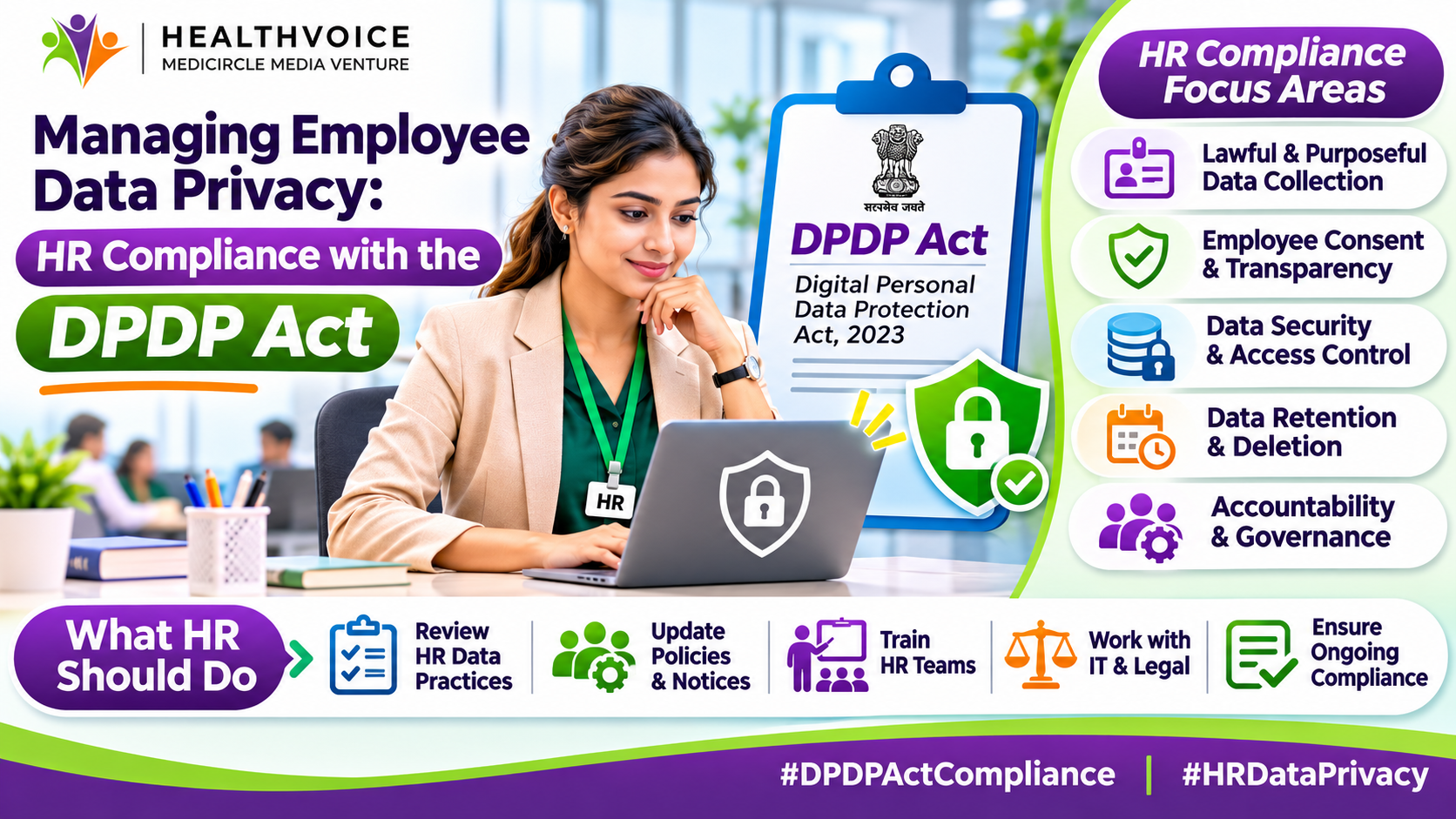
The DPDP Act, 2023 highlights the importance of protecting employee personal data. HR teams must focus on responsible data collection, transparency, security, and proper retention practices to strengthen compliance, safeguard privacy, and build employee trust.
Executive Overview: The Corporate Shift in Employment Data Governance
Human resources departments have historically operated as high-volume repositories of personal, financial, biometric, and medical information. From preliminary candidate CV screening and background verification checks to payroll routing, daily biometric attendance logging, health insurance onboarding, performance appraisals, and exit interviews, employers routinely collect and store deep profiles of their personnel.
Historically, this corporate record-keeping operated under broad internal employment contracts, discretionary company policies, and informal data management practices. Human resources data was treated as proprietary organizational property, stored across unencrypted local desktop spreadsheets, physical filing cabinets, legacy Enterprise Resource Planning (ERP) databases, and third-party software-as-a-service (SaaS) vendor silos without strict retention limits or auditable access logging.
The enactment and operationalization of comprehensive privacy legislation—epitomized by India’s Digital Personal Data Protection (DPDP) Act and comparable modern data protection frameworks globally—fundamentally upends this historical dynamic.
Under the DPDP architecture, the employer is legally designated as a Data Fiduciary, while the prospective, active, or former employee holds the statutory status of a Data Principal:
- The Erosion of Unchecked Employer Discretion: Employment does not waive an individual's fundamental right to informational privacy. Employers can no longer claim unlimited operational license over workforce data simply by embedding blanket, non-negotiable consent clauses into employment agreements.
- Severe Financial and Regulatory Liabilities: The DPDP framework imposes substantial statutory penalties—reaching hundreds of crores of rupees per incident—for systemic data protection failures, unnotified breaches, and non-compliance with data principal access rights.
- The Operational Burden of Historical Records: Most established enterprises house decades of legacy employment records: physical archives containing unredacted national identity cards, bank account statements, tax identifiers, medical clearance certificates, and disciplinary memos of personnel who departed the organization years ago. Under strict purpose-limitation and storage-limitation mandates, maintaining these un-audited historical archives constitutes an active regulatory liability.
Aligning human resources record-keeping with the DPDP Act demands an operational restructuring of the corporate talent lifecycle:
- Demarcating valid grounds for processing—balancing explicit consent notices against legally recognized "certain legitimate uses" tied to employment.
- Implementing strict purpose specification, data minimization, and automated storage-limitation schedules.
- Restructuring third-party vendor oversight across background check agencies, payroll processors, corporate group health insurers, and cloud HRMS providers.
- Institutionalizing clear, auditable workflows to address Data Principal rights, grievance redressal, and rapid-response breach notification protocols.
1. Legal Grounds for Processing Employee Data: Consent vs. Legitimate Uses
A critical area of confusion in employment data compliance centers on whether employers must secure ongoing, explicit consent for routine workplace operations, or whether processing falls under statutory legitimate grounds.
The Limits of Employment Consent
- In standard consumer transactions, freely given, specific, informed, unconditional, and unambiguous consent serves as the primary legal gateway for personal data processing.
- In an employment relationship, however, global privacy jurisprudence and modern statutory frameworks recognize an inherent imbalance of power between the employer and the employee.
- When an employer conditions onboarding, continued employment, or promotional evaluation on signing a blanket data collection waiver, that consent cannot be considered fully "freely given."
- If processing relies strictly on consent, the employee holds the statutory right to withdraw that consent at any time, which would freeze routine business operations if applied to essential payroll or tax functions.
"Certain Legitimate Uses" in Employment Contexts
The DPDP framework resolves this tension by providing explicit non-consent pathways categorized under "certain legitimate uses" for employment-related processing:
- Direct Employment Purposes: Employers may process digital personal data without separate, explicit consent when processing is strictly necessary for employment-related functions: calculating wages, processing direct-deposit salaries, managing attendance, provisioning essential technical workplace access (email and internal enterprise software), assessing job performance, and withholding mandatory statutory benefits.
- Corporate Asset Protection and Espionage Prevention: Processing employee communications, device activity, or facility access logs to safeguard intellectual property, protect corporate confidential trade secrets, prevent insider trading, or secure organizational digital networks against cyber threats falls under legitimate operational interests.
- Legal and Regulatory Compliance: Processing necessary to comply with prevailing labor laws, tax withholding mandates (e.g., income tax deductions, provident fund contributions, gratuity disbursements), workplace safety laws (e.g., prevention of sexual harassment investigations), or responding to court subpoenas and law enforcement directives operates independently of employee consent.
- The Non-Legitimate Boundary: Processing that falls outside essential core functions—such as deploying invasive keystroke logging, behavioral web-tracking during off-hours, harvesting personal social media activity, selling employee contact lists to marketing partners, or running unconsented facial-recognition emotion analysis—cannot be justified under legitimate employment uses and violates data protection standards.
2. The Talent Lifecycle Data Matrix: Minimization Across Employment Phases
Aligning HR record-keeping with DPDP mandates requires auditing and restructuring personal data handling across every chronological milestone of the employee journey.
1. Recruitment and Candidate Pre-Screening
- The Over-Collection Trap: Job application forms frequently demand unneeded sensitive disclosures: national identification numbers, marital status, residential home ownership, family background details, or past compensation slips before an interview is even scheduled.
- Data Minimization Mandate: Collect only the minimum information necessary to evaluate job competency at the initial phase (e.g., professional curriculum vitae, verified educational history, and direct contact details).
- Unsuccessful Candidate Data Disposal: The common corporate practice of indefinitely archiving resumes of rejected candidates in unindexed "talent pools" violates storage-limitation principles. Employers must establish an automated expiration policy: unless a candidate explicitly opts in to remain in an active talent network, application data must be securely purged within a defined operational window (e.g., six to twelve months post-rejection).
2. Active Employment and Onboarding
- Identity and Financial Verification: When a candidate is hired, collecting national identification documents, permanent account numbers, bank account numbers, and emergency contact details is legally justified for payroll, tax, and life-safety operations.
- However, copies of identity documents must be encrypted at rest, access-restricted to senior payroll administrators, and masked where feasible (e.g., storing masked identification tokens rather than raw, unredacted physical photocopies).
- Biometric Attendance and Surveillance Systems: Replacing physical registers with biometric fingerprint scanners or facial-recognition entry gates introduces high-risk biometric processing:
- Biometric data represents permanent physiological identity markers that cannot be reset if breached.
- Systems must store irreversible mathematical algorithmic templates (hashes) rather than raw photographic or fingerprint image files.
- Employers must offer non-biometric alternative entry mechanisms (such as encrypted RFID access cards) for personnel who object to biometric processing.
3. Occupational Health, Benefits, and Insurance
- Managing employee group health insurance requires transferring employee and dependent health data to third-party insurance brokers and underwriters.
- Medical information (pre-existing condition disclosures, pregnancy notifications, disability assessments) constitutes high-sensitivity personal data.
- HR teams must never maintain unencrypted, open health logs accessible to line managers. Health disclosures must be segmented onto isolated, role-restricted platforms to prevent medical conditions from biasing performance reviews or promotion cycles.
4. Separation, Resignation, and Post-Employment Archival
- The Illusion of Indefinite Retention: Departing employees do not lose their data protection rights. Employers cannot retain full personnel files indefinitely "just in case."
- The Dual-Retention Standard:
- Personal data whose purpose has ended (e.g., daily swipe-card logs, temporary performance review scratch-pads, personal emergency contact details) must be securely deleted or anonymized upon exit clearance.
- Records subject to statutory legal retention mandates (e.g., payroll tax records, provident fund registers, worker injury compensation filings, or records tied to active, pending labor litigation) must be moved into locked, restricted-access archival vaults, tagged with exact legal disposal dates matching statutory limitation acts.
3. Third-Party Vendor Ecosystems: Data Fiduciary and Processor Alignment
Modern HR departments rarely operate as self-contained operational islands. They rely on an ecosystem of external vendors: background verification agencies, cloud-hosted Human Resource Management Systems (HRMS), outsourced payroll bureaus, corporate travel agencies, and occupational health clinics.
The Chain of Legal Liability
- Under the DPDP Act, the employer remains the primary Data Fiduciary. The external service provider operates as a Data Processor.
- The statutory duty of care remains anchored to the Data Fiduciary: if an outsourced payroll software provider suffers an unencrypted data breach that exposes employee bank accounts and home addresses, the employer shares direct regulatory liability before the Data Protection Board.
Vendor Governance Protocols
Organizations must establish an unbroken compliance contract with every third-party processor interacting with workforce data:
- Mandatory Data Processing Addendums (DPAs): HR procurement must ban informal service agreements. Every vendor contract must feature a legally binding DPA that explicitly prohibits the vendor from using employee data for secondary machine-learning training, commercial cross-selling, or unauthorized sub-processing.
- Technical Security Standards: Mandating independent third-party cybersecurity certifications (such as ISO/IEC 27001 or SOC 2 Type II) for all external cloud HRMS platforms, enforcing end-to-end encryption in transit (TLS 1.3) and at rest (AES-256).
- Mandatory Post-Contract Data Sanitization: Requiring contracted background verification agencies to issue certified Data Destruction Certificates confirming that personal candidate data, criminal check transcripts, and credit reports are permanently purged from vendor servers within thirty to ninety days of delivering the final verification report.
4. Operationalizing Employee Rights and Grievance Redressal
Data Principals possess enforceable statutory rights that HR departments must operationalize through documented, auditable administrative workflows.
Managing Employee Data Subject Requests
- Right to Access and Summary: Employees hold the legal right to request an itemized summary of their personal data processed by the organization, the specific purposes of processing, and the identities of all third-party processors with whom their data has been shared.
- Right to Correction and Erasure: Employees may formally request the rectification of inaccurate or misleading personal data, the completion of incomplete profiles, or the erasure of personal data that is no longer necessary for the legal purpose for which it was originally collected.
- The Exception Boundaries: The right to erasure is not an absolute, unilateral license. An employee facing termination cannot demand the immediate deletion of their disciplinary records or performance improvement plans (PIPs) to sanitize their record, as the employer retains a legitimate legal ground to preserve those records for defense against potential wrongful termination litigation.
The Grievance Redressal Architecture
- The DPDP Act mandates that organizations establish accessible, efficient grievance redressal mechanisms before a Data Principal can escalate complaints to the regulatory Data Protection Board.
- The HR-Privacy Ombudsperson: Organizations must designate an independent, trained compliance contact—or coordinate directly with the enterprise Data Protection Officer (DPO)—to manage workforce privacy disputes.
- Statutory Timelines and Ticketing: HR intake must operate a formalized, confidential ticketing system for privacy grievances, tracking requests from receipt to resolution within mandatory statutory turnaround times (typically seven to thirty days).
- Non-Retaliation Protections: Corporate whistleblower and privacy policies must codify strict anti-retaliation protections: preventing managers from demoting, penalizing, or harassing an employee who exercises their legal privacy rights or reports an internal data privacy violation.
5. Structural Comparison: Legacy HR Record-Keeping vs. DPDP-Compliant Data Architecture
Evaluating traditional human resources administration alongside a modernized, DPDP-compliant data governance architecture highlights key operational transformations:
Legal Basis and Purpose Allocation
- Legacy HR Administration: Relies on broad, non-negotiable catch-all consent clauses buried deep within employment contracts; data collected for one purpose is routinely re-used across unrelated departments without notification.
- DPDP-Compliant Data Architecture: Maps processing to specific, documented "certain legitimate uses" or precise, unbundled consent notices; strictly enforces purpose-limitation rules that prevent secondary data usage.
- Operational Impact: Eliminates the legal vulnerability of relying on invalid, coerced employee consent waivers.
Data Collection and Minimization Standards
- Legacy HR Administration: Excessive, speculative collection; application forms demand comprehensive family, financial, and personal details years before they are operationally required.
- DPDP-Compliant Data Architecture: Strict data minimization; collects only the minimum, role-relevant information required for the immediate stage of the employment lifecycle.
- Operational Impact: Reduces organizational surface-area exposure, shrinking the volume of sensitive data vulnerable to internal compromise or external breach.
Storage Architecture and Retention Lifecycle
- Legacy HR Administration: Indefinite, unindexed storage; unencrypted physical files in basement archives; decentralized spreadsheets scattered across departmental hard drives.
- DPDP-Compliant Data Architecture: Centralized, encrypted, role-restricted digital repositories; automated lifecycle tagging that enforces scheduled deletion or anonymization when legal retention windows expire.
- Operational Impact: Lowers digital storage overhead and ensures full compliance with statutory data disposal mandates.
Incident Management and Regulatory Accountability
- Legacy HR Administration: Internalized and secretive; personnel data breaches or lost laptops are handled informally through quiet internal IT resets without external notification.
- DPDP-Compliant Data Architecture: Documented, high-velocity Incident Response Protocols; mandatory statutory notification of affected employees and the Data Protection Board within designated breach windows.
- Operational Impact: Shields the organization from catastrophic regulatory fines and preserves institutional trust with the workforce.
6. Phased Implementation Protocol: Institutionalizing HR Data Privacy Compliance
Transitioning an enterprise human resources department from legacy filing habits into an auditable, DPDP-aligned data governance model requires an organized four-phase strategy:
Phase 1: Enterprise HR Data Mapping and Privacy Audit (Months 1 to 3)
- Execute a comprehensive Data Protection Impact Assessment (DPIA) spanning all talent operations: recruitment, background screening, onboarding, performance tracking, payroll, benefits, and separations.
- Construct an exhaustive Record of Processing Activities (ROPA): documenting every category of personal data collected, physical storage locations (cloud servers, physical cabinets, local drives), processing purposes, legal grounds, and third-party data flows.
- Locate and quarantine shadow HR data: auditing departmental managers who maintain offline Excel spreadsheets tracking employee medical conditions, performance disputes, or personal contact details outside the primary secure HRMS.
Phase 2: Legal Re-Baselining and Contractual Re-Engineering (Months 4 to 6)
- Update all external candidate job application portals and internal employee handbooks with standardized, clear, transparent Privacy Notices detailing exact processing purposes and data principal rights.
- Revise employment contract templates: decoupling legitimate operational data processing from non-negotiable employment terms, and drafting specific consent notices for discretionary employee programs (e.g., voluntary wellness initiatives, employee spotlight marketing features).
- Execute formal Data Processing Addendums (DPAs) with all third-party background checkers, payroll providers, and corporate insurers, establishing strict data return, deletion, and breach-notification SLAs.
Phase 3: Technical Hardening, Access Control, and Lifecycle Automation (Months 7 to 9)
- Implement Role-Based Access Control (RBAC) and mandatory Multi-Factor Authentication (MFA) across all digital HR software: ensuring line managers cannot access employee banking profiles, and general HR staff cannot view occupational health or disciplinary investigation archives without authorized clearance.
- Deploy enterprise-grade encryption across all resting databases and active transit pipelines containing employee personal data.
- Configure automated retention and disposal rules within the enterprise HRMS: programming the automatic purging of rejected applicant profiles after 180 days and setting automated alerts for archiving and deleting separated employee files once statutory limitation periods expire.
Phase 4: Employee Rights Operationalization and Workforce Training (Months 10 to 12)
- Establish an accessible, internal Employee Data Rights and Grievance Portal: enabling personnel to submit secure, authenticated requests for data summaries, corrections, or erasures directly to the designated compliance ombudsperson.
- Conduct mandatory, role-specific data privacy hygiene training for all HR personnel, hiring managers, and corporate executives, focusing on preventing accidental disclosures, avoiding insecure email transmission of unencrypted employee files, and recognizing phishing vectors.
- Convene quarterly compliance review audits co-chaired by the Chief Human Resources Officer (CHRO), General Legal Counsel, and the enterprise Data Protection Officer to review access logs, audit vendor compliance, and refine internal data retention parameters.
Strategic Summary: Privacy as the Foundation of Modern Workforce Trust
Aligning human resources record-keeping with modern Digital Personal Data Protection Acts represents far more than an administrative compliance exercise or defensive legal shield. In an increasingly competitive knowledge economy, an organization’s operational posture toward employee data privacy directly reflects its organizational integrity and corporate culture. Treating workforce personal data as an un-governed corporate commodity invites catastrophic regulatory penalties, destructive cyber breaches, and widespread employee demoralization.
By replacing broad historical consent with well-defined legitimate operational grounds, enforcing strict data minimization from recruitment to separation, securing third-party vendor pipelines with enforceable processing agreements, and empowering employees with transparent data access and grievance mechanisms, enterprises build a resilient compliance framework.
This transformation protects the organization from severe statutory liabilities, elevates corporate governance standards, and honors the foundational compact between employer and employee: fostering a productive, transparent, and respectful workplace founded on mutual trust and personal dignity.
10 Frequently Asked Questions (FAQs)
Q1. Can an employer legally process employee personal data without explicit consent under the DPDP Act?
Yes. The DPDP Act explicitly provides for "certain legitimate uses" that exempt employers from obtaining separate consent for processing that is strictly necessary for employment-related functions:
- This includes calculating and disbursing salaries, managing statutory provident fund and tax contributions, tracking attendance, administering essential workplace benefits, and evaluating professional performance.
- However, processing that falls outside core employment necessities—such as selling employee directories, publishing personal details externally without approval, or conducting invasive off-duty personal monitoring—cannot be justified under legitimate uses and requires explicit, voluntary consent.
Q2. How long can an organization legally retain the personal records of a former employee after resignation or termination?
Under DPDP storage-limitation principles, personal data must be erased as soon as the purpose for which it was collected has been served:
- Employers cannot retain complete personnel files indefinitely.
- However, organizations may retain specific categories of data required to satisfy statutory legal obligations: payroll tax filings, provident fund registers, and records needed to defend against potential labor disputes or wrongful termination lawsuits.
- Once those statutory limitation periods expire (typically three to eight years depending on specific national labor and tax codes), the remaining personal data must be permanently deleted or irreversibly anonymized.
Q3. Does an employee have the legal right to demand the immediate deletion of their poor performance reviews or disciplinary records?
No. The statutory right to erasure is not an absolute, unconditional entitlement:
- An employer has a recognized, legitimate operational and legal ground to maintain objective records of performance assessments, warning letters, and disciplinary investigations.
- These records are essential for defending the organization against wrongful dismissal claims, managing internal promotions, and maintaining institutional accountability.
- An employee can request the correction of factually incorrect personal information (such as an incorrect date of birth or misspelled name), but cannot demand the erasure of legally held operational performance documentation.
Q4. Are copies of government identification documents (like Aadhaar cards or passports) collected during onboarding covered under the DPDP Act?
Yes. Digital copies, scanned PDFs, and entered identification numbers represent personal data and fall squarely under the statutory provisions of the DPDP Act:
- Employers must practice data minimization: collecting identity cards only when legally required for tax, provident fund, or identity verification mandates.
- Once verified, physical paper copies should be shredded, and digital scans must be stored in secure, encrypted vaults with restricted access.
- Storing unredacted identification cards in open, shared company drives or unencrypted email folders constitutes a serious regulatory violation.
Q5. Can HR departments share employee personal data with group health insurance companies without violating privacy laws?
Yes, provided the data transfer is strictly limited to the information required to enroll the employee and their eligible dependents in the corporate insurance policy:
- The employer must ensure that the insurance provider operates under a legally binding Data Processing Addendum (DPA) that prohibits the insurer from using employee data for unrelated commercial marketing, cold-calling, or secondary underwriting.
- Furthermore, HR must collect only the minimum necessary dependent details, ensuring that sensitive medical disclosures submitted during claim processing remain confidential between the employee and the medical insurer.
Q6. Is physical biometric attendance tracking (fingerprint or facial scanning) legally risky under modern privacy frameworks?
Yes, biometrics carry elevated legal and operational risks because physiological traits cannot be changed if the database is breached:
- If an employer uses biometric systems, the underlying software must convert the biological feature into an encrypted mathematical template (hash) rather than storing raw images of fingerprints or faces.
- Employers must implement robust technical safeguards to protect this template storage.
- Best practice mandates offering a non-biometric alternative (such as an encrypted RFID badge or mobile proximity check-in) for personnel who have legitimate objections or physical accessibility constraints regarding biometric capture.
Q7. What happens if a third-party background check agency hired by the employer suffers a major data breach?
Under the DPDP framework, the employer remains the primary Data Fiduciary, while the background verification agency acts as a Data Processor:
- If the agency suffers a breach involving employee data, the employer shares direct regulatory responsibility before the Data Protection Board.
- Employers must protect themselves by executing strict contracts requiring vendors to maintain high-grade encryption, undergo annual security audits (SOC 2 or ISO 27001), and notify the employer of any security compromise within hours of detection.
Q8. How should an HR department manage the resumes of candidates who were rejected during job interviews?
Indefinitely archiving resumes of rejected candidates without their knowledge is a direct violation of storage-limitation principles:
- HR departments must establish a clear retention threshold (typically six to twelve months) to handle any immediate recruitment appeals or candidate inquiries.
- After this window, the resumes must be automatically deleted from internal databases and recruiter drives.
- If the company wishes to retain a promising candidate’s profile for future openings, HR must send an explicit notification asking the candidate to voluntarily opt in to remaining in the corporate talent pool.
Q9. What are the legal risks of monitoring employee company laptops, emails, and internet usage?
Monitoring is legally permissible only when it is strictly proportionate, justified by legitimate business interests, and transparently disclosed:
- Employers have a legitimate operational right to protect company assets, prevent data leaks, and ensure network security on company-owned devices.
- However, monitoring must be conducted under a clear, written Corporate Acceptable Use Policy signed by the employee.
- Invasive monitoring that records keystrokes indiscriminately, accesses personal webcams, or inspects private personal communications during non-work hours violates fundamental privacy expectations and exposes the company to legal challenges.
Q10. What are the three most critical operational actions an HR team must take immediately to comply with the DPDP Act?
Take three prioritized operational actions:
- Execute an HR Data Mapping Audit: Locate, categorize, and index every piece of personal data currently stored across HR systems, physical filing cabinets, local spreadsheets, and cloud platforms to identify unneeded or legacy data that must be purged.
- Issue Updated, Transparent Employee Privacy Notices: Publish clear, accessible privacy notices to candidates and employees explaining what data is collected, the specific legitimate uses for which it is processed, and how employees can exercise their statutory access and grievance rights.
- Execute Data Processing Agreements with All Vendors: Audit every third-party vendor handling workforce data (payroll, background checking, health insurance, cloud HRMS) and bind them to formal agreements enforcing encryption, purpose limitation, and mandatory breach reporting.
 Team Healthvoice
#DPDPActCompliance #HRDataPrivacy