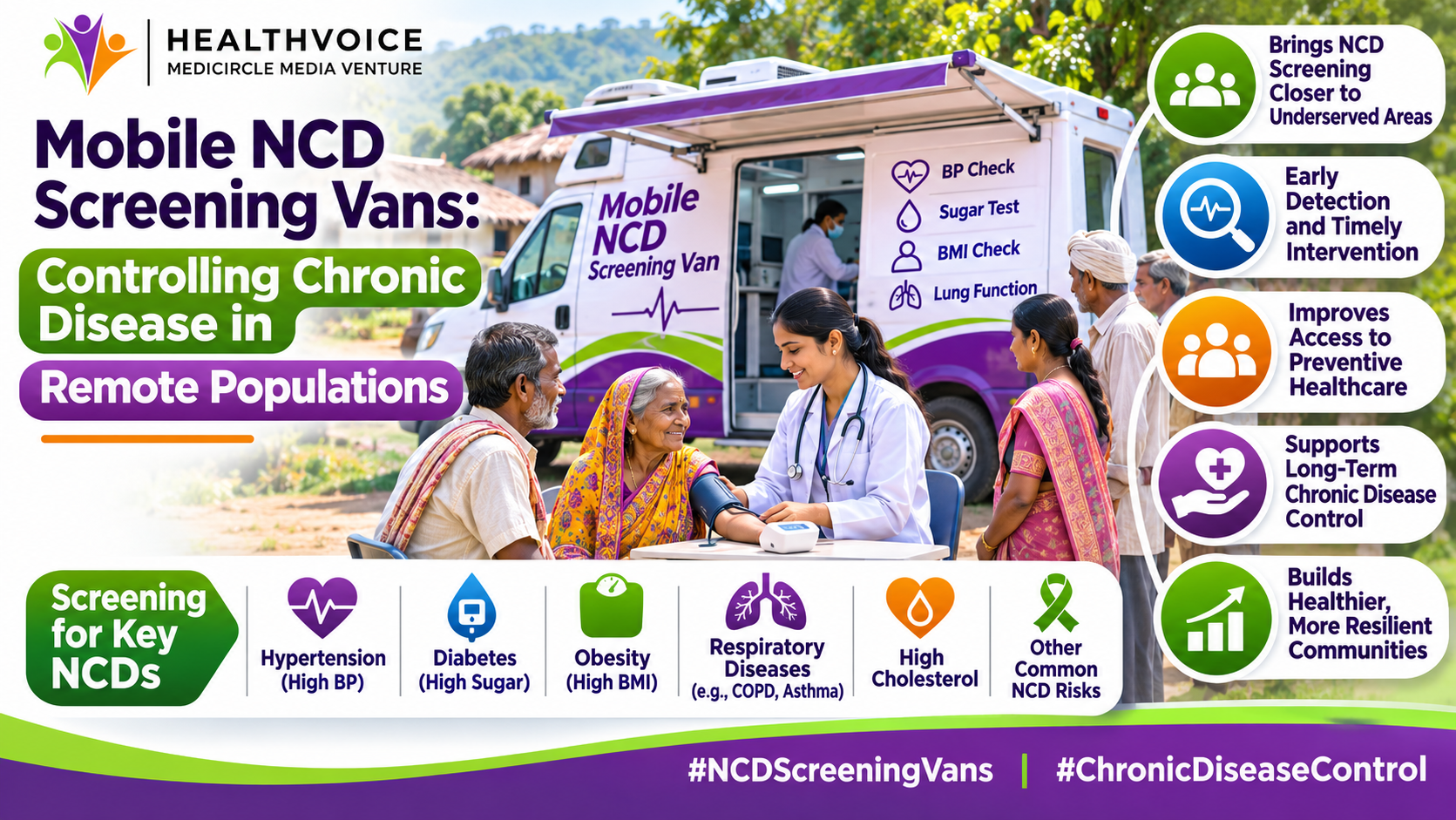
Mobile NCD Screening Vans: Controlling Chronic Disease in Remote Populations
Mobile NCD screening vans bring essential healthcare services to remote communities, enabling early detection of chronic diseases such as diabetes, hypertension, and respiratory conditions. These initiatives improve access to preventive care, support timely treatment, and promote healthier rural populations.
Executive Overview: The Epidemiological Transition and the Rural Diagnostic Divide
The global disease burden has undergone an irreversible epidemiological transition: non-communicable diseases (NCDs)—primarily cardiovascular disorders, Type 2 diabetes mellitus, chronic respiratory diseases, and early-stage oncological malignancies (oral, cervical, and breast cancers)—now account for over seventy percent of global mortality. While NCD management is traditionally perceived as an urban healthcare challenge, low- and middle-income countries face an escalating crisis in rural, tribal, and hard-to-reach geographies. In these peripheral environments, geographic isolation, out-of-pocket transportation costs, low health literacy, and fragmented primary healthcare centers coalesce into an acute diagnostic void.
Chronic metabolic and neoplastic disorders develop asymptomatically over years, transforming clinical delays into catastrophic morbidity:
- The Silent Latency Trap: Hypertension, hyperglycemia, and premalignant dysplasias produce minimal early physical discomfort. Consequently, rural agricultural workers and marginalized populations rarely seek preventative health checks, presenting only after acute end-organ failure manifests (e.g., hemorrhagic strokes, acute myocardial infarctions, diabetic retinopathy, end-stage renal disease, or metastasized Stage IV carcinomas).
- Catastrophic Health Expenditures: Late-stage episodic intervention requires tertiary hospitalization, hemodialysis, or advanced cytotoxic chemotherapy, plunging low-income rural households into generational poverty.
- The Fragmented Primary Healthcare Chasm: Rural Sub-Centers and Primary Health Centers (PHCs) frequently lack functional diagnostic hardware (e.g., non-functional colorimeters, uncalibrated sphygmomanometers, or absent laboratory reagents) and face chronic shortages of credentialed laboratory technicians and specialized physicians.
Bridging this healthcare access gap requires transforming healthcare delivery from facility-centric models to proactive, field-based community models.
Deploying fully integrated Mobile Medical Screening Vans for Non-Communicable Diseases delivers an effective population health strategy:
- Utilizing robust, all-terrain vehicular platforms configured with calibrated point-of-care (POC) clinical diagnostics that generate laboratory-quality metabolic profiles in minutes.
- Executing multi-disease population screening algorithms (hypertension, diabetes, chronic obstructive pulmonary disease, and common oncological screenings) within a single community visit.
- Establishing unbroken digital health linkages and longitudinal registries that synchronize field diagnostic data directly into national electronic health record (EHR) frameworks.
- Structuring closed-loop referral pathways and community-based supply chains that guarantee continuous pharmacotherapy and prevent newly identified chronic patients from falling through the administrative cracks.
1. Vehicular Engineering and Diagnostic Topology: Designing the Mobile Clinic
A mobile NCD screening unit is an advanced clinical workstation engineered to maintain diagnostic accuracy within harsh rural environments (dust, temperature extremes, unpaved terrain, and erratic electrical infrastructure).
Physical Configuration and Ergonomic Zonation
- Vehicular Base Platform: Medium-to-heavy commercial chassis or four-wheel-drive extended vans equipped with heavy-duty leaf-spring suspensions, high ground clearance, and dust-sealed cabin enclosures.
- Internal Clinical Compartmentalization:
- Zone 1 (Registration and Vitals Triage): Outdoor-facing shaded awning or entrance foyer for patient demographic intake, digital biometric registration, height/weight measurement, and automated blood pressure acquisition.
- Zone 2 (Point-of-Care Laboratory): Climate-controlled workspace housing vibration-isolated centrifuges, dry-chemistry point-of-care analyzers, and cold-chain sample preservation refrigerators.
- Zone 3 (Private Clinical Examination Suite): Fully partitioned, acoustic-dampened, and curtained interior suite with an examination gurney for physical examinations, clinical breast examinations (CBE), visual inspection with acetic acid (VIA) for cervical cancer, and digital fundoscopy.
- Autonomous Power Architecture: Multi-source power redundancy combining rooftop monocrystalline photovoltaic solar panels, high-capacity lithium iron phosphate (LiFePO4) battery banks, pure sine wave inverters, and a silent, auxiliary onboard diesel generator. This setup guarantees continuous power to sensitive diagnostic equipment and air conditioning during eight- to ten-hour field deployments without vehicle idling.
Point-of-Care (POC) Diagnostic Armamentarium
Field diagnostics must be rapid, reagent-stable, and operable without laboratory-grade piped water or complex drainage:
- Metabolic Diagnostics: Automated multi-parameter dry-chemistry analyzers utilizing disposable microfluidic discs to process capillary fingerstick or whole-blood samples. Quantifies Glycated Hemoglobin (HbA1c via boronate affinity chromatography), comprehensive lipid panels (total cholesterol, HDL, LDL, triglycerides), serum creatinine with automated estimated Glomerular Filtration Rate (eGFR) calculations, and urine microalbuminuria.
- Cardiovascular and Respiratory Devices: Bluetooth-enabled digital sphygmomanometers with validated multi-size cuffs, portable twelve-lead electrocardiography (ECG) units with automated diagnostic interpretation, and portable micro-spirometry units equipped with disposable viral-bacterial filters to screen for chronic airflow limitation.
- Oncological Screening Instruments: Handheld smart digital colposcopes with high-magnification LED optical heads for visual inspection of the cervix with acetic acid (VIA); handheld thermal imaging cameras or mechanical automated breast examination palpation sensors; and high-intensity LED intraoral illumination systems with fluorescence visualization for early oral precancerous lesion detection (leukoplakia, erythroplakia, and submucous fibrosis).
2. Integrated Clinical Screening Protocols: Multi-Disease Triage
Mobile screening models maintain economic and clinical efficiency by screening a single individual for multiple interdependent disease profiles simultaneously.
The Unified Patient Journey Protocol
- Step 1: Intake and Anthropometric Stratification: Rapid electronic registration linking to the patient’s national digital health identifier. Measurement of height, weight, body mass index (BMI), and waist-to-hip ratio. Automated recording of three resting blood pressure measurements spaced two minutes apart using validated oscillometric units.
- Step 2: Capillary and Biochemical Testing: Execution of random capillary blood glucose (RBG) for all individuals aged thirty and older. If RBG registers \ge 140\text{ mg/dL}, the technician performs an immediate confirmatory point-of-care HbA1c test and urine microalbumin strip assessment.
- Step 3: Cardiovascular Risk Stratification: For patients exhibiting elevated systolic blood pressure (\ge 140\text{ mmHg}) or documented dyslipidemia, the system algorithmically calculates their WHO/ISH Cardiovascular Disease (CVD) Ten-Year Risk Score, categorizing risk as low (< 10\%), moderate (10\%\text{ to }< 20\%), or high (\ge 20\%). Patients in moderate-to-high tiers receive immediate portable twelve-lead ECG profiling to evaluate for prior silent myocardial infarction, left ventricular hypertrophy (LVH), or cardiac arrhythmias.
- Step 4: Targeted Cancer Screening Protocols:
- Oral Cavity: Visual inspection and palpation of the oral mucosa, gingiva, buccal surfaces, and tongue in all tobacco and areca-nut users to identify dysplastic lesions.
- Breast Health: Clinical Breast Examination (CBE) performed by a female clinical nurse for all women aged thirty to sixty-five, combined with instruction on monthly breast self-awareness.
- Cervical Screening: Visual Inspection with Acetic Acid (VIA) performed in a sterile private suite, applying freshly prepared 3% to 5% dilute acetic acid to the transformation zone of the cervix, inspecting under magnification for sharp, distinct acetowhite lesions indicating high-grade cervical intraepithelial neoplasia (CIN 2/3).
3. Digital Infrastructure: Telemedicine, EHR Integration, and Offline Synchronization
Operating in geographically remote rural valleys, desert fringes, and dense tribal forests introduces significant telecommunications challenges: reliable cellular broadband is frequently unavailable.
Store-and-Forward Offline Architecture
- Local Edge Computing: The mobile van carries an onboard ruggedized local server configured with a lightweight relational database and local wireless access point. Tablets and laptops operated by the intake nurse, laboratory technician, and medical officer connect directly to this local intranet.
- Offline-First Data Ingestion: If cellular connectivity drops, the software functions seamlessly offline: registering patients, recording diagnostic outputs, storing digital colposcopy photographs, and generating printed physical patient health scorecards via local wireless thermal printers.
- Encrypted Asynchronous Synchronization: The moment the vehicle enters a cellular coverage zone (4G/5G) or docks at its evening base hospital, the edge server initiates an automated, encrypted, bidirectional sync with the central cloud-based National NCD Registry. It pushes newly identified clinical records and pulls down updated therapeutic prescription histories.
Real-Time Tele-Consultation and Decision Support
- Cloud-Enabled Specialist Tele-Consultation: High-bandwidth satellite or bonded multi-SIM cellular transceivers enable live tele-consultations between the field vehicle and urban tertiary specialists (cardiologists, endocrinologists, and oncologists).
- AI-Assisted Diagnostic Screening: Deploying edge-computed machine learning models directly on mobile devices:
- Computer-Vision Colposcopy: Machine learning models pre-screen digital images of the cervix, highlighting suspected acetowhite margins to assist field nurses with low colposcopic volume.
- ECG Arrhythmia Flagging: Automated algorithms highlight ST-segment elevations, deep Q waves, or atrial fibrillation, generating immediate clinical priority alerts for the on-site team.
4. Closed-Loop Care Cascades: Bridging the "Screening-to-Treatment" Chasm
The definitive failure of historical medical camps is the "screen-and-abandon" phenomenon: identifying hundreds of hypertensive and diabetic villagers who are handed a piece of paper, only to have zero individuals reach a distant tertiary hospital for definitive medication. Mobile screening vans are operational components of an unbroken care continuum.
The Phased Clinical Continuum
- Phase 1: Mobilization and Community Priming: Field visits are scheduled with village councils and local community health workers (e.g., ASHAs or Anganwadi workers) at least two weeks in advance. Health workers conduct door-to-door enumeration, identifying high-risk individuals aged thirty and older and providing mobilization slips to minimize idle clinic time.
- Phase 2: On-Site Confirmation and Immediate Dispensation: Patients with verified grade-2 hypertension (\text{SBP} \ge 160\text{ mmHg}) or unmanaged hyperglycemia (\text{HbA1c} \ge 8.0\%) are seen immediately by the mobile van's medical officer via in-person examination or tele-consultation.
- To prevent lost-to-follow-up drop-offs, the van carries a certified basic formulary of essential, stable NCD therapeutics (e.g., Amlodipine, Telmisartan, Metformin, and Statins), dispensing a thirty-day introductory starter supply directly to the patient at zero out-of-pocket cost.
- Phase 3: Digital Handover to Primary Health Infrastructure: The mobile unit transmits the patient's record to the nearest local Health and Wellness Center (HWC) or Primary Health Center (PHC). The local community health officer (CHO) receives an automated task to enroll the patient in their local monthly drug-distribution program, ensuring that month-two medication refills are available locally without requiring travel.
- Phase 4: Tertiary Surgical and Oncological Referral Fast-Tracks: When visual inspection with acetic acid reveals a suspected invasive cervical lesion, or an oral ulcer displays malignant characteristics, the mobile team issues an encrypted Green-Channel Fast-Track Referral Voucher.
- The referral is directly received by a patient navigator at the empaneled regional tertiary medical college, guaranteeing prioritized diagnostic biopsies and histopathology appointments without administrative waitlists.
5. Structural Comparison: Traditional Primary Health Centers vs. Mobile NCD Screening Units
Evaluating fixed, remote rural primary health centers alongside mobile diagnostic units highlights the distinct operational trade-offs governing chronic disease management:
Diagnostic Equipment Availability and Calibration
- Fixed Rural Primary Health Center: Frequently compromised; high rates of equipment downtime, depleted test reagents, broken diagnostic devices, and uncalibrated analog machines due to poor rural supply chains.
- Mobile NCD Screening Unit: High; self-contained, centralized equipment maintenance; diagnostic devices undergo standardized daily multi-parameter calibration at the central base hospital before field departure.
- Operational Impact: Delivers consistent, reliable laboratory-grade diagnostic accuracy to peripheral populations that typically receive inaccurate fingerstick checks.
Population Reach and Demographic Equity
- Fixed Rural Primary Health Center: Passive and geographically bounded; predominantly serves communities living within a three- to five-kilometer radius; vulnerable, elderly, and mobility-impaired individuals are excluded by geographic distance.
- Mobile NCD Screening Unit: Proactive and geographically unconstrained; navigates difficult terrain to stage clinics directly in village squares, tribal settlements, and farming cooperatives.
- Public Health Impact: Overcomes transportation costs and wage-loss barriers, capturing the underserved demographic groups that carry the highest unmanaged chronic disease burdens.
Capital Allocation and Operational Cost
- Fixed Rural Primary Health Center: High initial fixed capital expenditure (physical building construction, civil utilities, ongoing facility maintenance); low variable operating efficiency if local patient density is low.
- Mobile NCD Screening Unit: Low-to-moderate initial capital expenditure; dynamic operational cost centered on fuel, vehicular maintenance, disposable microfluidic test cartridges, and traveling clinician salaries.
- Economic Impact: Optimizes resource allocation by sharing specialized diagnostic assets and skilled healthcare staff across dozens of dispersed geographic communities.
Continuity of Care and Chronic Disease Adherence
- Fixed Rural Primary Health Center: Continuous physical presence; ideally suited for longitudinal monthly medication refills, chronic disease surveillance, and long-term patient relationship management.
- Mobile NCD Screening Unit: Episodic physical presence; typically visits an individual village once every two to three months; not designed for daily drop-in acute care.
- Systemic Requirement: Requires a hybrid operational model: the mobile van serves as the specialized diagnostic detection engine, feeding diagnosed patients into local fixed rural clinics for ongoing monthly maintenance.
6. Phased Implementation Protocol: Rolling Out a Regional Mobile Screening Fleet
Deploying an enterprise-grade mobile NCD screening fleet across a district, state, or regional province requires an organized four-phase operational roadmap:
- Phase 1: Epidemiological Auditing and Route Optimization (Months 1 to 2):
- Map district health registries, geographic boundary files, and census datasets to identify peripheral villages situated more than fifteen kilometers from functional primary diagnostic facilities.
- Execute route modeling: designing logical geographical circuits that allow each mobile unit to visit twelve to fifteen villages monthly on fixed, predictable schedules.
- Secure inter-agency partnerships uniting public health departments, regional transport authorities, and academic medical centers.
- Phase 2: Fleet Engineering and Clinical Procurement (Months 3 to 4):
- Procure and customize all-terrain vehicle chassis: installing dust-sealed interior clinical modules, rooftop solar arrays, and vibration-damped laboratory benches.
- Procure and validate validated point-of-care dry-chemistry analyzers, digital colposcopes, twelve-lead ECGs, and micro-spirometers.
- Develop the offline-first mobile software application, ensuring integration with national digital health identifiers and regional EHR platforms.
- Phase 3: Staff Credentialing and Field Pilot Simulation (Months 5 to 6):
- Recruit and credential mobile multidisciplinary clinical teams: one general duty medical officer, two public health nurses, one certified laboratory technician, and one driver-logistics coordinator per vehicle.
- Conduct intensive simulation drills covering point-of-care quality control, digital VIA interpretation, cervical photography, and emergency tele-consultation protocols.
- Launch a controlled, single-district pilot across five target villages; audit diagnostic yields, referral completion rates, and software offline-sync reliability.
- Phase 4: Full Enterprise Scaling and Continuous Quality Auditing (Months 7 to 12):
- Deploy the full operational fleet across the entire regional territory.
- Activate automated key performance indicator (KPI) dashboards: monitoring daily screening volumes, screening-to-treatment enrollment percentages, and average cost per screened individual.
- Convene monthly clinical governance panels: tracking patient retention across local Primary Health Centers, verifying that newly identified hypertensive and diabetic patients demonstrate measurable drops in mean blood pressure and HbA1c values over six- and twelve-month milestones.
Strategic Summary: Transforming Passive Healthcare into Proactive Population Health
The escalating burden of non-communicable diseases in remote populations cannot be solved by waiting for impoverished patients to travel to distant secondary or tertiary healthcare facilities. Treating chronic diseases requires early, asymptomatic detection paired with localized, continuous care.
By engineering all-terrain mobile medical clinics, deploying advanced point-of-care dry-chemistry and oncological diagnostics, operating through offline-first digital registries linked to national health ecosystems, and establishing closed-loop clinical referral handoffs to local village health workers, health authorities dismantle geographic and economic barriers.
This mobile public health architecture identifies chronic diseases years before catastrophic organ damage occurs, protects vulnerable families from financial devastation, and builds an equitable, proactive, and resilient healthcare delivery model for every remote community.
10 Frequently Asked Questions (FAQs)
Q1. What is the fundamental difference between a general mobile health clinic and an NCD-specific screening van?
A general mobile health clinic operates primarily as an urgent-care outpatient service:
- It focuses on treating acute, symptomatic infections (fever, diarrhea, skin infections, respiratory illness) and dispensing short-term symptomatic medications (paracetamol, antibiotics, cough syrups).
- An NCD-Specific Screening Van is an advanced preventative diagnostic platform designed to detect asymptomatic chronic conditions.
- It carries specialized quantitative analyzers (POC HbA1c, lipid profiles, microalbuminuria), cardiovascular telemetry (12-lead ECG), and oncological screening tools (digital colposcopes, thermal scanners), focusing on early detection and integrating patients into long-term disease registries rather than delivering episodic acute relief.
Q2. How can complex point-of-care diagnostic equipment remain accurate in dusty, bumpy rural terrain?
Protecting sensitive laboratory equipment requires specialized vehicular engineering:
- Analyzers are anchored to vibration-dampened workbenches lined with shock-absorbing elastomeric mounts that isolate sensitive optical and microfluidic sensors from rural road vibrations.
- The diagnostic laboratory suite features dedicated dust-sealed double-gasket door frames and high-efficiency particulate air (HEPA) positive-pressure filtration systems that blow air outward when doors open, preventing rural dust from entering.
- Technicians execute daily multi-level quality control (QC) checks using certified calibration strips and control reagents before commencing daily patient testing.
Q3. Why is Visual Inspection with Acetic Acid (VIA) preferred over Pap smears for cervical cancer screening in mobile units?
The conventional cervical Papanicolaou (Pap) smear presents major operational hurdles in remote settings:
- It requires specialized cytotechnologists and pathology laboratories to stain, mount, and microscopically examine slides, introducing multi-week reporting delays that lead to loss-to-follow-up rates exceeding fifty percent.
- Visual Inspection with Acetic Acid (VIA) provides an immediate, point-of-care result.
- The application of dilute vinegar causes dysplastic precancerous cells to turn opaque white (acetowhite) within one minute, visible to trained nurses under magnification.
- This allows the clinical team to inform the patient immediately and coordinate instant referral for colposcopy or thermal ablation within the same visit.
Q4. How do mobile screening vans function in areas with zero cellular or internet connectivity?
The mobile vehicle functions as an autonomous, local computing environment:
- An onboard ruggedized server broadcasts a local Wi-Fi intranet within and directly around the vehicle.
- Clinical staff record patient demographics, clinical measurements, and diagnostic readings using tablets that store data locally in an offline database.
- The software stores all encrypted records safely off-grid.
- When the vehicle returns to a highway with cellular data or docks at its base hospital station, the system automatically runs an encrypted, background sync that uploads all records to the centralized cloud registry.
Q5. What is the primary cause of failure in mobile screening programs?
The leading cause of program failure is the breakdown of post-screening referral and treatment cascades:
- When a mobile van simply screens patients, hands them a paper report showing elevated blood pressure or glucose, and drives away, less than fifteen percent of patients navigate the financial and logistical barriers required to visit a distant hospital.
- Without guaranteed, local medication access and active tracking by community health workers, screening initiatives fail to alter population health outcomes.
- Successful programs mandate direct medication delivery, digital registration, and formal electronic handovers to local primary clinics.
Q6. How long does a comprehensive NCD screening take per patient on a mobile van?
A streamlined, multi-station workflow takes fifteen to twenty-five minutes per individual:
- Triage, registration, and blood pressure checks take three to five minutes.
- Capillary blood sampling and automated point-of-care analyzer loading take two to three minutes, with microfluidic analyzers delivering full HbA1c and lipid results within five to eight minutes.
- While blood samples are processing, the patient proceeds to private clinical examination rooms for oral, breast, or cervical evaluations.
- This parallel processing architecture allows a single mobile unit to thoroughly screen sixty to one hundred individuals during a typical six-hour field deployment.
Q7. Can point-of-care fingerstick HbA1c tests match the accuracy of hospital laboratory blood draws?
Yes, provided the device meets strict international performance standards:
- Modern point-of-care HbA1c platforms certified by the National Glycohemoglobin Standardization Program (NGSP) and the International Federation of Clinical Chemistry (IFCC) demonstrate a high correlation (R^2 > 0.98) with standard laboratory High-Performance Liquid Chromatography (HPLC) assays.
- Using boronate affinity chromatography or micro-optical immunoassay methods, these instruments achieve coefficients of variation (CV) under three percent, delivering accurate clinical results from a single capillary drop of blood.
Q8. What criteria should public health planners use to select villages for mobile van visits?
Planning committees prioritize target locations using objective vulnerability metrics:
- Geographic isolation: villages situated more than ten to fifteen kilometers from an accredited public or private diagnostic laboratory.
- High prevalence of socioeconomic vulnerability: agricultural worker settlements, indigenous tribal reserves, and low-income rural colonies.
- Disease burden data: areas historically reporting high rates of acute hemorrhagic stroke, uncontrolled diabetes, or high tobacco consumption.
- Active primary community worker presence: selecting villages with functional health workers who can manage advance patient mobilization and ensure post-visit treatment adherence.
Q9. How does mobile screening reduce overall public healthcare costs?
Early asymptomatic detection is drastically cheaper than late-stage hospital intervention:
- Identifying and controlling early-stage essential hypertension using inexpensive generic medications costs a few dollars per patient annually.
- Conversely, treating an acute hypertensive hemorrhagic stroke, managing intensive care admissions, or providing long-term hemiplegia rehabilitation costs health systems and families thousands of dollars.
- Similarly, detecting and treating cervical pre-cancer (CIN 2/3) via localized outpatient ablation prevents expensive radical hysterectomies and radiation therapies, generating significant long-term health-economic savings.
Q10. What are the three most critical operational metrics to evaluate a mobile NCD screening program?
Track three prioritized, operational metrics:
- Screening Yield Rate: The percentage of screened individuals newly diagnosed with previously unrecognized hypertension, diabetes, or premalignant neoplastic lesions.
- Treatment Linkage and Enrollment Rate: The proportion of newly diagnosed patients who successfully register at their local Primary Health Center and receive their second-month medication refills within forty-five days of initial screening (target: > 80\%).
- Biochemical Control at 6 and 12 Months: Measuring the percentage of enrolled patients who achieve clinical targets (blood pressure < 140/90\text{ mmHg} and \text{HbA1c} < 7.0\text{–}8.0\%) during longitudinal follow-up evaluations.
 Team Healthvoice
#NCDScreeningVans #ChronicDiseaseControl