Healing Under the Lens: The Ethical Cost of CCTV Monitoring in Critical Care
Surveillance may offer short-term reassurance, but long-term success will depend on rebuilding confidence between policymakers and providers.
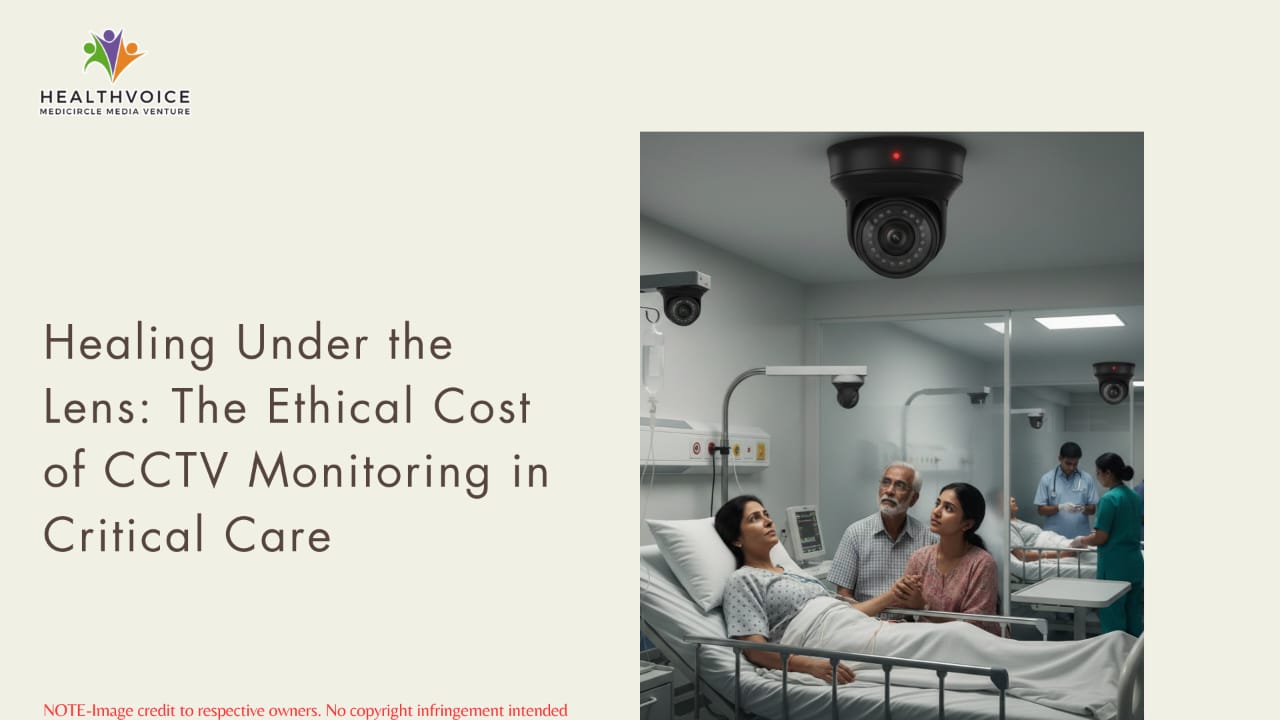
In India’s long and uneven journey towards universal health coverage, few schemes have carried as much promise and pressure as Ayushman Bharat Pradhan Mantri Jan Arogya Yojana. Conceived as a lifeline for the poorest families and senior citizens, the scheme was meant to remove fear from the act of falling ill. Cashless treatment, a generous coverage ceiling, and access to both public and private hospitals were its moral backbone. Yet, years into its implementation, the scheme now finds itself at the centre of a debate that goes far beyond insurance claims and reimbursement delays. It has opened an uncomfortable conversation about surveillance in hospitals, patient privacy, and the growing mistrust between the state and healthcare providers.
The controversy erupted when a senior official overseeing Ayushman Bharat implementation in Haryana issued a directive to nearly 1,300 empanelled hospitals, asking them to install cameras inside intensive care units and provide live footage of admitted patients. The instruction carried a sharp edge. Claims under the scheme, hospitals were told, would be processed based on the CCTV feed shared with the state agency. Non-compliance could invite penalties, claim rejection, suspension, or administrative action. For a sector already strained by rising costs, delayed payments, and regulatory fatigue, the order landed like a shock.
At first glance, the government’s intent appeared rooted in accountability. Ayushman Bharat operates on public funds, and the scale of the programme makes it vulnerable to misuse. Over the years, state agencies have flagged cases of false admissions, inflated procedure counts, and hospitals charging patients despite the promise of cashless care. Data placed before Parliament revealed that since the launch of the scheme, several lakh claims had been rejected on grounds of fraud, amounting to hundreds of crores of rupees. Hundreds of hospitals across the country have faced suspension for malpractice. From the government’s perspective, the argument is simple: when misuse exists, monitoring becomes necessary.
Yet, when that monitoring enters spaces like intensive care units, the simplicity vanishes. An ICU is not just another hospital ward. It is a place of vulnerability, where patients lie sedated, semi-conscious, or struggling to survive. It is a space where dignity matters as much as treatment, where privacy is woven into ethical medical care. Doctors and hospital administrators reacted swiftly, calling the directive intrusive and ethically troubling. Many refused to implement it, citing the sanctity of patient privacy and the impracticality of constant surveillance in critical care settings.
Professional bodies added weight to the protest. The state unit of the Indian Medical Association urged the Haryana authority to withdraw the order, arguing that cameras in ICUs would amount to a breach of trust between doctor and patient. They pointed out realities that policy documents rarely capture. Patients in ICUs require frequent sponging, catheter care, injections, and close physical monitoring. Their clothes are often partially removed as part of treatment. Recording such moments, even with the stated aim of verification, risks crossing a line that healthcare has traditionally guarded fiercely.
The pushback forced a revision. The Haryana authority softened its stance, clarifying that cameras would not be installed at bedsides or inside patient rooms. Instead, surveillance would be limited to corridors leading to ICUs, as well as entry and exit points of intensive care and high-dependency units. Patient identities, the revised note claimed, would not be revealed. The stated objective, officials said, was never to watch patients, but to prevent malpractices like false bookings and inflated claims. CCTV footage, they clarified, would serve as a supplementary tool during audits, claim verification, and fraud investigations.
This partial retreat, however, did little to settle the deeper unease. Hospitals argue that even corridor surveillance raises unanswered questions. ICUs treat a mix of patients, including those who are not beneficiaries of Ayushman Bharat and those paying out of pocket. If cameras capture movements related to all patients, how will consent be managed? Who owns the data? How securely will footage be stored, and who ensures it is not misused? Under the directive, the burden of data safety, camera maintenance, storage of footage for 30 days, and prevention of tampering rests entirely with hospitals. For smaller private facilities, this adds another layer of cost and compliance in a system where margins are already thin.
Behind the technicalities lies a larger conflict that has been simmering for years. Hospitals accuse state agencies of delaying payments, deducting amounts arbitrarily, and rejecting claims over minor documentation errors. Several states have witnessed prolonged protests by private hospitals demanding the clearance of pending dues under Ayushman Bharat. In Haryana alone, doctors associations have claimed that hundreds of crores remain unpaid, forcing hospitals to borrow, delay salaries, or reconsider their participation in the scheme. Government officials dispute some of these figures, but the frustration within the medical community is unmistakable.
From the state’s side, the story sounds different. Nodal officers tasked with monitoring the scheme speak of routine violations discovered during inspections. Patients charged despite being eligible for free treatment. Claims submitted for patients who were never admitted. Procedures billed at higher rates than permitted. Physical inspections, they argue, are limited by manpower and time. Constant on-ground monitoring is not feasible in a scheme of this scale. Surveillance tools, in their view, offer a deterrent effect, nudging hospitals towards compliance simply by their presence.
What emerges is a portrait of deep mistrust. The government appears to view hospitals as potential defaulters, while hospitals feel they are being treated as suspects rather than partners. Each new compliance requirement widens the gap. Daily uploads of test reports, frequent audits, documentation demands, and now surveillance measures have made many private players question whether participation in Ayushman Bharat remains viable. Doctors argue that the scheme, designed to expand access to care, is slowly becoming unworkable for those expected to deliver that care.
This tension raises uncomfortable questions about how India chooses to regulate healthcare. Transparency is essential, especially when public money is involved. Fraud must be checked, and patients must be protected from exploitation. At the same time, healthcare cannot be governed by suspicion alone. Excessive monitoring risks eroding professional autonomy and patient trust, two pillars without which medicine cannot function. Surveillance may catch wrongdoing, but it can also create a climate of fear, where compliance replaces compassion as the dominant force.
Patient privacy adds another layer of complexity. India’s healthcare system is still evolving its understanding of data protection. While discussions around digital health records and data governance continue at the policy level, ground realities remain uneven. CCTV footage from hospital premises, even if limited to corridors, is sensitive data. It captures moments of distress, vulnerability, and personal crisis. Without a robust legal framework clearly defining consent, access, retention, and accountability, such data risks misuse or leakage.
There is also a symbolic dimension to the debate. For many doctors, the idea of cameras linked to claim approvals feels like a reversal of trust. Instead of clinical judgment guiding care, administrative oversight appears to loom over every decision. Instead of audits triggered by red flags, blanket surveillance becomes the default. This shift, critics argue, reduces healthcare to a transaction monitored by lenses rather than a service anchored in ethics.
Yet, ignoring the problem of fraud is not an option either. The scale of Ayushman Bharat makes it both transformative and fragile. Leakages hurt the very beneficiaries the scheme aims to serve. Money lost to inflated claims is money unavailable for genuine patients. The challenge lies in designing oversight mechanisms that are precise rather than sweeping, intelligent rather than intrusive.
Some doctors have suggested alternatives. Strengthening surprise inspections. Improving audit algorithms that flag unusual billing patterns. Investing in better-trained vigilance teams. Creating faster, fairer grievance redressal systems for hospitals. Above all, ensuring timely payments to empanelled facilities, so financial stress does not become a trigger for corner-cutting. Trust, many argue, is built when both sides honour their commitments.
The CCTV episode in Haryana may eventually fade into administrative history, but the questions it raises will linger. How far should the state go in monitoring healthcare delivery? At what point does accountability slip into overreach? Can transparency be achieved without compromising dignity? These are not questions with easy answers, yet they demand careful thought as India expands publicly funded healthcare.
Ayushman Bharat remains a landmark programme, that has changed how millions approach illness and hospitalisation. Its future depends on more than claim ratios and fraud statistics. It rests on a delicate balance between vigilance and trust, regulation and respect. Surveillance may offer short-term reassurance, but long-term success will depend on rebuilding confidence between policymakers and providers. Without that, even the most ambitious health insurance scheme risks losing its moral core.
In the end, healthcare thrives on relationships. Between doctor and patient. Between hospital and state. Between policy intent and lived reality. When cameras enter the ICU debate, they force us to ask whether we are strengthening those relationships or quietly straining them. The answer will shape not just Ayushman Bharat’s trajectory, but the broader soul of India’s healthcare system.
 Sunny Parayan
#AyushmanBharat #PatientPrivacy #HealthcareEthics #CriticalCare #MedicalEthics #HealthcareGovernance #PublicHealth #RightToPrivacy #HealthPolicy #HealthcareReform #HospitalAccountability #IndianHealthcare #MedicalNews #HealthcareWorkers #healthvoice