Merit, Missteps, and Midnight Changes: A Cautionary Tale from MBBS Admissions
As India strives to build a robust, ethical, and competent healthcare system, the foundations laid in medical colleges matter immensely.
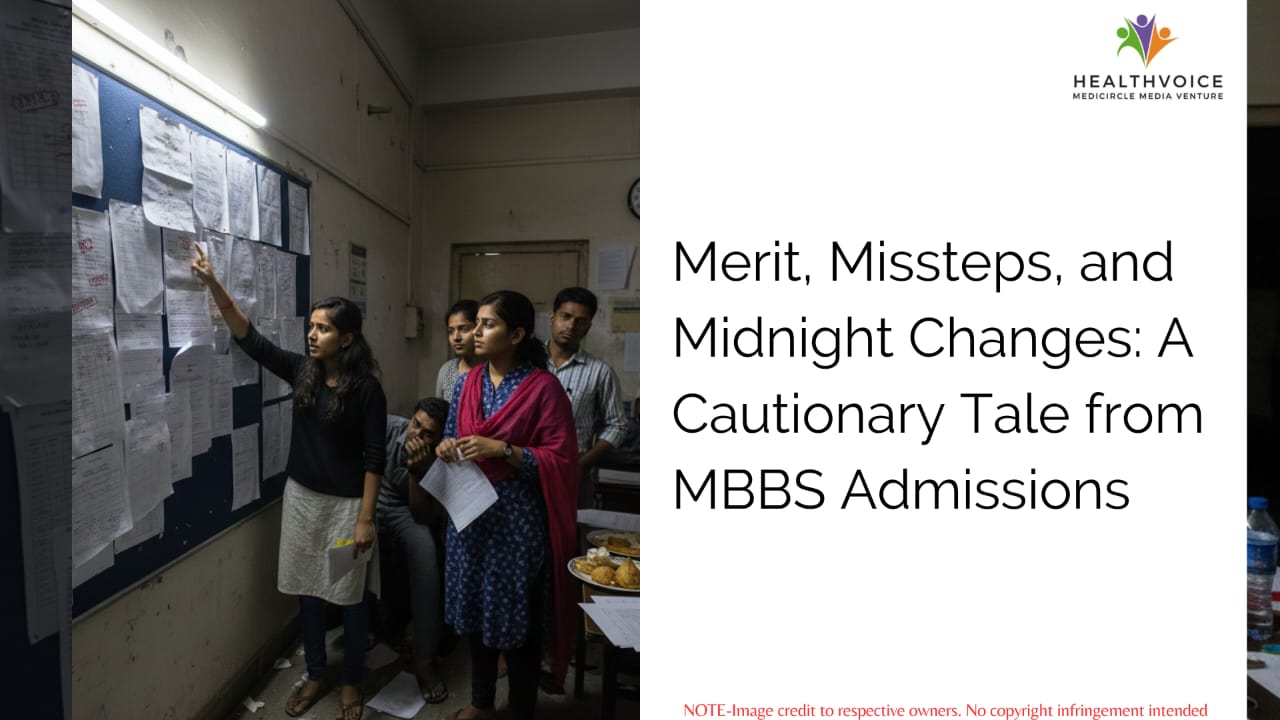
In a country where a single medical seat can change the destiny of an entire family, admission processes are expected to stand on the strongest pillars of fairness, transparency, and constitutional discipline. The recent judgment of the Supreme Court on sports quota admissions to MBBS and BDS courses in Punjab arrives as a sharp reminder that even well-intentioned policies can collapse when clarity gives way to convenience. At its core, the verdict is not merely about sports achievements or academic years. It is about trust in medical education governance and the fragile contract between aspirants and institutions.
The controversy stemmed from admissions under the one per cent sports quota for MBBS and BDS courses for the 2024 academic session in Punjab. As per the prospectus issued by Baba Farid University of Health Sciences in early August 2024, sports achievements were to be assessed strictly on the basis of performance during Classes XI and XII. Thousands of candidates planned their applications around this stated criterion, believing that the rulebook was fixed and the playing field level. However, on the final day of applications, an unexpected communication altered the course of the process. An evening email invited candidates to submit sports achievements from any class or year, followed by an addendum that expanded the zone of consideration to include Classes IX and X as well.
What appeared, at first glance, to be a minor administrative tweak soon revealed deeper fault lines. The revised evaluation pushed certain candidates higher up the merit list, displacing others who had relied on the original prospectus. For aspirants already navigating the emotional and financial strain of medical entrance processes, this sudden shift felt less like policy evolution and more like a breach of faith.
The matter eventually reached the apex court, where a Bench led by Justice Sanjay Kumar and Justice Alok Aradhe examined whether such a midstream change could survive constitutional scrutiny. The Court’s answer was unambiguous. Altering admission criteria after the process has begun, it held, violates the core principles of equality and non-arbitrariness enshrined in Article 14.
The judgment drew upon a well-settled doctrine familiar to every competitive arena: the rules of the game cannot be changed once the game has started. While this principle has often been applied to public employment and recruitment, the Court reaffirmed that it applies with equal force to medical admissions, where stakes are extraordinarily high and margins between success and failure razor thin. The Bench observed that elasticity in admission norms opens the door to discretion, and discretion, when unchecked, can quietly mutate into favouritism.
One of the most troubling aspects of the case was the origin of the policy shift itself. Court records revealed that the expansion of the sports achievement window was triggered by a representation from a sports coach, who failed to disclose that his own daughter stood to benefit directly from the change. This omission, the Court noted, was not a minor oversight but a material non-disclosure that tainted the very foundation of the decision-making process. In regulatory environments, especially those governing medical education, the appearance of conflict can be as corrosive as conflict itself.
The Bench also highlighted inconsistencies that further weakened the State’s defence. During the same academic session, other medical and allied health courses continued to assess sports achievements strictly within defined academic periods. Even postgraduate medical and dental admissions followed a clear, limited framework tied to the MBBS and BDS years. Against this backdrop, the sudden flexibility introduced only for undergraduate MBBS and BDS seats appeared arbitrary, lacking any rational explanation grounded in academic or policy logic.
Equally significant was the Court’s rejection of the State’s attempt to justify the 2024 change by citing a Covid-era exception from the previous year. While the zone of consideration had indeed been expanded in 2023, that decision was explicitly linked to pandemic-related disruptions. The Supreme Court made it clear that an exception carved out for extraordinary circumstances cannot be allowed to harden into a permanent norm without fresh reasoning. Policy continuity, the Court emphasised, must rest on reason, not habit.
This judgment resonates beyond the immediate facts. Medical education in India has long struggled with perceptions of opacity, whether in admissions, transfers, or faculty appointments. Each episode where rules appear malleable deepens scepticism and erodes confidence in the system. By striking down the mid-process modification, the Supreme Court reinforced a critical message: credibility in medical education is built through predictability and principled governance.
Importantly, the Court balanced legality with pragmatism while crafting relief. Rather than unsettling the entire admission process, it confined remedies to the appellants before it. The displaced candidates were directed to be accommodated in the seats originally occupied by those who benefited from the flawed policy, with corresponding adjustments to private college seats. Academic progress and fees already paid were protected, ensuring that students did not become collateral damage in a larger institutional correction.
The Court also took note that the same flawed approach continued into the 2025 admission cycle. However, recognising that admissions for that year had concluded and affected candidates were not before it, the Bench exercised restraint. It left the door open for future legal challenges while cautioning the State to frame clear, comprehensive policies in advance, insulated from ad-hoc representations.
Admissions to MBBS and BDS courses are not mere administrative exercises. They are gateways to the healthcare workforce, shaping who will eventually diagnose, treat, and care for patients. Any dilution of fairness at the entry point risks long-term consequences for the integrity of the profession.
The judgment also carries lessons for universities and regulatory bodies across India. Prospectuses are not casual documents; they are binding assurances to aspirants. When institutions depart from them without transparent processes and prior notice, they invite legal scrutiny and public distrust. In an era where medical education is expanding rapidly, with new colleges and seats added each year, governance frameworks must grow stronger, not looser.
For students, particularly those aspiring to medical careers, the verdict offers reassurance that constitutional courts remain vigilant guardians of merit. It affirms that even subtle manipulations of policy will be examined through the lens of equality and reasonableness. For policymakers, it is a reminder that good intentions cannot substitute for good process.
As India strives to build a robust, ethical, and competent healthcare system, the foundations laid in medical colleges matter immensely. Transparent admissions, consistent policies, and resistance to ad-hoc decision-making are not bureaucratic ideals; they are prerequisites for public trust. The Supreme Court’s intervention in the Punjab sports quota case is, therefore, more than a correction of one flawed admission cycle. It is a signal that in medical education, the rules must be written clearly, followed faithfully, and never rewritten after the race has begun.
In reaffirming that principle, the Court has reminded all stakeholders that merit cannot thrive where rules are unstable. For a profession that rests on precision, discipline, and ethical conduct, that reminder could not have come at a more crucial time
 Team Healthvoice
#MedicalAdmissions #MBBS #SupremeCourtOfIndia #MedicalEducation #EducationPolicy #HealthcareGovernance #StudentRights #MedicalColleges #NEET #FutureDoctors #PolicyMatters #PublicTrust #EducationJustice #HealthPolicy #healthvoice