Why real-world practice differs from textbooks
Medical textbooks provide essential scientific foundations, but true healing emerges in practice, where experience, empathy and context guide physicians in adapting knowledge to real human lives.
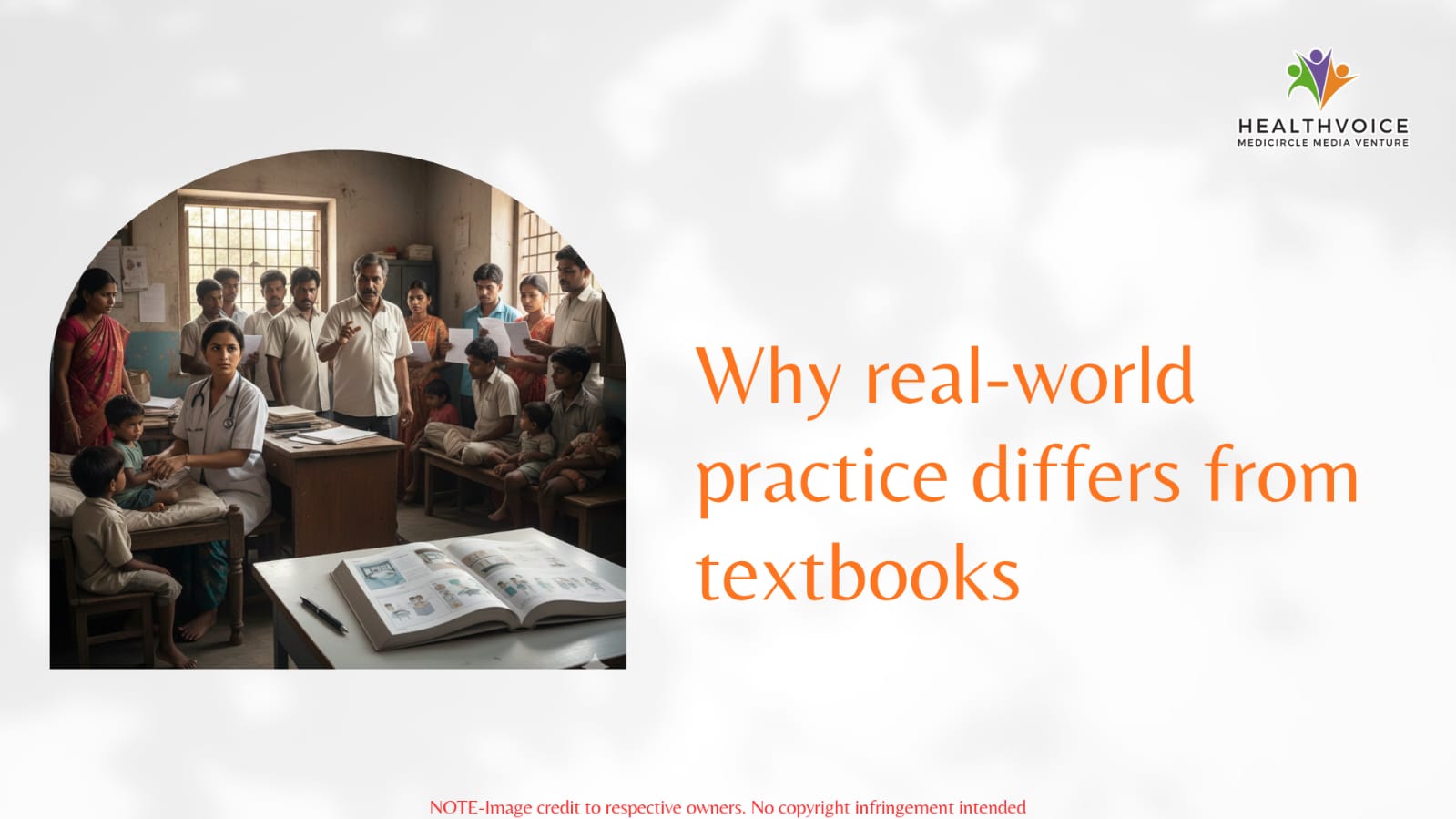
Every doctor’s story starts in a similar place, surrounded by thick, authoritative textbooks. Those pages hold everything we are first taught about the human body, disease and cure. They are the bedrock, the undeniable science of our profession. But talk to a physician after a long day in the clinic and you will hear a different narrative. It is a story not just of what the books say, but of what actually happened at the bedside. This difference is not an error. It is the natural and often profound, space where learned knowledge meets a living, breathing person.
Why does this gap exist? It is perhaps the most important lesson not found in any index.
The blueprint:
Consider those medical tomes as a master blueprint. They outline the ideal structure, the precise mechanics of a failing heart, the textbook presentation of pneumonia, the statistically proven dose of a life-saving drug. This blueprint is non-negotiable. It gives every healthcare professional a common language and a foundation built on decades of global research. It answers the critical questions of what we are treating and the scientific why behind our interventions.
Without this shared blueprint, medicine would have no common ground, no starting line from which to begin the complex race of healing. It is the essential theory, the science that must be known.
The construction site:
Now, take that perfect blueprint to a busy, unpredictable construction site. That site is the real world of medical practice. Here, the blueprint is vital, but it cannot account for the sudden afternoon rain, the unique quality of the materials on hand or the skilled worker’s instinct for solving an unforeseen problem.
This is where the blueprint must be interpreted, not just followed. Several very human factors shape this phase.
Patients are people, not profiles. Books describe the most common path of an illness. In reality, a doctor sees Mrs. Sharma, who has the symptoms but also a deep seated fear of scans, a tight budget and a family history that complicates the simple answer. Her treatment must be crafted for her life, not just her diagnosis.
The clock and the checklist also matter. A textbook chapter has no time limit. A real clinic has a waiting room full of anxiety and urgency. It operates with the equipment available, which in a remote area might be limited. The art lies in making the best, safest decision for now, with what you have.
There is also an unwritten chapter on trust. The most effective drug in the world is useless if the patient does not take it. Healing requires a connection that convinces a frightened person to follow a difficult path. This balance of empathy, clear communication and motivation is a skill learned through experience, not lecture notes.
As a seasoned surgeon once remarked, the textbook gives you the science of the disease, but the patient gives you the story of the illness. Listening to both is the real work.
Building the bridge:
So how does a young medical graduate become a healer? They build a bridge, brick by brick, through every patient they meet. This bridge is made of practical wisdom. It is the gut feeling that something is not right despite normal tests. It is the memory of a similar case from five years ago. It is continuous learning that moves beyond journals to include understanding new tools and technologies that simplify complex care.
In today’s world, this learning extends into the digital realm. For Indian doctors especially, staying connected to the latest advancements and reliable medical resources is key. Platforms that focus on authentic information and access to modern medical devices play a quiet but crucial role. They help translate the static knowledge of the page into dynamic solutions for the patient in front of you, ensuring that geography does not limit the quality of care one can provide.
The unchanging core:
Ultimately, the distance between the textbook and the treatment room is not a problem to solve. It is the very definition of medical practice. The science provides the indispensable what. The human context demands the compassionate how.
Excellent healthcare is not about choosing between the rigor of the book and the reality of the person. It is about holding both in mind at once. It is respecting the blueprint while having the courage to adapt its lessons for the individual standing before you. For every clinician, this is the lifelong pursuit, to marry knowledge with kindness, creating a healing that is both scientifically sound and deeply human. That is where the true art of medicine lives and it begins where the textbook’s final page ends.
 Team Healthvoice
#ArtOfMedicine #MedicalEducation #ClinicalPractice #DoctorLife #PatientCare #HealthcareProfessionals #MedicalCommunity #IndianHealthcare #ClinicalWisdom #FutureOfHealthcare #DoctorsOfIndia #healthvoice
