Space Medicine Begins in India: Why AIIMS and ISRO Want Doctors at the Center of Human Spaceflight
The partnership between AIIMS and ISRO marks the beginning of a journey where healthcare professionals contribute to the exploration of space while enriching medical knowledge on Earth.
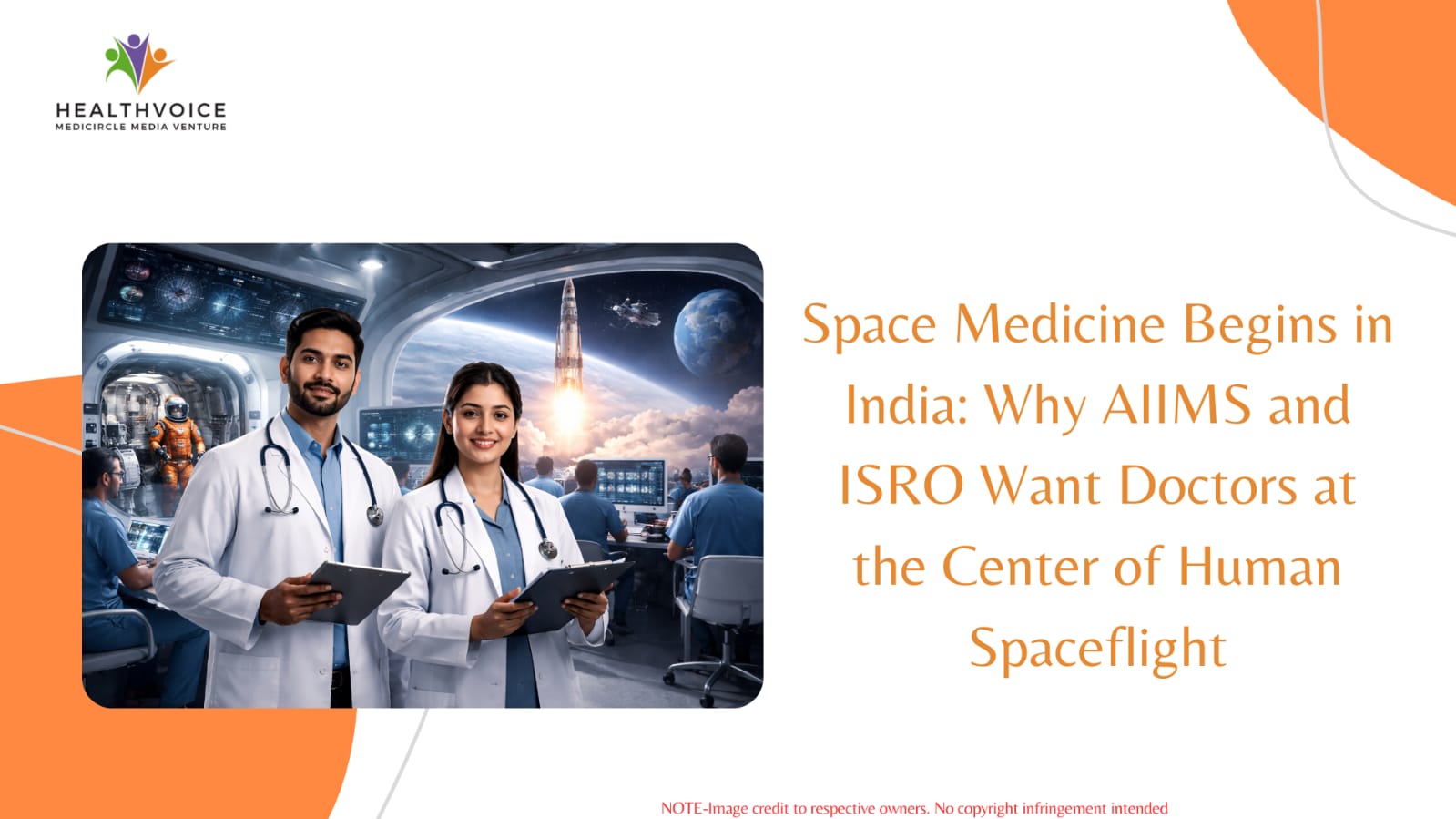
India’s healthcare community has long been accustomed to pushing the boundaries of medical science within hospitals, laboratories, and research institutes. Now a remarkable shift is silently unfolding that takes Indian medical research far beyond hospital corridors and deep into the realm of space exploration. In a development that signals a new era for both medicine and science, the All India Institute of Medical Sciences in New Delhi has entered into a strategic partnership with the Indian Space Research Organisation. The collaboration focuses on advancing research in the rapidly emerging discipline of space medicine, a field that explores how the human body adapts to the extreme conditions of outer space.
For many doctors and healthcare professionals, the phrase “space medicine” may still sound futuristic. Traditionally, the role of physicians has been defined by patient care within the gravity-bound environment of Earth. But as nations prepare for extended human missions into space, medical science is becoming central to the success of those journeys. Astronauts living in microgravity environments face profound physiological changes, and understanding these changes requires the combined expertise of clinicians, physiologists, biomedical scientists, and aerospace researchers.
The new partnership between AIIMS and ISRO represents a decisive step toward building that expertise within India. The agreement outlines cooperation in several research areas connected to the health of astronauts and the biological consequences of space travel. These include investigations into human physiology under microgravity, cardiovascular regulation, bone and muscle health, immune system behaviour, microbial ecosystems in space environments, genetic responses to spaceflight, and the psychological resilience required for long-duration missions.
For India’s medical community, the implications are far-reaching. The collaboration signals that doctors, physiologists, and biomedical researchers will play an increasingly visible role in shaping the country’s future in human spaceflight. As India moves toward sending astronauts on more ambitious missions, medical knowledge will be as important as rocket engineering or spacecraft design.
The partnership was formalised in New Delhi during a ceremony attended by senior scientists, faculty members, and representatives of the medical community. The event reflected the growing intersection between space technology and healthcare innovation. On one side stood a premier medical institute known for shaping generations of clinicians and medical researchers. On the other stood India’s national space agency, which has steadily evolved into one of the world’s most respected space research organisations.
The human body is the most complex system aboard any spacecraft. While spacecraft engineers focus on propulsion systems, navigation technologies, and mission logistics, physicians must address an entirely different challenge ensuring that astronauts remain healthy during and after their journey.
Spaceflight alters the human body in ways that are still not fully understood. The absence of gravity affects nearly every physiological system. Muscles begin to weaken because they no longer need to support body weight. Bones gradually lose density, increasing the risk of fractures. The cardiovascular system adjusts to new fluid distribution patterns. Even the immune system may behave differently in space.
For astronauts who spend weeks or months in orbit, these changes are more than academic concerns. They influence mission safety, performance, and long-term health. Studying these effects therefore becomes a priority for any nation planning human space missions.
India’s ambitions in human spaceflight are steadily expanding. Over the past decade, the country’s space programme has demonstrated remarkable technological progress. Satellite launches, lunar missions, and interplanetary exploration have all placed India among the world’s leading spacefaring nations. The next chapter involves sending Indian astronauts into space under indigenous programmes, an endeavour that demands advanced medical research.
This is where institutions like AIIMS become invaluable. With decades of expertise in physiology, cardiology, neuroscience, and biomedical research, the institute provides a strong scientific foundation for studying how the human body responds to extreme environments.
Researchers involved in the collaboration will examine several critical aspects of astronaut health. One major area involves cardiovascular adaptation. In space, body fluids shift towards the upper body due to the absence of gravity. This can influence heart function and blood pressure regulation. Understanding these changes helps scientists design countermeasures that protect astronauts during missions.
Another area of interest is musculoskeletal health. Without gravitational loading, bones gradually lose calcium and strength. Muscles also experience atrophy due to reduced use. These changes can compromise an astronaut’s ability to function effectively during missions and after returning to Earth. Research into exercise protocols, nutritional strategies, and pharmaceutical interventions may help mitigate these risks.
The human microbiome is another frontier being explored. The microbial communities that inhabit the human body play a crucial role in digestion, immunity, and overall health. Space environments may alter these microbial populations in unpredictable ways. Studying these changes could provide insights into maintaining astronaut health during prolonged missions.
Genomic research will also play a role in understanding how human cells respond to the stresses of space travel. Scientists hope to identify biological markers that signal early signs of physiological stress, allowing interventions before health problems develop.
Beyond physical health, psychological resilience is equally important. Astronauts must operate in confined environments for extended periods, often separated from Earth by vast distances. Behavioural health research helps scientists understand how isolation, altered sleep cycles, and demanding mission schedules influence mental wellbeing.
While these investigations are designed to support space missions, their benefits are likely to extend far beyond astronaut health. Many discoveries in space medicine eventually influence healthcare practices on Earth. Technologies and treatments developed for astronauts often find applications in hospitals and clinics.
For example, research into bone density loss in astronauts has contributed to better understanding of osteoporosis in aging populations. Studies of cardiovascular adaptation in microgravity can provide insights into blood pressure regulation and heart disease. Even advances in telemedicine, originally designed to monitor astronauts remotely, now help deliver healthcare to patients in remote regions.
This means that the collaboration between AIIMS and ISRO may produce knowledge that benefits millions of patients on Earth.
India’s entry into the field of space medicine also carries symbolic significance. For decades, the discipline has been dominated by space agencies in the United States, Russia, and Europe. By investing in research capacity and interdisciplinary collaboration, India is positioning itself as a serious contributor to the global knowledge base in this specialised field.
The partnership also highlights the importance of collaboration between different branches of science. Medical research has traditionally operated within hospitals and biomedical laboratories, while space research has focused on engineering and physics. Space medicine brings these worlds together.
Doctors must now engage with aerospace engineers, mission planners, and space scientists to develop integrated solutions for astronaut health. This multidisciplinary approach encourages new ways of thinking about both medicine and technology.
For young doctors and medical researchers in India, the emergence of space medicine opens new career possibilities. Traditionally, medical graduates have pursued careers in clinical practice or conventional biomedical research. The expanding space programme introduces an entirely new avenue where physicians contribute to astronaut training, mission planning, and biomedical experimentation in space environments.
This may inspire a new generation of physician-scientists who bridge the gap between clinical medicine and aerospace science.
The journey that brought India to this moment has been remarkable. In the early years of the national space programme, resources were limited and infrastructure was modest. Stories from those pioneering days describe equipment transported in unconventional ways and experiments conducted under challenging conditions. Yet over time, sustained investment in science and engineering transformed the programme into a global leader in space technology.
Today, India launches satellites for multiple countries, conducts ambitious planetary missions, and develops cutting-edge space technology. The integration of medical science into this ecosystem represents the next stage of progress.
However, the path ahead will not be without challenges. Space medicine requires sophisticated laboratories, specialised training programmes, and sustained funding. Researchers must design experiments that simulate microgravity conditions on Earth while also preparing for eventual studies aboard spacecraft.
Another challenge involves building a skilled workforce capable of operating at the intersection of medicine and aerospace science. Physicians involved in this field must understand physiology, engineering constraints, mission logistics, and even spaceflight operations.
Despite these challenges, the potential rewards are immense. India’s investment in space medicine could transform the country into a global hub for research in human spaceflight health. It may also contribute to international collaborations with other space agencies and research institutions.
The benefits could reflect through multiple areas of medicine. Innovations in biomedical monitoring, wearable health technologies, remote diagnostics, and preventive healthcare may all emerge from research designed for astronauts.
The broader public may wonder why space medicine deserves such attention when healthcare challenges on Earth remain significant. The answer lies in the history of scientific progress. Many technologies that are now part of everyday healthcare originated in research conducted for space missions.
Medical imaging techniques, advanced monitoring devices, and certain rehabilitation technologies owe their development to the demands of space exploration. Investing in space medicine therefore serves a dual purpose of advancing national space ambitions while strengthening medical innovation.
For India, the collaboration between AIIMS and ISRO represents a vision of science that transcends traditional boundaries. It suggests that the future of healthcare may extend beyond hospitals and research centres to include laboratories orbiting hundreds of kilometres above Earth.
As the world enters an era where human presence in space may become more frequent, the role of doctors will expand in ways previously unimaginable. Physicians may help design medical protocols for astronauts travelling to the Moon or Mars. They may study how human biology adapts to new planetary environments. They may develop treatments for conditions that arise in extreme environments far from Earth.
For the Indian medical community, this moment offers an opportunity to participate in one of the most exciting chapters of modern science. The partnership between AIIMS and ISRO marks the beginning of a journey where healthcare professionals contribute to the exploration of space while enriching medical knowledge on Earth.
In the decades ahead, when historians look back at the evolution of India’s space programme, they may recognise this collaboration as a pivotal step. It represents the moment when medicine joined rockets, satellites, and spacecraft as a central pillar of India’s space ambitions.
 Team Healthvoice
#AIIMS #ISRO #IndianSpaceResearch #HealthcareInnovation #MedicalResearch #SpaceHealth #HumanSpaceflight #FutureOfMedicine #BiomedicalResearch #SpaceScience #IndianHealthcare #MedicalInnovation #healthvoice