The Jan Aushadhi Expansion Debate: Access to Medicines vs Patient Safety
When the lines between convenience and caution begin to blur, it becomes essential to pause and ask whether the system is moving forward wisely or simply moving faster.
In the complex ecosystem of healthcare, few things are as sensitive as the journey of a medicine from manufacturer to patient. A small tablet may look harmless, but behind that simple pill lies a tightly regulated system designed to ensure safety, quality, and responsible use. Every prescription, every pharmacy shelf, and every licensed pharmacist is part of a structure meant to protect public health. When this structure is altered, even with good intentions, the consequences can reflect across the healthcare system in unexpected ways.
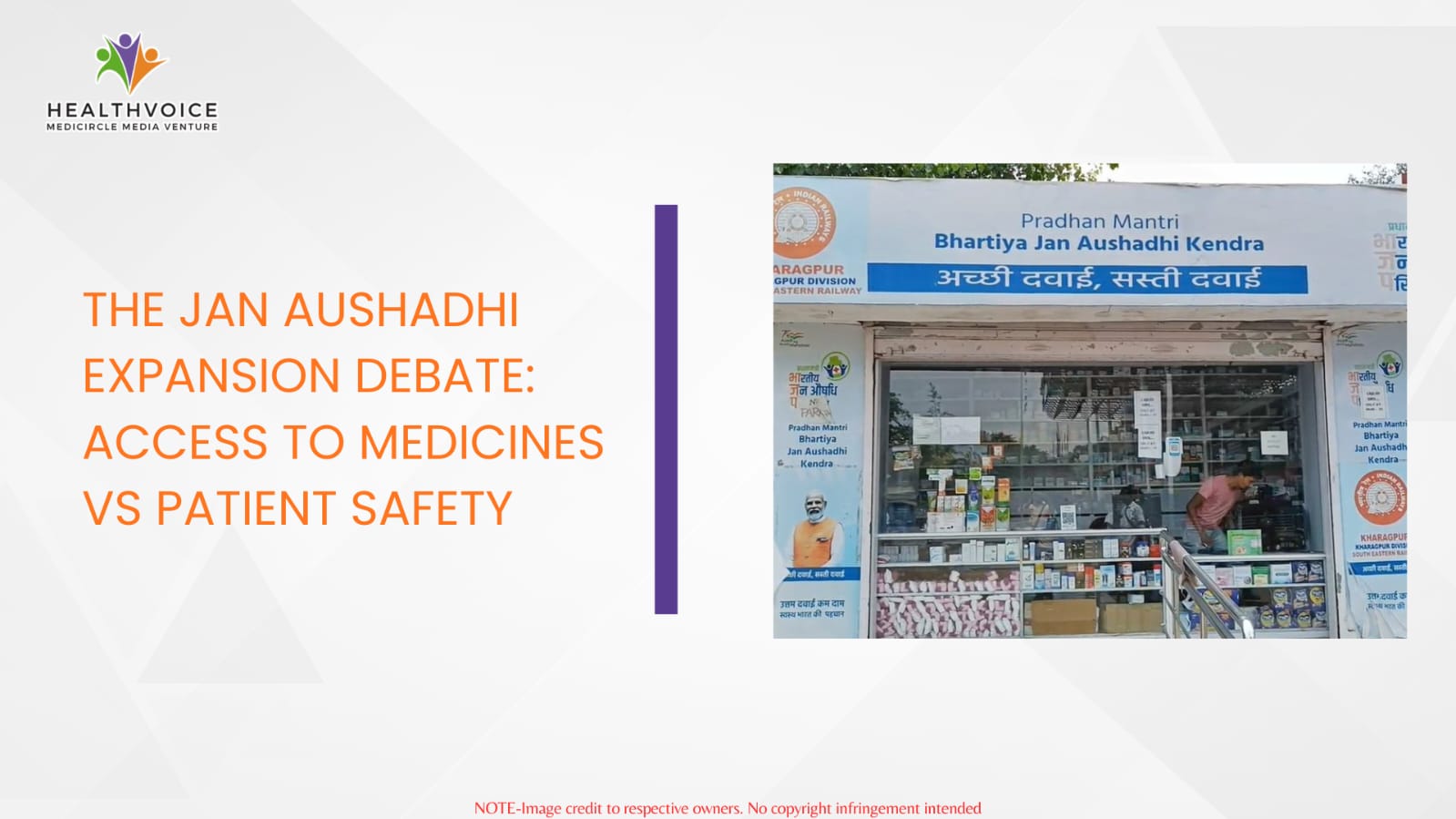
A recent proposal being discussed at the policy level has sparked exactly such a debate. The suggestion involves granting restricted drug licences to Primary Agricultural Credit Societies, commonly known as PACS, enabling them to operate outlets under the Pradhan Mantri Bhartiya Janaushadhi Pariyojana scheme. The idea, on the surface, appears aligned with a broader national goal: making affordable medicines accessible to more citizens, particularly in rural and underserved areas. Yet the proposal has drawn strong opposition from the All India Organisation of Chemists and Druggists, one of the country’s largest pharmacy trade bodies, which argues that such a move could weaken safeguards that have long governed the sale and dispensing of medicines in India.
The issue has quickly evolved from a routine administrative suggestion into a deeper question about how medicines should be handled in a country with more than 1.4 billion people and a healthcare system that is already under significant strain.
At the centre of the controversy is a communication from the Ministry of Cooperation requesting the Ministry of Health and Family Welfare to explore whether Primary Agricultural Credit Societies could be granted restricted licences under the Drugs and Cosmetics Act, 1940. These licences, governed by provisions within the Drugs and Cosmetics Rules, allow the sale of certain medicines under specific conditions without the continuous supervision of a qualified pharmacist.
Supporters of the idea see it as a practical extension of India’s expanding cooperative network. PACS institutions have long played a vital role in rural credit and agricultural support. They operate in thousands of villages, often acting as the closest financial and supply centres for farmers. By allowing these institutions to host Jan Aushadhi Kendras, the government could theoretically expand the reach of affordable generic medicines into areas where pharmacy infrastructure may still be limited.
But critics warn that medicines cannot be treated like any other commodity that can be distributed through existing retail networks. Unlike seeds, fertilizers, or agricultural tools, medicines carry significant risks when handled incorrectly. The act of dispensing a drug is not merely a commercial transaction; it is a professional responsibility that involves knowledge of dosage, interactions, contraindications, and patient safety.
This is precisely where the opposition from the pharmacy community has become vocal. Leaders of the All India Organisation of Chemists and Druggists argue that the proposal could undermine the foundational principle that medicines should be dispensed under professional supervision. In their view, loosening this requirement may appear administratively convenient, yet it risks turning drug distribution into an uncontrolled experiment with public health.
Their concern is rooted in the historical intent of the regulatory provisions being discussed. The rules that allow restricted licences were originally designed for exceptional circumstances, not for widespread application across large institutional networks. The idea was to address rare situations where access to medicines was severely limited and alternative systems were temporarily necessary.
Expanding this provision on a larger scale, critics argue, could gradually dilute the professional safeguards that pharmacy regulations were built upon.
To understand why the issue has triggered such intense debate, it is important to consider how pharmacy regulation works in India. The Drugs and Cosmetics Act, one of the country’s most important health laws, was created to ensure that medicines available to patients meet strict standards of quality, storage, and dispensing. Pharmacies are required to operate under the supervision of trained and registered pharmacists who understand the complexities of pharmaceutical products.
Pharmacists do far more than simply hand over medicines. They verify prescriptions, identify possible drug interactions, advise patients on correct dosage, and help prevent misuse of medications. In many cases, particularly in rural settings, pharmacists become the first point of healthcare guidance for patients who may not have immediate access to doctors.
Removing or weakening this layer of professional oversight raises several questions. How will patients receive proper guidance on medicines if trained pharmacists are absent? Who will ensure that drugs are stored correctly to maintain their efficacy? And perhaps most importantly, who will be accountable when something goes wrong?
One of the concerns highlighted by pharmacy associations relates to the physical environment where medicines would be stored. Primary Agricultural Credit Societies traditionally handle agricultural inputs such as fertilizers, pesticides, and agro-chemicals. These substances require their own storage conditions and safety precautions. Mixing pharmaceutical products in such environments could raise the risk of contamination or improper handling.
Even subtle storage issues can affect the stability of medicines. Temperature, humidity, and exposure to chemicals all influence drug quality. A medicine that loses potency due to poor storage may appear normal to the naked eye but fail to deliver the intended therapeutic effect when consumed by patients.
Beyond storage and supervision, the proposal also intersects with one of the most serious healthcare challenges of the 21st century: antimicrobial resistance. India already faces significant concerns regarding the misuse of antibiotics, with many experts warning that unregulated access to these medicines accelerates the development of drug-resistant bacteria.
Antibiotics are powerful tools when used correctly, still dangerous when taken unnecessarily or in incorrect doses. Pharmacists play a critical role in ensuring that such medications are dispensed responsibly. Without professional oversight, there is a risk that antibiotics could be sold casually, increasing the likelihood of misuse.
The rise of antimicrobial resistance is not an abstract global concern. It has real consequences for everyday medical practice. Infections that were once easily treatable are becoming harder to manage. Routine surgeries and common treatments may carry greater risk if antibiotics lose their effectiveness. Expanding access to medicines must therefore be balanced carefully with mechanisms that prevent misuse.
Those opposing the proposal also question whether the underlying problem it seeks to address truly exists at the scale assumed. India already has a vast network of licensed pharmacies and trained pharmacists spread across urban and rural regions. While some remote areas still face gaps in access, the pharmacy sector has grown significantly over the past two decades.
Many experts believe that strengthening existing pharmacy infrastructure might be a safer approach than creating parallel channels for drug distribution. Investing in rural pharmacy services, encouraging trained pharmacists to work in underserved regions, and improving monitoring of medicine supply chains could potentially achieve the goal of accessibility without compromising safety.
The debate also touches on an important regulatory principle: once a rule is relaxed, it becomes difficult to restore its original strength. Policy decisions in healthcare often create precedents that shape future governance. Allowing non-traditional entities to dispense medicines today could open the door to similar demands from other sectors tomorrow.
Regulatory dilution rarely occurs through a single dramatic change. Instead, it happens gradually through small policy adjustments that accumulate over time. By the time the consequences become visible, reversing course may be far more complicated.
Yet it would be simplistic to view the issue solely through the lens of opposition. The government’s interest in expanding Jan Aushadhi Kendras reflects a genuine and urgent priority: making affordable medicines accessible to millions of Indians. The Jan Aushadhi scheme has already played a significant role in reducing the cost burden of healthcare for many patients by promoting quality generic medicines at lower prices.
In a country where out-of-pocket healthcare expenditure remains high, such initiatives are essential. The challenge lies in expanding these benefits without weakening the systems that safeguard drug quality and responsible dispensing.
Some healthcare policy analysts suggest that the current debate should be seen as an opportunity for broader reform. Instead of focusing only on whether PACS should receive restricted licences, policymakers could explore more comprehensive solutions to improve medicine access in rural India.
One possibility is integrating trained pharmacists directly into cooperative networks rather than allowing medicine distribution without professional supervision. Another approach could involve strengthening digital prescription monitoring, tele-pharmacy services, and mobile pharmacy units that maintain regulatory compliance while reaching remote populations.
Such innovations could achieve the twin goals of accessibility and safety, ensuring that rural communities receive medicines responsibly while maintaining the integrity of pharmaceutical regulation.
The controversy has also highlighted the importance of dialogue between policymakers and healthcare professionals. Pharmacy associations, medical practitioners, public health experts, and regulatory authorities all bring valuable perspectives to the table. Decisions affecting medicine distribution should ideally emerge from collaborative discussions rather than isolated administrative proposals.
At its core, the debate raises a fundamental question about the philosophy of healthcare governance: should accessibility and regulation be seen as competing priorities, or can they be balanced through thoughtful policy design?
The answer may determine the future shape of India’s pharmaceutical ecosystem.
For patients, the issue might seem distant from everyday life. Most people simply expect that the medicines they receive are safe, effective, and dispensed responsibly. They trust that the healthcare system has safeguards in place to protect them from harm.
Maintaining that trust requires constant vigilance. Regulations that appear technical or bureaucratic often exist because past experiences revealed the dangers of unregulated medicine distribution.
The current debate over restricted drug licences for cooperative societies is therefore about much more than a policy proposal. It reflects the broader tension between rapid expansion of healthcare services and the careful regulatory frameworks needed to sustain them.
Ultimately, the real measure of success for any healthcare policy lies in its impact on patient safety and public trust. Medicines are among the most powerful tools in modern medicine. They cure infections, control chronic diseases, relieve pain, and save lives every day.
But that power comes with responsibility.
If India hopes to build a healthcare system that is both accessible and safe, the pathways through which medicines reach patients must remain guided by expertise, accountability, and careful regulation. When the lines between convenience and caution begin to blur, it becomes essential to pause and ask whether the system is moving forward wisely or simply moving faster.
Because in healthcare, the difference between those two directions can shape the health of an entire nation.
 Team Healthvoice
#PharmacyIndia #JanAushadhi #MedicinesForAll #DrugSafety #HealthcareInIndia #PharmaceuticalRegulations #PatientSafety #AccessToMedicines #HealthcarePolicy #RuralHealthcare #PharmacyProfessionals #DrugDistribution #GenericMedicines #PublicHealthIndia #healthvoice