When Medical Education Opens Its Doors to Business, the Nation Must Decide What It Wants from Its Doctors
Opening medical education to for-profit participation could democratise access to training and modernise infrastructure but it could also commercialise a profession that relies on trust more than any other.
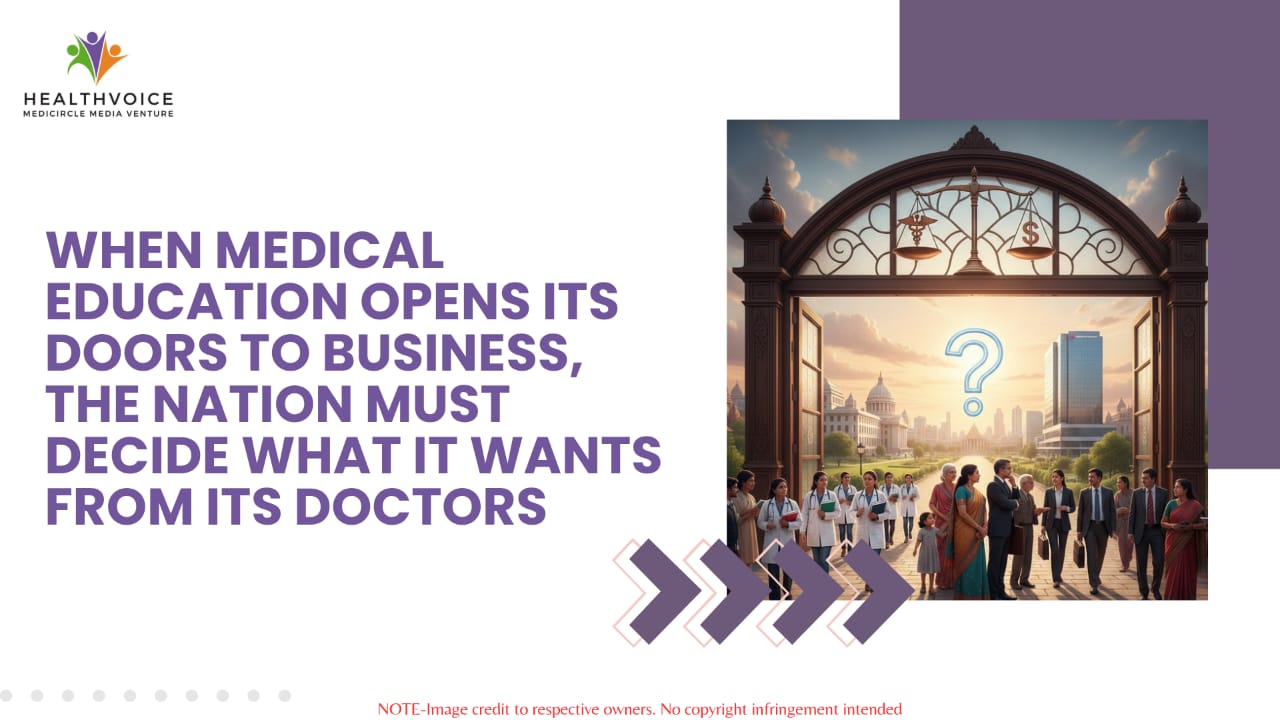
Medical education in India has always walked a tightrope between public service and private ambition. Colleges were expected to produce doctors with skill, empathy, and ethical grounding, while regulators struggled to balance quality, affordability, and access. A recent decision is trying to alter this balance. By removing the restriction that allowed only non-profit entities to set up medical colleges, the country’s medical education framework has entered a new phase that invites both optimism and unease. For the first time, for-profit companies are formally welcomed into the space of training India’s future doctors, including through Public Private Partnership models. This is a philosophical shift with long-term consequences for healthcare delivery, medical training standards, and patient trust.
Until now, the argument for limiting medical colleges to non-profit entities rested on a simple belief. Medical education should be driven by service, not shareholder pressure. While reality often fell short of this ideal, the legal framework at least tried to preserve the moral high ground. That framework has now been dismantled. The reasoning is pragmatic. India needs more doctors, better infrastructure, modern laboratories, advanced teaching hospitals, and wider geographic spread of medical colleges. Public funding alone cannot meet this demand. Private capital, if brought in under state oversight, could unlock dormant capacity and accelerate growth. In theory, this approach could solve several persistent problems in one stroke.
Medical education in India remains unevenly distributed. Urban centres attract investment, faculty, and technology, while large parts of the country continue to face acute doctor shortages. Opening the door to for-profit players may encourage investments in underserved regions, especially if states structure PPP models carefully. Supporters of the move argue that when private efficiency meets public oversight, outcomes improve. Hospitals under PPP arrangements, they point out, already provide free or subsidised treatment in several states while remaining financially viable. Extending this model to medical colleges could expand training capacity without diluting access to affordable patient care.
There is also a compelling case around resource utilisation. Many government hospitals have patient loads but lack teaching infrastructure. Some private hospitals boast world-class facilities but remain outside formal medical education. A partnership between the two could convert service hospitals into teaching hospitals, allowing students exposure to real-world clinical volumes while patients benefit from supervised care. This makes sense. Idle resources are wasteful in a country where demand for healthcare far exceeds supply.
Yet, medicine is not manufacturing, and doctors are not assembly-line products. Introducing profit motives into undergraduate and postgraduate medical education raises uncomfortable questions.
Will fee structures remain within reach of middle-class families? Will merit-based admissions withstand commercial pressure? Will clinical training be shaped by patient welfare or revenue targets?
These concerns are not theoretical. India’s past experience with private medical colleges has been mixed, at times deeply troubling. High fees, opaque admissions, faculty shortages, and compromised training standards have repeatedly drawn judicial and public scrutiny.
The reassurance offered by regulators lies in accreditation frameworks and standard operating procedures. Quality, it is said, will be ensured through strict norms, inspections, and outcome-based assessments. On paper, this sounds adequate. In practice, regulatory capacity has often lagged behind ambition. Accrediting hundreds of institutions, monitoring faculty ratios, patient loads, research output, and ethical practices requires manpower, expertise, and political independence. Without these, even the best frameworks risk becoming box-ticking exercises.
What gives this reform a broader dimension is its timing. Medical education itself is undergoing a conceptual transformation. Clinical research is no longer seen as an optional academic pursuit reserved for a few interested faculty members. It is being positioned as a core component of medical training, embedded into undergraduate and postgraduate curriculum. This shift recognises an uncomfortable truth. India produces a large number of doctors, but contributes relatively little to original clinical research that shapes global practice. Changing this requires early exposure, structured mentorship, and institutional support.
The plan to integrate clinical research deeply into medical education, with formal assessment and training, signals intent. The proposed collaboration involving bodies such as Indian Council of Medical Research, Indian Institute of Science, and leading Indian Institutes of Technology reflects an understanding that modern medicine sits at the intersection of biology, data science, engineering, and ethics. Artificial intelligence, digital health platforms, predictive analytics, and precision medicine are no longer futuristic concepts. They are reshaping diagnosis, treatment, and patient engagement in real time.
Here, the entry of for-profit players could be either a catalyst or a complication. On the positive side, private capital can fund advanced research infrastructure, simulation labs, digital platforms, and AI-driven learning tools that many government institutions struggle to afford. Industry-linked institutions could foster innovation, translational research, and collaboration with technology firms. Students trained in such environments may be better prepared for the realities of modern healthcare.
On the other hand, research driven by commercial interests risks prioritising marketable outcomes over public health needs. Diseases that affect millions but offer limited commercial returns could remain under-researched. Ethical oversight becomes critical when corporate funding intersects with clinical trials, patient data, and emerging technologies. Medical education must prepare doctors to question evidence, not just consume it, and to place patient welfare above institutional or financial interests.
The ecosystem that trains future colleagues is changing. Teaching hospitals may look different, curriculum may evolve faster, and assessment methods may increasingly value research output and technological literacy. This could elevate standards if implemented thoughtfully. It could also widen gaps between institutions that attract investment and those that do not.
Patients, often absent from policy debates, are central to this story. If PPP medical colleges function as intended, patients could benefit from expanded access to care, subsidised services, and better-equipped hospitals. Students learn best when exposed to diverse, real-world cases, and patients benefit from attentive, supervised care. However, vigilance is essential to ensure that patients do not become mere teaching material in profit-driven settings. Consent, dignity, and safety must remain non-negotiable.
The language of reform often emphasises numbers. More seats, more colleges, more doctors. Quantity matters in a country with low doctor-to-population ratios. Yet, quality defines outcomes. A poorly trained doctor is not just ineffective but dangerous. The challenge lies in ensuring that expansion does not dilute competence. This is where regulatory courage will be tested. Shutting down non-compliant institutions, penalising violations, and resisting political or commercial pressure require resolve.
There is also the question of affordability for students. Medical education is already one of the most expensive professional pathways in India. Allowing for-profit entities into the sector raises fears of escalating fees, increased student debt, and a workforce driven toward high-paying specialities at the expense of primary care. Policy safeguards around fee regulation, scholarships, and service obligations could mitigate this, but only if enforced consistently.
Internationally, models vary. Some countries successfully combine private medical education with strong public oversight, producing competent, ethical doctors. Others struggle with inequity and uneven standards. India’s scale and diversity make simple comparisons difficult. What is clear is that regulation cannot be reactive. It must anticipate risks and adapt continuously.
The emphasis on integrating research, AI, and digital health into curriculum is a welcome evolution. Medicine today demands lifelong learning, data literacy, and interdisciplinary thinking. Training doctors to engage with research early could improve clinical decision-making and foster innovation tailored to Indian realities. For-profit institutions, if aligned with national health priorities, could contribute meaningfully to this vision.
Ultimately, this reform forces a larger societal question. What does India expect from its doctors? Are they skilled service providers operating within a market-driven system, or custodians of a social contract rooted in trust and care? The answer is likely somewhere in between. Markets can drive efficiency and innovation, but medicine cannot surrender its ethical core.
This moment marks a juncture. Opening medical education to for-profit participation could democratise access to training and modernise infrastructure. It could also commercialise a profession that relies on trust more than any other. The difference will lie in governance, transparency, and collective vigilance. If regulation remains firm, research remains ethical, and patient care remains central, this shift could strengthen India’s healthcare future. If not, the cost will be paid over years, in compromised training and eroded trust. Medicine has always evolved with society. The question is whether it can evolve with the market without losing its soul.
 Sunny Parayan
#MedicalEducation #IndianHealthcare #FutureOfMedicine #MedicalPolicy #DoctorTraining #MedicalEthics #HealthPolicy #MedicalColleges #HealthcareInnovation #ClinicalResearch #AIinHealthcare #MedicalStudents #HealthcareInfrastructure #TrustInMedicine #HealthSystems #HealthcareFuture #healthvoice
