AI in Cardiology: Risk Prediction to Remote Monitoring
Artificial intelligence is transforming cardiology in India through risk prediction, ECG analysis, cardiac imaging, remote monitoring, and clinical decision support, offering scalable solutions to the country's growing cardiovascular disease burden.
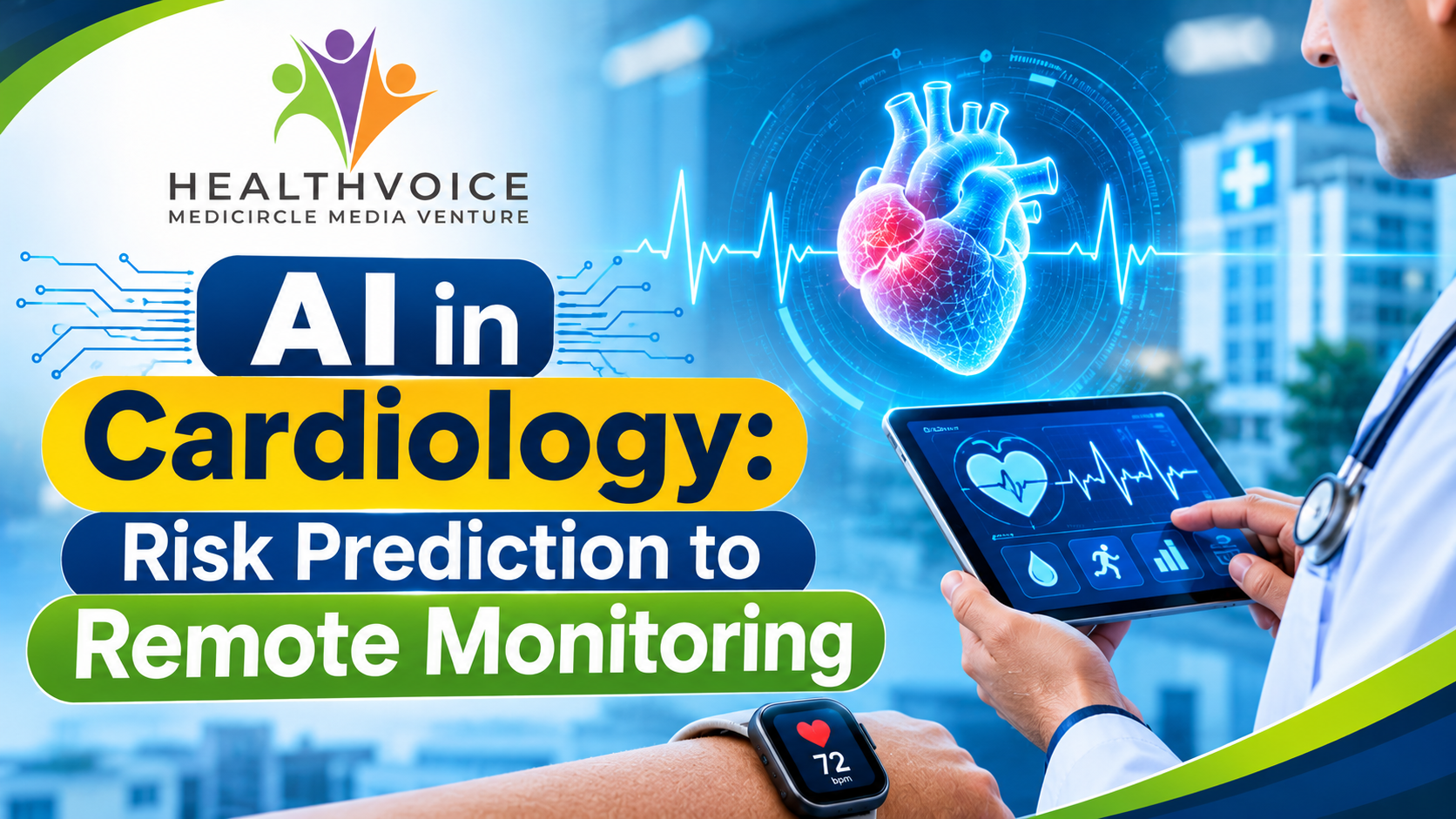
AI in Cardiology: From Risk Prediction to Remote Monitoring
Introduction
Cardiovascular disease remains the single largest cause of death in India. According to the Indian Council of Medical Research, heart disease accounts for nearly one in four deaths in the country, with the burden falling disproportionately on working-age adults. At the same time, India faces a severe shortage of cardiologists, particularly in Tier 2 and Tier 3 cities where specialist access is limited or virtually absent.
Artificial intelligence is not a futuristic promise in this context. It is an active, evolving clinical tool that is already reshaping how cardiologists predict risk, interpret data, monitor patients remotely, and make time-sensitive decisions. For a healthcare ecosystem as complex and resource-constrained as India's, the intersection of AI and cardiology holds genuine, practical relevance. HealthVoice, as a platform dedicated to advancing credible medical dialogue, considers it important to bring this conversation to the doctors and healthcare communities at the centre of this transformation.
Understanding AI and Its Role in Modern Cardiology
Artificial intelligence in medicine broadly refers to systems that use algorithms, machine learning, and deep learning to analyse large volumes of clinical data, identify patterns, and generate clinically useful outputs. In cardiology specifically, the data inputs are rich and varied: electrocardiograms, echocardiograms, cardiac MRI scans, patient health records, wearable device data, genomic information, and population-level epidemiological data.
The appeal of AI in cardiology stems from two core strengths. First, the human heart generates enormous volumes of electrical, structural, and functional data that exceed the processing capacity of any individual clinician. Second, many cardiovascular events, including heart attacks and sudden cardiac death, are preceded by subtle signals that standard clinical workflows may miss. AI systems, trained on millions of data points, are increasingly capable of detecting these signals earlier and more consistently than conventional diagnostic approaches.
It is important to understand that AI in cardiology does not replace the cardiologist. It augments clinical decision-making by handling pattern recognition at scale, freeing physicians to focus on the nuanced, humanistic dimensions of patient care that algorithms cannot replicate.
AI-Powered Cardiovascular Risk Prediction
One of the most consequential applications of AI in cardiology is the ability to predict cardiovascular risk years before a clinical event occurs. Traditional risk scoring tools, such as the Framingham Risk Score or the Pooled Cohort Equations, rely on a limited set of variables including age, blood pressure, cholesterol, and smoking status. While these tools are useful, they were designed for Western populations and may not accurately reflect the cardiovascular risk profile of Indian patients, who tend to develop coronary artery disease a decade earlier than their Western counterparts.
AI models trained on Indian patient data, including data from registries such as the CREATE registry and cohorts from institutions like AIIMS and Narayana Health, are beginning to generate risk scores that account for Indian-specific variables. These include:
- Elevated lipoprotein(a) levels, which are more prevalent among South Asians
- Insulin resistance and metabolic syndrome patterns common in urban Indian adults
- Dietary patterns, physical inactivity, and psychosocial stress factors specific to Indian working populations
- Family history profiles that differ meaningfully from Western cohort data
Platforms integrating AI with electronic health records can now flag high-risk individuals during routine consultations, prompting earlier investigation and preventive intervention. For primary care physicians working in high-volume settings across Indian cities, this kind of automated risk stratification has the potential to significantly change outcomes.
AI in Cardiac Imaging and Diagnostic Interpretation
Echocardiography, cardiac CT, and cardiac MRI generate complex visual datasets that require significant expertise to interpret accurately and consistently. AI-assisted imaging analysis tools are now capable of automated left ventricular segmentation, ejection fraction measurement, wall motion abnormality detection, and structural defect identification with accuracy that rivals experienced echocardiographers in several validated studies.
For Indian hospitals managing large patient volumes with limited specialist availability, AI-assisted echo interpretation offers a practical pathway to reducing diagnostic delays. Automated measurements reduce inter-observer variability and ensure that junior physicians or general practitioners operating in settings without on-site cardiologists can generate reliable preliminary reports for specialist review.
In cardiac CT angiography, AI tools now assist with:
- Automated coronary artery calcium scoring
- Plaque characterisation to distinguish stable from vulnerable plaques
- Fractional flow reserve estimation from CT data, reducing the need for invasive coronary procedures
These capabilities are particularly relevant to multi-specialty hospitals in Indian metropolitan areas that have invested in advanced imaging infrastructure but face staffing constraints in radiology and cardiology departments.
AI and ECG Interpretation: A Quiet Revolution
The 12-lead ECG remains the most widely available and cost-effective cardiac diagnostic tool in India. It is performed in district hospitals, primary health centres, and urban clinics alike. Yet ECG interpretation is skill-dependent, and misread ECGs remain a significant source of diagnostic error, particularly in emergency settings.
AI-based ECG analysis tools have demonstrated the ability to detect conditions far beyond standard arrhythmia identification. Research published in leading journals, including Nature Medicine and the Journal of the American College of Cardiology, has shown that AI algorithms can detect:
- Atrial fibrillation, including paroxysmal forms not captured during a standard recording window
- Structural abnormalities such as hypertrophic cardiomyopathy from a resting ECG
- Low ejection fraction, which may otherwise require an echocardiogram for detection
- Electrolyte abnormalities, including hyperkalaemia, using waveform pattern analysis
The clinical implication for India is significant. An AI-enhanced ECG device deployed in a rural health centre or telemedicine kiosk could serve as a first-pass screening tool, identifying patients who need urgent referral to a cardiologist. Under the Ayushman Bharat Digital Mission (ABDM) framework, integrating such tools into the digital health ecosystem could meaningfully extend the reach of cardiac care into underserved geographies.
Remote Cardiac Monitoring and Wearable AI
Cardiovascular events do not occur only in hospitals. Many of the most critical arrhythmias, ischaemic episodes, and haemodynamic changes occur during daily life. Remote cardiac monitoring, powered by AI, is fundamentally changing how cardiologists track patients between clinical encounters.
Wearable devices, ranging from smartwatches with photoplethysmography sensors to dedicated cardiac patch monitors, now generate continuous streams of data that AI algorithms can analyse in near real time. For post-discharge patients recovering from acute myocardial infarction or cardiac surgery, remote monitoring with AI-driven alert systems allows for earlier detection of complications without requiring hospital readmission.
In India, the uptake of wearable health technology has grown rapidly in urban centres. Studies indicate that smartwatch-based ECG features are increasingly used by urban Indian adults, though awareness of their clinical relevance remains limited. The opportunity for cardiologists and HealthVoice's doctor community is to actively guide patients on the appropriate use of these tools and to establish protocols for integrating wearable-generated data into clinical workflows.
Remote monitoring is also central to the management of patients with heart failure, a condition with high readmission rates and significant mortality burden in India. AI models trained on physiological signals from wearables and implantable cardiac devices can identify decompensation patterns days before a patient becomes symptomatic, enabling pre-emptive clinical intervention.
AI in Clinical Decision Support for Cardiologists
Beyond diagnostics and monitoring, AI is entering the decision-making layer of cardiology practice. Clinical decision support systems powered by machine learning can assist cardiologists in:
- Selecting appropriate antithrombotic therapy based on individual patient bleeding and ischaemic risk profiles
- Stratifying patients with chest pain in emergency settings to prioritise those requiring urgent catheterisation
- Predicting outcomes after percutaneous coronary intervention or coronary artery bypass grafting
- Personalising cardiac rehabilitation programmes based on patient fitness data, adherence patterns, and comorbidities
For cardiologists in India managing high outpatient volumes and working within complex referral systems, AI-assisted decision support can serve as a cognitive safety net, reducing the probability of oversight under time pressure.
Challenges and Ethical Considerations for the Indian Context
Adopting AI in cardiology in India is not without challenges. Several important considerations deserve attention from the medical community:
- Data quality and representativeness: Most AI models in cardiology have been trained predominantly on Western datasets. Deployment in Indian populations without adequate local validation carries the risk of biased or inaccurate outputs.
- Digital infrastructure: Reliable connectivity and interoperable electronic health record systems remain inconsistent across Indian healthcare settings, limiting AI tool integration outside major urban hospitals.
- Regulatory frameworks: The Central Drugs Standard Control Organisation (CDSCO) and the Ministry of Health and Family Welfare are actively developing regulatory pathways for AI-based medical devices in India, but comprehensive guidelines are still evolving.
- Clinician training: Cardiologists and physicians need structured education on how to critically evaluate AI outputs, understand their limitations, and integrate them appropriately rather than accepting them uncritically.
- Patient data privacy: Cardiac data is sensitive health information. Robust data governance aligned with India's Digital Personal Data Protection Act, 2023, is essential for ethical AI deployment in cardiology.
These challenges are not reasons for hesitation. They are reasons for structured, evidence-based, and community-led adoption, the kind that platforms like HealthVoice are well positioned to support through informed clinical dialogue.
The Road Ahead: AI, Cardiologists, and the Future of Heart Care in India
The trajectory is clear. AI will not make cardiologists redundant. It will make cardiologists who use AI more effective than those who do not. The physicians and institutions that embrace validated AI tools thoughtfully, while maintaining clinical judgement as the final arbiter, will be better equipped to address India's cardiovascular disease burden at scale.
National initiatives such as ABDM, the National Digital Health Blueprint, and telemedicine frameworks under the Telemedicine Practice Guidelines are creating the digital scaffolding on which AI-powered cardiac care can be built. The cardiologist's role in this ecosystem is irreplaceable: as the clinical validator, the patient advocate, and the professional voice that ensures AI serves medicine rather than the other way around.
HealthVoice is committed to being a trusted space where cardiologists, cardiac surgeons, electrophysiologists, and healthcare institutions can share evidence, exchange experience, and shape the responsible integration of technology into cardiovascular medicine.
Frequently Asked Questions
Q1: How is AI currently being used in cardiology in India?
AI is being used in India for ECG interpretation in telemedicine platforms, echocardiography analysis in large hospitals, remote patient monitoring through wearable devices, and cardiovascular risk stratification in preventive cardiology programmes. Several Indian hospitals and health-tech companies are piloting AI-based diagnostic tools, though widespread adoption remains concentrated in urban and metropolitan healthcare settings.
Q2: Can AI diagnose a heart attack?
AI tools can assist in identifying patterns on ECGs and imaging studies that are consistent with myocardial infarction, and they can flag high-risk presentations in emergency settings. However, the diagnosis of a heart attack requires clinical correlation, laboratory confirmation including troponin levels, and the judgment of a qualified cardiologist or emergency physician. AI supports but does not replace that clinical assessment.
Q3: Are AI-based cardiac monitoring wearables reliable?
Several wearable devices with AI-based cardiac monitoring have received regulatory clearances from agencies including the United States Food and Drug Administration, and some are under evaluation by CDSCO in India. Studies indicate good sensitivity for detecting atrial fibrillation using smartwatch-based ECG features. However, their accuracy varies by condition, patient population, and device type. Cardiologists recommend using them as adjuncts to, rather than replacements for, clinical evaluation.
Q4: What are the risks of relying on AI in cardiology practice?
Key risks include algorithm bias from non-representative training data, over-reliance on AI outputs without adequate clinical scrutiny, integration failures in settings with poor digital infrastructure, and data privacy concerns. The medical community and regulatory bodies in India are actively working to establish validation standards and governance frameworks to manage these risks responsibly.
Q5: How can cardiologists in India prepare for AI-driven practice?
Cardiologists can prepare by developing familiarity with validated AI tools in their specialty, engaging with continuing medical education programmes that address health informatics and digital medicine, participating in clinical research on AI validation in Indian populations, and contributing to policy discussions on AI regulation in healthcare through bodies such as the National Medical Commission and the Indian College of Cardiology.
Resources
- Indian Council of Medical Research (ICMR): Guidelines and research publications on cardiovascular disease burden and emerging diagnostic technologies in India
- Ministry of Health and Family Welfare (MoHFW): Policy documents on digital health infrastructure, ABDM, and telemedicine practice guidelines
- World Health Organization (WHO) India Office: Reports on cardiovascular disease epidemiology, risk factor surveillance, and digital health strategies in the South-East Asia Region
- PubMed and National Library of Medicine: Peer-reviewed literature on AI applications in cardiology, including ECG analysis, imaging interpretation, and remote monitoring
- Central Drugs Standard Control Organisation (CDSCO): Regulatory guidance on AI-based medical devices and software as a medical device frameworks in India
Interlinking Keywords
AI in cardiology, cardiovascular risk prediction India, AI ECG analysis, remote cardiac monitoring, cardiac imaging AI, clinical decision support cardiology, wearable heart monitoring India, digital health cardiology, ABDM cardiology, artificial intelligence heart disease
Last reviewed by:
Dr. Manthan Tripathi, HealthVoice Editorial and Medical Advisory Team, November 17, 2026.
Disclaimer
This article is intended for informational and educational purposes only. It is written for a healthcare professional audience and does not constitute medical advice, clinical guidance, or a substitute for professional consultation. The information provided reflects general knowledge about artificial intelligence in cardiology and should not be applied to individual patient care without the independent judgement of a qualified medical professional. HealthVoice and its editorial team do not endorse any specific AI product, device, or platform referenced in this article. Readers are advised to consult current clinical guidelines and regulatory frameworks applicable to their practice settings.
 Dr. Manthan Tripathi
#AIinCardiology #CardiacCare