• Editorial Note • Cover Story • Feature • Spotlight • Innovations • Research • Education • Doctor's Speak • Achievement • Initiative • Technology • Events • Expert's Opinion • Artificial Intelligence • My Health
**Abstract** Voice-assisted clinical documentation enables real-time conversion of clinician–patient interactions into structured records, reducing administrative burden. It improves workflow efficiency and allows clinicians to focus more on patient care. However, considerations around accuracy, privacy, and system integration remain important.
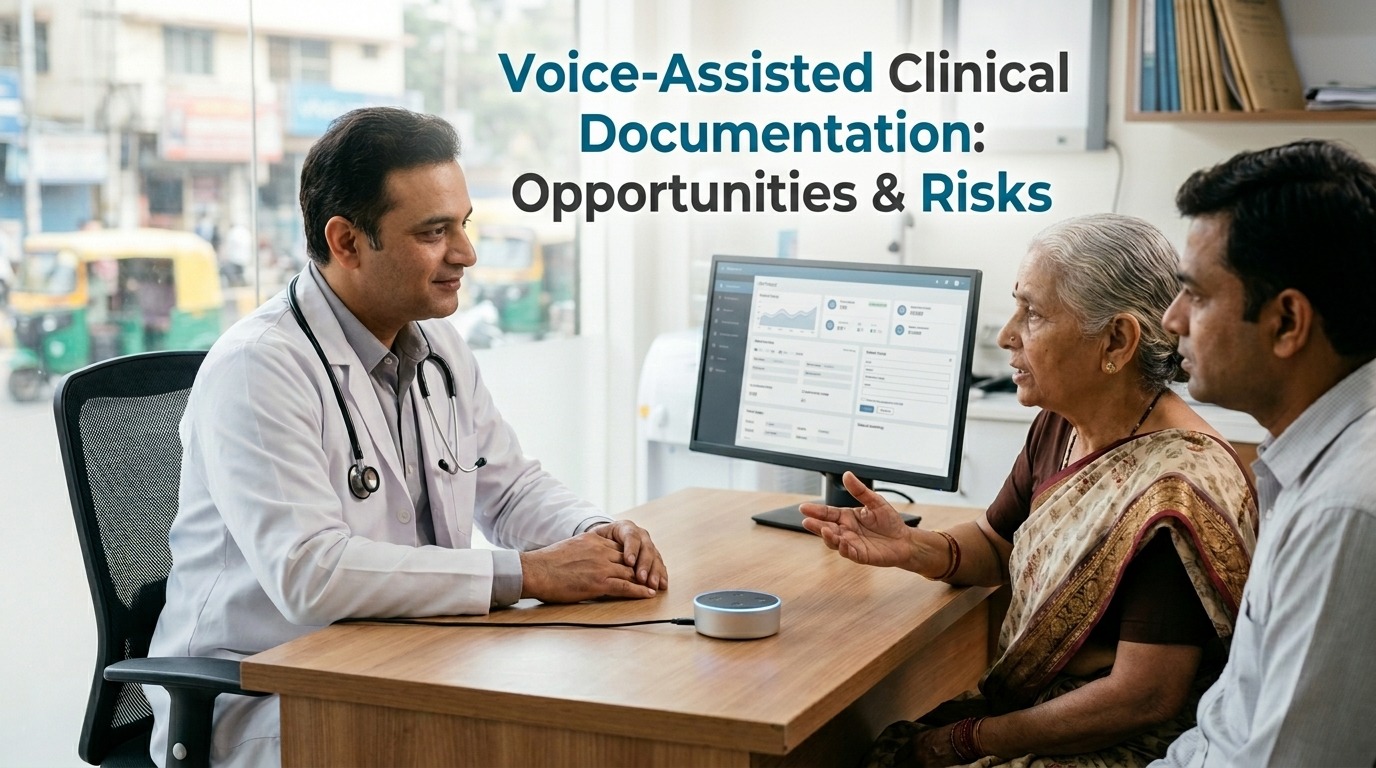
Clinical documentation has always been one of the most time-consuming parts of healthcare delivery. A consultation may take a few minutes, but documentation often extends far beyond that interaction. With the rise of voice assisted clinical documentation systems, this pattern is beginning to change. Documentation is no longer something that happens after care. It is becoming part of the care process itself.
As ai voice documentation in healthcare workflow continues to evolve, hospitals are finding ways to reduce the gap between patient interaction and record creation. The result is a system where documentation feels less like an additional burden and more like a natural extension of clinical work.
What Voice-Assisted Documentation Really Means
Voice-assisted documentation today goes beyond simple dictation. It combines speech recognition with contextual understanding, allowing systems to convert conversations into structured clinical records. This shift is supported by advancements in clinical voice recognition software for doctors, where systems are trained to understand medical terminology, conversational cues, and clinical context.
Unlike earlier tools, modern systems do not just capture words. They organize information into meaningful formats that align with clinical requirements. This is where improvements in speech to text medical documentation accuracy play a critical role. Higher accuracy ensures that the generated records are reliable enough to support real-world use.
Over time, this approach begins to change how clinicians interact with documentation itself. Instead of switching between speaking and typing, they can focus on the patient while the system captures the necessary details.
Why This Shift Matters In Clinical Practice
In many clinical settings, documentation competes directly with patient interaction. Doctors often divide their attention between screens and conversations, which can affect both efficiency and communication quality.
With real time voice documentation in hospitals, this dynamic begins to shift. Documentation happens alongside the consultation, allowing clinicians to stay engaged without interruption. This improves not only workflow efficiency but also the overall experience for patients.
The benefits of voice enabled clinical documentation become more visible over time. Reduced after-hours work, smoother consultations, and better continuity of care are some of the outcomes hospitals begin to observe. In high-volume environments, even small improvements in workflow can create significant impact.
Opportunities: Where Voice Technology Adds Real Value
When integrated properly, voice-assisted systems create measurable improvements across different parts of healthcare delivery. These improvements are not limited to time savings. They influence how care is delivered and experienced.
Some of the most practical advantages include:
- More focused patient interactions, as clinicians are not tied to screens
- Faster documentation cycles, with notes generated during consultations
- Reduced administrative workload across departments
- Improved consistency in clinical records
- Better alignment with digital systems and workflows
Technologies such as ambient voice technology in clinical documentation are central to this shift. By capturing conversations passively, they reduce the need for active input and make documentation less intrusive.
Risks And Limitations That Need Attention
Despite its advantages, voice-assisted documentation comes with challenges that require careful consideration. These systems are not fully independent and must be implemented with the right balance of automation and oversight.
Some of the key concerns include:
- Limitations in accuracy during complex or multi-speaker interactions
- Privacy and security risks associated with voice data
- Over-reliance on automated outputs without proper review
- Environmental factors such as background noise affecting performance
- Regulatory requirements related to ai powered voice transcription healthcare compliance
These issues are often discussed under risks of voice based medical documentation systems, especially in settings where accuracy and compliance are critical.
How Voice-Assisted Documentation Works In Practice
The workflow behind voice-assisted documentation is designed to integrate into clinical routines without disrupting them. It follows a structured process that connects conversation to record creation.
Typically, the process includes:
- Capturing doctor-patient conversations in real time
- Processing speech using AI-based recognition systems
- Structuring information into clinical formats
- Integrating data into electronic health records
- Allowing clinicians to review and finalize documentation
This is where ai voice documentation in healthcare workflow becomes most effective. It supports documentation while allowing clinicians to remain focused on care delivery.
Case Studies: Real-World Use In Clinical Settings
Case Study 1: Reducing Documentation Backlog
In a hospital managing high patient volumes, doctors often stayed beyond working hours to complete documentation. The workload was consistent and difficult to reduce without affecting record quality. After introducing voice assisted clinical documentation systems, much of the documentation began happening during consultations. Doctors still reviewed the notes, but the need to create records from scratch reduced significantly. Over time, the backlog decreased, and workflows became more manageable.
Case Study 2: Improving Consultation Quality
A clinic noticed that doctors frequently shifted attention between patients and screens while documenting. This created interruptions in communication and reduced patient engagement. With the adoption of ambient voice technology in clinical documentation, documentation became less intrusive. Conversations flowed more naturally, and clinicians could maintain focus without constant interruptions. The change was subtle but noticeable in patient experience.
Case Study 3: Strengthening Accuracy And Compliance
A healthcare provider initially faced challenges with transcription accuracy and regulatory alignment. Background noise and varied speech patterns affected system performance. By refining implementation and aligning processes with ai powered voice transcription healthcare compliance, accuracy improved over time. Clinicians were trained to review outputs carefully, ensuring that automation supported rather than replaced clinical responsibility.
Mistakes To Avoid When Implementing Voice Systems
Hospitals often encounter issues when implementation is rushed or poorly aligned with workflows. The technology itself is rarely the problem. The challenge lies in how it is introduced.
Common mistakes include:
- Selecting systems not designed for clinical environments
- Skipping proper staff training and onboarding
- Failing to integrate with existing hospital systems
- Ignoring compliance and data security requirements
- Expecting immediate accuracy without adjustment
Addressing these gaps helps reduce challenges in voice assisted healthcare documentation and improves long-term adoption.
FAQs
1. What are voice assisted clinical documentation systems?
They are AI-driven tools that convert spoken clinical interactions into structured medical records.
2. How accurate is speech to text medical documentation?
Speech to text medical documentation accuracy is high in controlled environments but still requires clinician review.
3. What are the benefits of voice enabled clinical documentation?
The benefits of voice enabled clinical documentation include time savings, improved patient interaction, and reduced workload.
4. What are the risks of voice based medical documentation systems?
The risks of voice based medical documentation systems include accuracy issues, privacy concerns, and dependency on automation.
5. How does AI voice documentation fit into healthcare workflow?
Ai voice documentation in healthcare workflow enables real-time documentation without interrupting consultations.
6. What is ambient voice technology in clinical documentation?
Ambient voice technology in clinical documentation captures conversations passively and converts them into structured notes.
7. Are voice systems compliant with healthcare regulations?
They must meet ai powered voice transcription healthcare compliance standards to ensure data protection.
8. What are the challenges in voice assisted healthcare documentation?
Challenges in voice assisted healthcare documentation include noise interference, integration issues, and accuracy limitations.
9. Can voice documentation replace manual documentation?
No, it supports documentation but still requires human validation.
10. Where is voice documentation most effective?
It works best in high-volume clinical environments where efficiency is critical.
Conclusion
The adoption of voice assisted clinical documentation systems reflects a broader shift in how healthcare workflows are designed. By integrating documentation into real-time interactions, these systems reduce administrative burden while improving efficiency. At the same time, careful implementation is essential to address risks and ensure accuracy. When balanced correctly, voice-assisted documentation becomes a practical tool that supports both clinicians and patient care.
 Team Healthvoice
#HealthcareTechnology #ArtificialIntelligence