Reducing Administrative Burden for Doctors: How India's Medical Community Can Reclaim Time for Patient Care
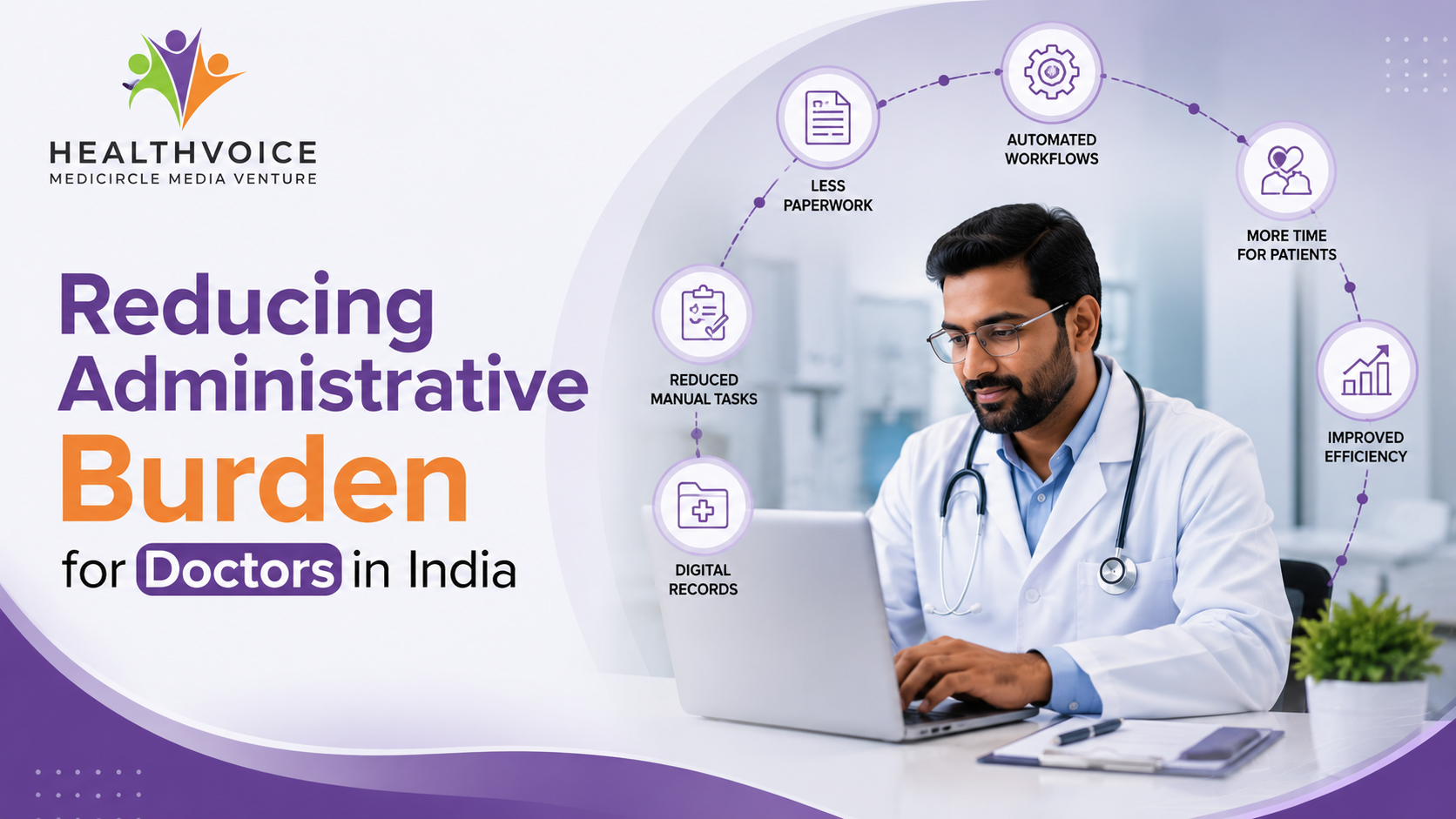
Administrative burden reduces Indian doctors' clinical time and fuels burnout. AI, digital health infrastructure, and systemic reforms can restore focus on patient care.
Introduction
Every day, thousands of doctors across India walk into hospitals and clinics ready to practice medicine. What many of them end up spending a considerable portion of their day doing, however, has very little to do with medicine. Forms to fill, insurance pre-approvals to chase, compliance registers to update, billing codes to verify, and digital health records to manually enter have quietly taken over the professional lives of doctors who trained for years to diagnose diseases and save lives.
This is not a problem unique to India, but it has a particularly sharp edge here. In a country where the doctor-to-patient ratio remains well below the World Health Organization's recommended standard of 1:1000, the time a doctor spends on administrative tasks is time taken directly away from patient care. According to various estimates, doctors in India spend anywhere between 30 to 50 percent of their working hours on non-clinical work. That is not a marginal inefficiency. That is a structural problem that is costing the healthcare system dearly, in quality of care, in doctor wellbeing, and in patient outcomes.
The medical community in India deserves a serious, informed conversation about this problem. HealthVoice, committed to amplifying the voices of doctors and healthcare communities, believes that reducing administrative burden is one of the most important systemic reforms the Indian healthcare ecosystem needs to pursue in the years ahead.
Understanding the Administrative Burden Problem in Indian Healthcare
Administrative burden in healthcare refers to the cumulative weight of non-clinical tasks that pull doctors away from patient care. These tasks span a wide range and include clinical documentation, prior authorisation for treatments and investigations, insurance claim processing, regulatory compliance reporting, medical record management, billing verification, and various government scheme-related paperwork.
In the Indian context, the complexity is amplified by several factors. Doctors working in empanelled hospitals under Ayushman Bharat Pradhan Mantri Jan Arogya Yojana (AB-PMJAY) are required to submit detailed treatment documentation to justify claims. Doctors in private hospitals navigate insurance third-party administrator (TPA) processes for dozens of different insurance providers. Doctors in government hospitals manage extensive manual registers alongside digital systems that are often poorly integrated. Doctors running their own clinics handle billing, compliance, and medical records largely on their own or with minimal support staff.
The result is a system where clinical expertise is being consumed by clerical demands. A senior specialist in a tertiary care hospital in Mumbai or Chennai may see forty or fifty patients a day, but then spend an additional two to three hours on documentation, approvals, and reporting. In smaller district hospitals and primary health centres, the problem is equally severe, but the resources to address it are far fewer.
The Impact on Doctors, Patients, and Healthcare Quality
The consequences of unchecked administrative burden are not abstract. They are visible in everyday healthcare delivery across the country.
On doctor wellbeing and burnout: Research consistently shows that administrative overload is one of the leading contributors to physician burnout globally, and India is no exception. Burnout among Indian doctors manifests as emotional exhaustion, reduced empathy, and declining job satisfaction. When a doctor is mentally drained from hours of non-clinical work, the quality of clinical judgment, patient communication, and diagnostic thoroughness inevitably suffers.
On patient access and waiting times: When doctors spend disproportionate time on paperwork, fewer patients get seen per session. Waiting times increase. Follow-up consultations get shortened. Preventive counselling gets skipped. Patients who travel long distances to see a specialist may spend only a few minutes in actual consultation.
On medical errors: Fatigue and cognitive overload linked to excessive administrative demands raise the risk of clinical errors. A doctor who has been entering data into a hospital management system for an hour before seeing a complex patient is not functioning at full cognitive capacity.
On the healthcare workforce: India is already facing a shortage of qualified doctors, particularly in rural and semi-urban areas. Administrative burden makes existing doctors less productive, effectively reducing the functional capacity of the healthcare system without any reduction in the actual number of practitioners.
Primary Drivers of Administrative Burden in India
To address the problem meaningfully, it is important to understand where administrative burden originates in the Indian setting.
Insurance and TPA processes: The health insurance sector in India, while growing rapidly, remains operationally fragmented. Doctors and hospitals dealing with multiple TPAs must comply with different documentation formats, pre-authorisation requirements, and claim submission timelines. The lack of standardisation across insurers creates enormous duplication of effort.
Manual clinical documentation: Despite growing adoption of Hospital Management Information Systems (HMIS), a large number of hospitals, nursing homes, and clinics in India still rely heavily on manual documentation. Even where digital systems exist, they are often not designed with the clinician's workflow in mind, making data entry cumbersome and time-intensive.
Government scheme compliance: Schemes like AB-PMJAY, Rashtriya Swasthya Bima Yojana (RSBY), and various state health insurance programmes require extensive case documentation, beneficiary verification, and outcome reporting. While the intent is accountability, the execution often places the administrative load directly on clinical staff.
Regulatory and statutory compliance: Doctors and hospitals must maintain records as per the Clinical Establishments (Registration and Regulation) Act, Medical Council guidelines from the National Medical Commission (NMC), NABH accreditation standards, and various state health regulations. These requirements are necessary but cumulatively demanding.
Prescription and referral paperwork: Even routine prescriptions, referral letters, fitness certificates, and medical reports consume clinical time that could otherwise be directed toward patient care.
Strategies to Reduce Administrative Burden for Indian Doctors
Addressing this challenge requires action at multiple levels: individual practice, institutional systems, technology adoption, and healthcare policy.
Hiring dedicated administrative and clinical support staff: One of the most immediate and practical solutions for hospitals and larger clinics is to hire trained medical administrative staff who can handle documentation, insurance processes, appointment scheduling, and compliance work. When a trained hospital coordinator manages TPA correspondence or pre-authorisation requests, the doctor is freed to focus on clinical care. This is standard practice in well-run private hospitals and needs to be expanded across the healthcare sector.
Implementing integrated Hospital Management Information Systems: Comprehensive HMIS platforms that connect outpatient departments, inpatient wards, pharmacy, laboratory, and billing into a single digital workflow dramatically reduce redundant data entry. When a doctor enters a diagnosis once in the system, it should automatically populate the prescription, billing code, insurance claim, and medical record without the need for repeated manual entry.
Leveraging artificial intelligence for clinical documentation: AI-powered documentation tools, including ambient clinical scribes that can listen to a doctor-patient conversation and automatically generate structured clinical notes, represent a significant opportunity. These tools are already being piloted in hospitals in the United States and are gaining traction globally. For Indian healthcare, adapting such tools to work with multiple languages, including Hindi, Tamil, Telugu, Bengali, and others, would be transformative. Several Indian healthtech startups are already developing AI-assisted documentation solutions tailored to the local context.
The following areas are particularly well-suited for AI-driven efficiency gains in Indian healthcare:
- Automated clinical note generation from voice input
- AI-assisted billing and coding to reduce errors and rejections
- Intelligent prior authorisation processing that pulls relevant clinical data automatically
- Automated quality reporting and compliance documentation
- Digital prescription generation integrated with pharmacy systems
Utilising the Ayushman Bharat Digital Mission infrastructure: The ABDM is building a national digital health ecosystem in India that includes Unique Health Identifiers for patients, a Health Facility Registry, a Healthcare Professionals Registry, and an interoperable electronic health records framework. When fully implemented, ABDM has the potential to significantly reduce documentation duplication by allowing patient health data to flow securely between providers, insurers, and government systems without manual re-entry at each point of care.
Doctors who register on the ABDM platform and link their practice to this ecosystem will be better positioned to benefit from these efficiencies as the infrastructure matures.
Standardising insurance and TPA processes: The Insurance Regulatory and Development Authority of India (IRDAI) and the health insurance industry need to work toward standardised pre-authorisation formats, unified digital submission portals, and faster processing timelines. Reducing the number of different documentation formats doctors must handle across different insurers would alone free up significant clinical time.
Empowering medical associations to advocate for systemic reform: Medical associations including the Indian Medical Association (IMA) and specialty bodies like the Association of Physicians of India (API), the Cardiological Society of India (CSI), and others have an important role to play in advocating for policies that protect doctor time and reduce non-clinical workloads. Collective professional advocacy is one of the most powerful levers available to the medical community.
The Role of Hospital Leadership and Healthcare Institutions
Individual doctors can adopt better tools and practices, but lasting change requires institutional commitment. Hospital administrators and healthcare leaders need to view administrative burden as an operational efficiency problem with direct consequences for clinical quality, not merely a doctor welfare issue.
Hospitals that invest in proper support staff, integrate their digital systems, train clinical teams on efficient documentation practices, and actively work to streamline insurance processes will see measurable improvements in doctor satisfaction, patient throughput, and care quality. NABH-accredited hospitals already have a framework that encourages systematic documentation and quality processes, but the goal should be for these systems to support doctors rather than add to their workload.
Healthcare institutions should also track and report on the administrative time burden carried by their clinical staff, using this data to drive internal process improvements. What gets measured gets managed.
The Broader Significance for Indian Healthcare
India's healthcare goals, whether measured by Universal Health Coverage targets, outcomes under the National Health Policy 2017, or the aspirations of the Ayushman Bharat programme, cannot be achieved if doctors are spending half their working day on paperwork. The country needs every qualified doctor to be as clinically productive as possible.
Reducing administrative burden is therefore not just a matter of professional comfort for individual doctors. It is a matter of healthcare system capacity, quality, and equity. Doctors who are less burdened by administrative demands can see more patients, think more clearly, communicate more thoughtfully, and continue practising with greater longevity and satisfaction.
At the community level, platforms like HealthVoice provide a space for doctors and medical associations to share best practices, advocate for systemic reforms, and connect with healthtech innovators who are building tools to address these very challenges. The conversation about reducing administrative burden needs to happen loudly and consistently within the medical community, and that professional voice matters enormously.
Conclusion
The administrative burden on Indian doctors is not an unavoidable feature of healthcare delivery. It is a systems problem with identifiable causes and addressable solutions. From AI-powered documentation tools and integrated digital health platforms to standardised insurance processes and stronger advocacy by medical associations, there are concrete pathways to giving doctors back the time they need for what they trained to do.
India's doctors carry an enormous responsibility toward a population of over 1.4 billion people. The least the healthcare system can do is ensure that their professional time and energy are not drained away by paperwork, redundant data entry, and administrative inefficiency. Building a healthcare ecosystem that protects doctor time is not optional. It is essential to the future of healthcare in this country.
Frequently Asked Questions
Q1: What is administrative burden for doctors?
Administrative burden refers to the non-clinical tasks that consume a doctor's time, including paperwork, billing, insurance processing, documentation, and compliance reporting, all of which reduce the time available for actual patient care.
Q2: How does administrative burden affect doctor burnout in India?
In India, doctors in both public and private hospitals spend a significant portion of their working hours on non-clinical tasks. This leads to physical exhaustion, emotional detachment, and reduced job satisfaction, all of which are key contributors to professional burnout.
Q3: What role does ABDM play in reducing administrative tasks for Indian doctors?
The Ayushman Bharat Digital Mission (ABDM) aims to create a unified digital health infrastructure in India, enabling electronic health records, digital prescriptions, and interoperable patient data, which collectively reduce manual documentation burdens on doctors.
Q4: Can AI tools help Indian doctors with clinical documentation?
Yes. AI-powered ambient scribes and clinical documentation assistants can listen to doctor-patient conversations and automatically generate structured notes, reducing the hours doctors spend on manual charting after each consultation.
Q5: What steps can hospitals in India take to reduce administrative workload for doctors?
Hospitals can hire dedicated administrative staff, implement Hospital Management Information Systems (HMIS), adopt digital billing and insurance processing tools, and train support teams to handle documentation, allowing doctors to focus on clinical responsibilities.
RESOURCES
- Ayushman Bharat Digital Mission (ABDM): Official digital health infrastructure initiative of the Government of India enabling electronic health records and interoperability.
- National Medical Commission (NMC): Regulatory body governing medical education and professional standards for doctors in India.
- Indian Council of Medical Research (ICMR): India's apex body for the formulation, coordination, and promotion of biomedical research including health systems research.
- World Health Organization India Country Office: Provides data and guidance on health workforce, healthcare delivery, and administrative efficiency in the Indian context.
- National Accreditation Board for Hospitals and Healthcare Providers (NABH): Accreditation standards body that sets quality and documentation benchmarks for Indian hospitals.
INTERLINKING KEYWORDS
doctor burnout India, hospital management information systems, Ayushman Bharat Digital Mission, AI in Indian healthcare, clinical documentation automation, healthcare administrative reform, physician workload management
Medical Disclaimer:
The information provided in this article is intended for general awareness and professional discussion purposes only. It does not constitute medical, legal, or regulatory advice. Doctors, healthcare administrators, and institutions should consult qualified professionals and refer to the latest guidelines from the National Medical Commission, Ministry of Health and Family Welfare, and other relevant regulatory bodies before implementing any administrative or clinical process changes.
Last medically reviewed by:
HealthVoice Editorial and Medical Advisory Team on August 19, 2026.
 Team Healthvoice
#DoctorWellbeing #HealthcareIndia