Who Pays for Recognition? Can NMC’s $10,000 Foreign MBBS Fee Shape India’s Doctor Pipeline
The hope is that the cost of recognition yields measurable quality dividends in the form of higher FMGE/NExT pass rates, fewer revoked degrees, better compliance with Indian internship protocols, and reduced graduate fraud.
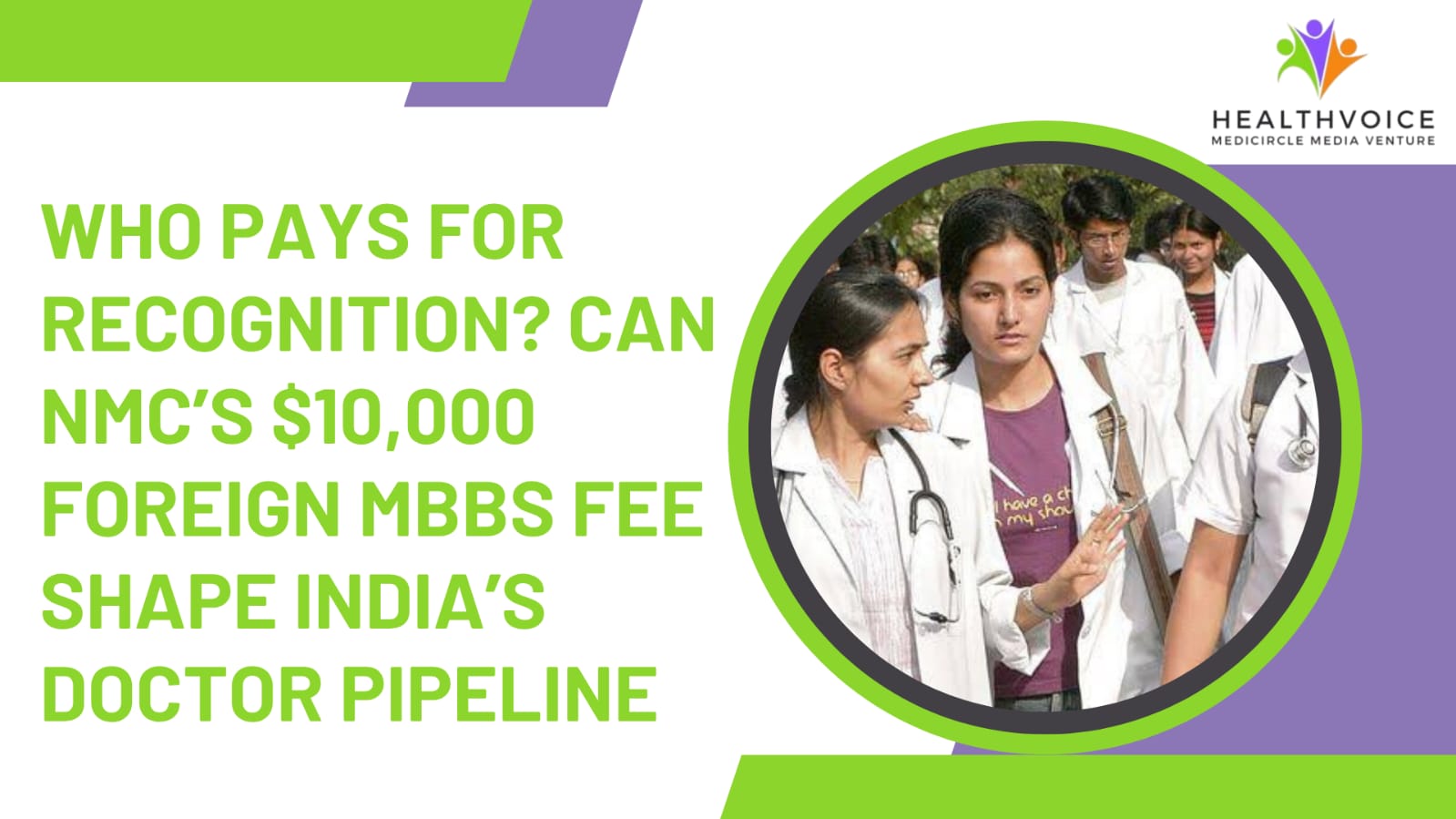
India’s medical regulator has dropped what could become the most consequential policy shift for thousands of students pursuing MBBS abroad. The National Medical Commission (NMC) has proposed that universities outside India seeking recognition of their MBBS qualifications be made to pay $10,000 per student which is equivalent to approximately ₹8.6 lakh per graduate, to the NMC in order for that degree to qualify in India. In the same breath, the NMC has quietly scrapped the previous ₹2.5 lakh application fee that individual Indian doctors had to pay after completing MBBS overseas. What this means is clear: the cost burden is shifting from students to foreign institutions but with no obvious guarantee that it won’t simply be passed back onto eager families.
Every year 20,000 to 25,000 Indian students choose to pursue MBBS in countries such as Russia, China, Philippines, Georgia, and Kyrgyzstan. India offers around 1.1 lakh MBBS seats, while over 25 lakh NEET-UG aspirants compete for them. This mismatch has made overseas medical education a viable, if imperfect, alternative. Yet upon returning, these graduates must get their degrees recognised by the NMC under the Foreign Medical Graduate Licentiate (FMGL) Regulations before they sit for the FMGE or NExT to gain eligibility to practise in India. Without recognition, the overseas degree serves no purpose.
Charging a fee for recognition is not unusual. Regulators in the US, UK, Canada, and even global bodies like the World Federation for Medical Education routinely charge European or American accrediting agencies tens of thousands of dollars. In that sense, India’s shift toward an institutional fee system positions it within global norms. But that doesn’t make this change benign. The draft rule explicitly states: “Any foreign authority… shall remit $10,000 per qualification...” This wording creates scope for universities to recover the cost likely by hiking tuition or passing administrative burdens to Indian students.
For Indian students and parents, this raises red flags. Many institutions abroad operate on razor-thin margins and already cater to Indian contingents, sometimes with low-cost accommodations and learning. If these institutions are suddenly asked to remit hefty fees to the NMC, the only trigger they have is the student’s wallet. And unlike Western regulators which work on periodic recognition, renewal, and accreditation cycles Indian medical regulators reserve the right to revoke recognition at short notice, making distant students vulnerable to abrupt changes during their 5-year course duration.
This wave of alarm is already rippling among stakeholders who worry that NMC’s well-meaning attempt to tighten quality scrutiny could constrain access, raise costs without commensurate gains in training standards, and even cause some foreign universities to withdraw their India recognition altogether, leaving enrolled students stranded.
Doctors and medical educators, particularly in rural districts hosting returning graduates, should carefully assess the capacity of institutions abroad to absorb such fees without compromising teaching quality. The concern is not about blacklisting entire countries; the NMC already maintains advisories against certain colleges in Belize and Uzbekistan for not complying with FMGL norms. Students from those universities are categorically barred from registration. Yet even China, Russia, and Philippines are not immune to scrutiny under this new regime.
The timing of this policy tweak also dovetails with other regulatory changes that compound the burden on foreign medical graduates. Not long ago, Kerala’s High Court struck down a state-government decision that imposed a ₹5,000 monthly internship fee for foreign graduates under the Compulsory Rotating Medical Internship (CRMI). The court ruled that the NMC regulations mandate stipend payments not fees for interns; a fee structure at odds with NMC policy was held invalid.
As of now, NMC’s current draft shift is silent on reversing that internship fee ruling or whether the $10,000 fee policy will be seen as part of training cost or a one-time administrative levy.
The logic behind NMC’s reform is clear and arguably necessary. India's FMGE/NExT pass rate for medical graduates from abroad remains stubbornly low averaging around 20 to 25 percent which speaks to a foundational problem in educational quality and clinical alignment. By forcing universities to commit capital for recognition, the regulator hopes to heighten institutional accountability. The expectation is that only serious, compliant institutions will apply making the recognition list itself a benchmark of reliability.
Still, there are risk points. Indian regulators must enhance enforcement across 2021 FMGL requirements such as: 54 months of study at the same institution, 12‑month internship in the same country, English medium, and English clinical exposure. These are already mandatory do-or-die norms under FMGL; failure to meet them leads to disqualification regardless of recognition. A high fee without concurrent enforcement becomes hollow theatre.
Further, the NMC must clarify if public feedback or exemptions will be allowed. Does a $10,000 fee really create a safer MBBS programme, or does it just stratify students by the financial strength of their families? Many middle-class parents may be priced out of options in certain countries, forcing them into less familiar or lower-ranked institutions that choose not to comply or fold recognition after 2–3 years when fee demands persist.
For individual doctors coming back from abroad, the removal of the ₹2.5 lakh application fee is welcome. But that relief may be dwarfed if their alma mater transfers the institutional recognition cost in the form of tuition hikes or admission levies. Students may find themselves in the familiar predicament: paying more for less transparency.
From a policy perspective, this entire exercise highlights India’s continued struggle balancing access, affordability, and quality in medical education. The NMC claims the fee is “not just a revenue-generating mechanism but a filtering tool,” yet there are few guardrails to ensure that filtering is effective. Without real-time audits such as re-verification of clinical rotations, faculty-patient ratios in overseas institutions, and exam board accreditation the fee becomes a static patch, not a cure.
Hospitals and medical colleges in India have much stake in this transition. In districts where foreign medical graduates fill intern and doctor roles, a sharp drop in recognised foreign MBBS seats could create acute staffing gaps. At the same time, any decline in quality due to insufficient institutional oversight could translate into public-health liabilities. Medical colleges tied to returning foreign-medical alumni may need to scale up bridging programs for realigning clinical knowledge, language, and Indian ethics.
Doctors in leadership roles can play a constructive part. Hospitals can partner with returning foreign graduates to map areas of clinical dissonance such as Indian medico-legal norms, the legal duties of a resident, primary care protocols, and consultation etiquette. Such co-designed bridging modules preserve patient safety and avoid exploitation of a “tempted graduate” eager for say, internships or PG seats.
The regulatory debate ahead may focus on three main axes: equity, enforcement, and effect. Equity asks: does the fee freeze out economically weaker students or institutions? Enforcement demands that recognition is quality-based, not profit-based. Effect asks whether returns to Indian healthcare via improved doctors, not just high fees actually follow from the policy.
If the NMC allows transparent reporting like listing which universities paid, which were denied, and why then the $10,000 fee could evolve from suspicion into supervision. Regulators like the Educational Commission for Foreign Medical Graduates (ECFMG) in the US already publish annual compliance reports that enable Indian doctors to make real-time decisions. NMC can mirror this approach to reduce uncertainty.
Ultimately, the hope is that the cost of recognition yields measurable quality dividends in the form of higher FMGE/NExT pass rates, fewer revoked degrees, better compliance with Indian internship protocols, and reduced graduate fraud. Absent that, the policy will resemble any other licensing fee: expensive, burdensome, and disconnected from patient care.
For medical colleges, PG aspirants, and healthcare centres nationwide, this is not just a matter of cross-border regulation. It’s about the credibility of India’s doctor output, the fairness of access to medical education, and whether a regulatory body designed to assure quality can also guard against inequity. As costs rise and applications shift, the first casualty should not be the ambitions of students or the trust of patients.
If the NMC’s new fee is to be more than a licensing license, if it is to become the backbone of accountability, the Commission must marry cost with care, fee with formulation, and recognition with responsiveness. Because the collective future of Indian medicine is at stake.
 Sunny Parayan
#NMCPolicy #MedicalEducation #MedicalEducationReform #NMCUpdates #MBBSRecognition #MBBS #MBBSAbroad #MedicalDreams #NEETAspirants #FutureDoctors #MedicalEquity #DoctorsOfIndia #MedicalPolicy #healthvoice