A Medical College on Paper: The Bitter Reality of Kasaragod’s Healthcare Dream
The government still has time to act, to invest sincerely, to finish what it started, and to give Kasaragod not a miracle on paper but a hospital in reality.
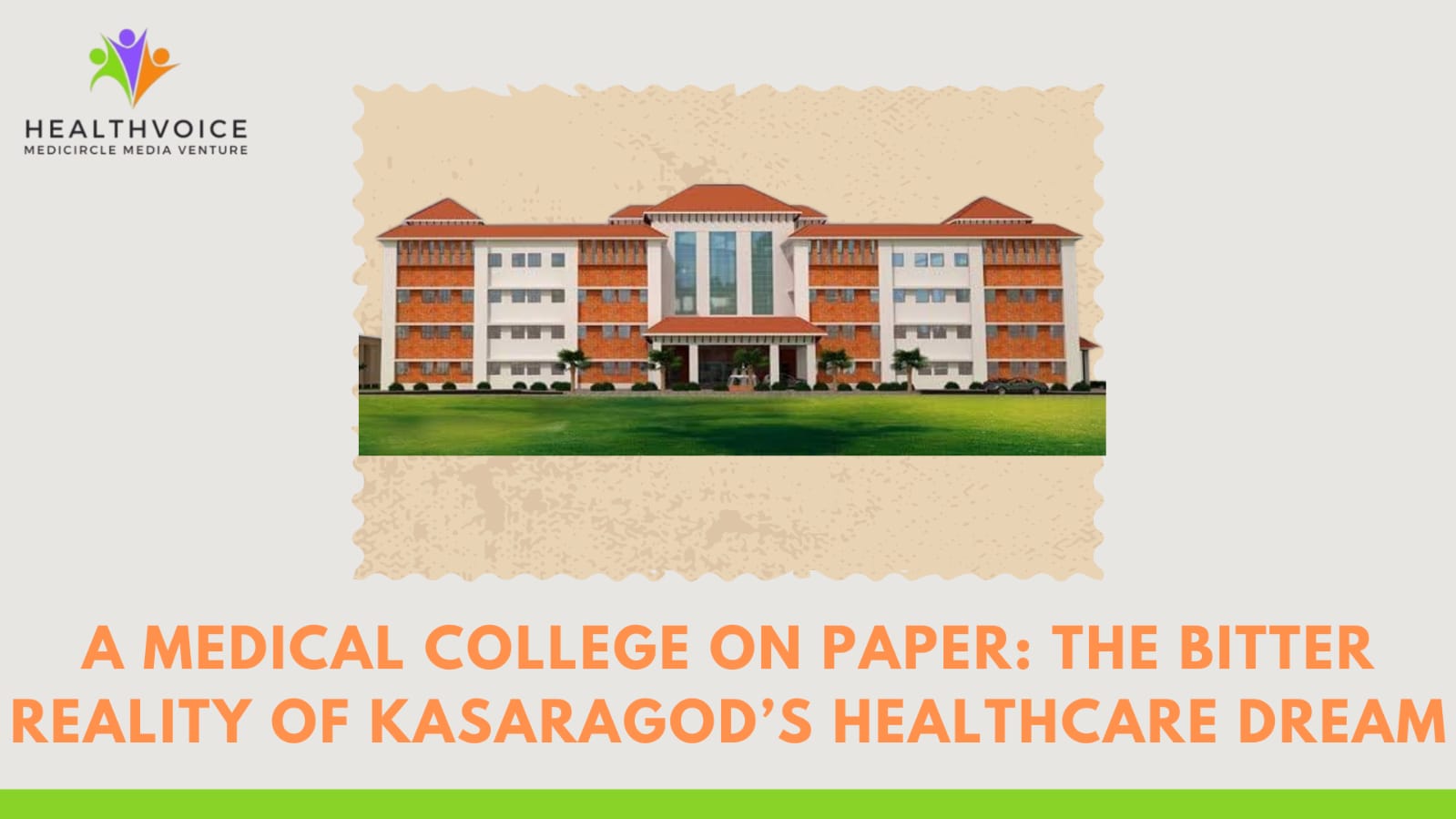
On the first day of 2025, as the rest of Kerala welcomed the new year with celebration, the people of Kasaragod were handed what appeared to be a gift of hope. Overnight, their century-old General Hospital was reborn on paper as the “Government Medical College Hospital, Kasaragod.” A new nameplate under a tired arch announced the transformation, and a government order issued on December 31 proclaimed it official. With that stroke of bureaucracy, the state declared that Kasaragod finally had its long-promised medical college hospital. But beyond the cosmetic change, the reality remained starkly different.
The move was intended to make way for admitting fifty MBBS students in the 2025–2026 academic year, fulfilling a promise that has lingered for more than a decade. Yet eight months later, as national NEET UG counselling races towards closure, Kasaragod finds itself absent from the list of choices. No students, no admissions, no recognition just an institution that exists in name alone. While the government maintains optimism, declaring that approval from the National Medical Commission (NMC) could still arrive, the gap between aspiration and reality in Kasaragod remains as wide as ever.
For the residents of this northernmost district of Kerala, the dream of a medical college has always been about much more than seats for aspiring doctors. What they desperately sought was access to advanced healthcare. Kasaragod continues to remain the only district in Kerala without tertiary healthcare facilities. For emergencies, cancer care, complex surgeries, or life-threatening illnesses, families have no choice but to cross state borders into Mangaluru, paying exorbitant bills at private medical colleges and corporate hospitals. In a state that proudly showcases its health model to the world, Kasaragod stands as a contradiction, a forgotten periphery in the larger healthcare story.
The NMC’s role in this saga has been pivotal. In July this year, the commission conducted a virtual inspection of the renamed General Hospital and the half-finished Ukkinadka campus, located 27 kilometers away near the Karnataka border. Regulations demand that if the teaching hospital is situated on a different campus, it must be reachable within thirty minutes from the academic block. That rule itself was a relaxation from the earlier ceiling of ten kilometers. But in Kasaragod, even an ambulance struggles to cover the distance in under fifty minutes. Health activists in the district point out that no amount of paperwork or optimism can reduce the physical reality of that journey. A teaching hospital separated by such a distance is not just a bureaucratic hurdle; it undermines the very foundation of medical training and patient care.
Medical education is not built on classrooms alone. Anatomy, physiology, pathology and microbiology, all these form the bedrock of the first years. But from the very start of the MBBS course, students are expected to encounter patients, observe real cases, and integrate theory with practice. Early clinical exposure is no longer optional; it is central to the curriculum. A medical college without a functioning hospital in proximity does not simply violate norms; it fails its students and, eventually, its patients. The NMC’s requirement that a hospital mature over at least three years before students begin clinical rotations ensures that departments are stabilized, patient flow is established, and specialists across fields are recruited. Kasaragod’s project, still struggling with unfinished hostels, missing libraries, and incomplete hospital blocks, has none of these essentials in place.
A closer look at the infrastructure reveals how hollow the transformation truly is. Of the twenty-one mandatory departments for a medical college with fifty seats, only twelve are currently functional at the Kasaragod General Hospital. Critical pre-clinical and para-clinical departments such as Anatomy, Physiology, Biochemistry, Pathology, and Community Medicine are entirely absent. Laboratories remain unbuilt, museums have not been established, and the library stands as an unfulfilled promise. Even basic hostels, a necessity in the remote Ukkinadka campus, are incomplete. A women’s hostel block exists but without electrical wiring, while the men’s hostel has not gone beyond the foundation stage. Without these facilities, students cannot even reside on campus, let alone train.
This dissonance between declaration and delivery is not new to Kasaragod. More than a decade has passed since the foundation stone for the Kasaragod Medical College was laid in Ukkinadka. In the same year, the Central University of Kerala began work on its permanent campus forty kilometers away in Periya. Today, the university flourishes with multiple hostels, quarters, and departments, having graduated thousands of students. By contrast, the medical college project remains a ghost campus, its hospital block frozen in time since 2022. The contractor tasked with its construction, RR Thulasi Builders, stopped work after the government failed to clear dues. Legal disputes dragged on, and though the project has now been handed to another state-backed contractor, work cannot proceed without clearance from the earlier firm. Meanwhile, the skeletal building stands unfinished, its empty walls a silent testimony to official neglect.
What makes the situation more painful is the shifting narrative. When activists demand a medical college or even an AIIMS for Kasaragod, what they truly mean is a functional tertiary hospital. The residents need critical care units, specialist doctors, trauma centers, and advanced diagnostic facilities. Yet the government seems more concerned with satisfying regulatory checkboxes to admit fifty students, chasing academic recognition without first addressing the core healthcare needs of the population. This inversion of priorities has led to a paradox: neither have students been admitted, nor have patients gained access to modern facilities.
The comparison with other institutions is stark. The Central University in Periya, started later, has managed to establish itself as a thriving center of education and research. In Kasaragod’s own medical college project, however, the state has stumbled repeatedly. Announcements are made, ceremonies are organized, and foundation stones are laid, but progress halts midway. The hospital block remains unfinished, equipment lies unprocured, and staffing is more a promise than a plan. Against this backdrop, the government’s attempt to simply rename an existing hospital as a medical college seems less like a solution and more like a desperate shortcut.
The larger tragedy, however, rests on the people of Kasaragod. For decades, they have borne the indignity of being the only district in Kerala without tertiary healthcare. Families with critically ill patients are compelled to spend enormous sums at private hospitals in Mangaluru. For the poor, this often means falling into debt or foregoing treatment altogether. A district battered by the endosulfan tragedy and struggling with chronic health issues deserved more than tokenism. Instead, what it received was a new signboard over an old hospital.
The state’s defense has been that the first batch of MBBS students would not require a teaching hospital immediately, as the initial years focus on pre-clinical subjects. While technically correct, this misses the essence of medical training under the updated curriculum. Exposure to patients, wards, and clinical scenarios begins early, and without a teaching hospital, students are denied a vital component of their education. Moreover, building a hospital’s reputation, attracting patient flow, and setting up specialized departments takes years. Starting late does not help; it only ensures that students, when they finally reach clinical postings, will be met with fledgling wards rather than robust departments.
The future of the Kasaragod project now hangs in the balance. If the NMC rejects the application due to the distance of the teaching hospital, the blow will be severe. There is no alternate 220-bed facility nearby that can be repurposed. Even if permissions are granted, the missing infrastructure, staffing shortages, and incomplete facilities mean the college cannot function effectively. Optimism may keep the project alive on paper, but without urgent and honest investment, it risks collapsing into farce.
In the end, the Kasaragod story is about promises unfulfilled and priorities misplaced. A district’s demand for healthcare has been reduced to a bureaucratic juggle of names and files. The people who asked for a lifeline have been given an illusion. And while officials continue to hope for regulatory approvals, patients continue to cross borders, students wait for seats that never open, and a half-built hospital stands as a monument to neglect.
If there is a lesson here, it is that healthcare cannot be conjured through paperwork or cosmetic renaming. It requires vision, honesty, and the courage to prioritize people over appearances. For Kasaragod, what is at stake is not just a medical college; it is the health and dignity of an entire district. The government still has time to act, to invest sincerely, to finish what it started, and to give Kasaragod not a miracle on paper but a hospital in reality. Until then, the story of Kasaragod’s medical college remains a cautionary tale of how a promise meant to heal became another wound of neglect.
 Sunny Parayan
#HealthcareJustice #PaperPromises #PatientsOverPolitics #RightToHealthcare #HealthcareDignity #HealthcareCrisisIndia #PublicHealth #HealthIsARight #healthvoice