Bribes in White Coats: When Corruption Threatens the Future of Medical Education in India
The medical fraternity must not let this moment pass as just another scandal in the headlines.
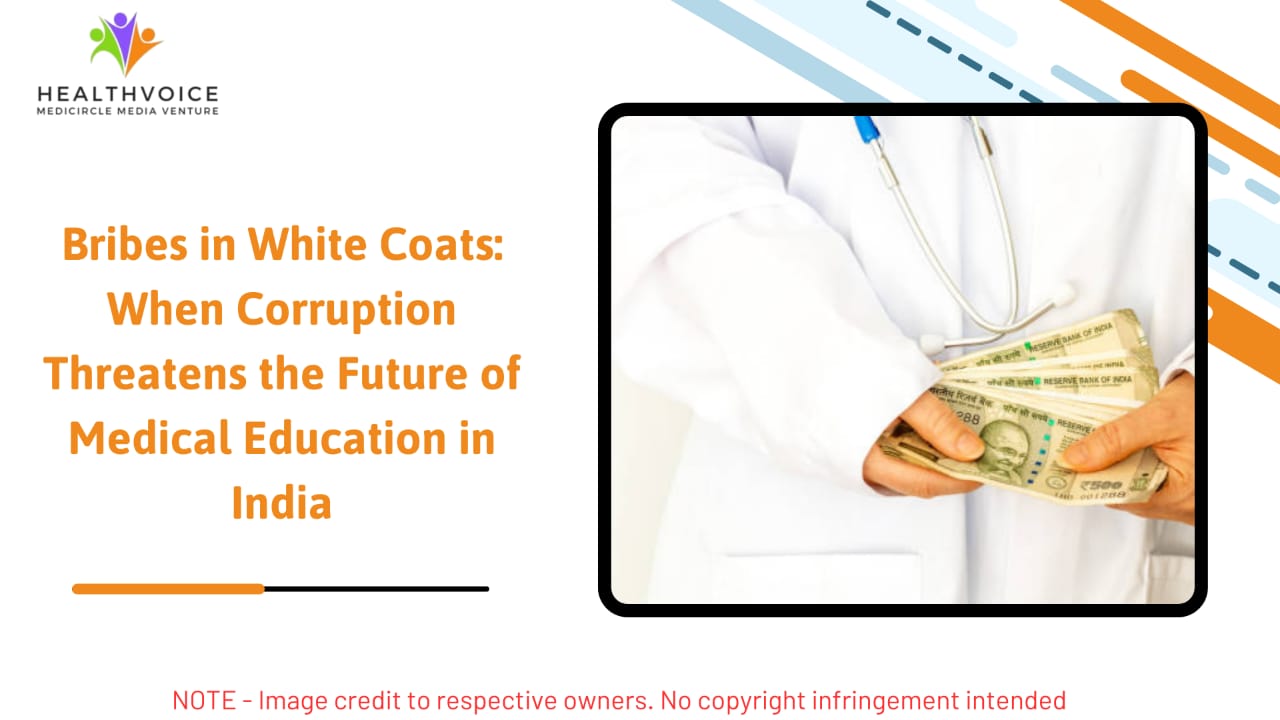
The corridors of Indian medical institutions have long symbolized discipline, sacrifice, and the pursuit of knowledge. They are where generations of doctors learn the science of healing and the art of empathy. Yet, every so often, shadows creep into this sacred space, revealing cracks in a system that carries the hopes of millions. The recent suspension of three doctors in Karnataka, accused of accepting bribes while serving as members of the National Medical Commission’s inspection team, has reopened uncomfortable conversations about corruption within medical education. This case does not merely spotlight three individuals; it highlights systemic vulnerabilities that can distort the very foundation of healthcare in India.
The Karnataka Medical Education Department’s swift action in suspending Dr. Chaitra M S of Atal Bihari Vajpayee Medical College and Research Institute, Dr. Manjappa C N of Mandya Institute of Medical Sciences, and Dr. Ashok Shelke of Bidar Institute of Medical Sciences reflects the gravity of the allegations. According to official reports, the three doctors allegedly took bribes to provide favorable inspection reports for a medical institution in Chhattisgarh. The Central Bureau of Investigation (CBI) had already registered an FIR in the matter, taking the accused into custody and signaling that the scandal extends beyond isolated misconduct. When doctors entrusted with upholding regulatory standards become entangled in corruption, the implications extend far beyond the fate of a single college. They shake confidence in the system itself.
The CBI’s investigation earlier this year revealed a wider network of malpractice, implicating officials from the Union Health Ministry, intermediaries, and representatives of private colleges. The FIR named 34 individuals, including eight Health Ministry officials, one National Health Authority officer, and five doctors associated with the NMC’s inspection processes. The fact that these allegations come from different corners of the regulatory framework underscores how systemic and organized such misconduct may be. The NMC’s immediate response, blacklisting assessors and halting the renewal of undergraduate and postgraduate seats in several medical colleges was an attempt to restore credibility. Yet the damage to public trust runs deep.
For decades, medical inspections have been a cornerstone of India’s regulatory mechanism, ensuring that colleges maintain the required standards in faculty strength, infrastructure, and clinical facilities. These inspections are not just routine audits; they decide whether a college can admit students, whether it can expand seats, and whether it remains eligible to function at all. When inspection teams succumb to bribery, the stakes are monumental. A favorable report issued in exchange for money can allow an underprepared institution to admit students, thereby compromising the quality of training for future doctors. The ripple effect is chilling: inadequately trained doctors entering the system, jeopardizing patient safety, and weakening the very foundation of healthcare delivery.
The ethical breach here is perhaps the most disturbing. Doctors are not just professionals; they are custodians of trust. They embody the Hippocratic oath, where the duty to patients and to society supersedes personal gain. When medical professionals themselves are accused of manipulating the system for profit, it corrodes the moral fabric of the profession. For young medical graduates, watching their seniors embroiled in scandals is demoralizing. It conveys a dangerous message: that influence and money can trump merit and integrity. In a country where medical education is already one of the most expensive pursuits, with families making immense sacrifices to secure an MBBS or MD seat, the perception of corruption adds to frustration and disillusionment.
Dr. Abhijat Sheth, the newly appointed chairperson of the National Medical Commission, acknowledged the seriousness of the issue in a recent statement. He made it clear that the Commission is adopting a zero-tolerance policy toward corruption, emphasizing that the actions of a few individuals should not taint the reputation of the entire regulatory body. His assertion that systemic reforms are already underway reflects the urgency of the moment. The NMC has introduced measures such as self-assessment reports, CCTV-monitored inspections, and Aadhaar-enabled biometric attendance systems for faculty verification. These steps reduce dependence on physical inspections and limit opportunities for manipulation. By digitizing processes, the Commission hopes to create transparency and accountability, minimizing human discretion that can be swayed by personal interests.
Yet technology alone cannot resolve what is fundamentally an ethical crisis. No system, however advanced, can function effectively if integrity is compromised at its core. This is where medical education must embrace a cultural shift. Integrity, accountability, and service must be woven into the training of every doctor, not just as abstract ideals but as lived realities. From the first day of medical school, students must be exposed to conversations about ethics, not confined to token lectures but embedded in clinical training and daily practice. When students see their mentors living by these values, they internalize them. Conversely, when they witness mentors implicated in scandals, they learn cynicism.
The wider implications for patient care cannot be ignored. If compromised inspections allow inadequately equipped colleges to function, patients will ultimately bear the cost. Doctors trained in such environments may lack exposure to essential clinical cases, may not have practiced in properly staffed hospitals, and may graduate without the competencies needed to treat patients safely. The result is a dilution of healthcare quality across the country. In a nation where the doctor-patient ratio already struggles to meet global benchmarks, India cannot afford to produce doctors whose skills and training are compromised from the start.
Corruption in medical inspections also widens inequity. For many aspiring doctors from modest backgrounds, entrance into government medical colleges represents the only feasible path. If private colleges, enabled by bribery, gain approvals without meeting standards, they can charge exorbitant fees without offering commensurate training. This perpetuates a cycle where only the affluent can afford medical education, and the less privileged either give up on their dreams or incur crushing debt. Transparency in regulation is not just about institutional credibility; it is about ensuring equal opportunity for every aspiring doctor in the country.
There is also the matter of India’s global reputation. As the country aspires to be a hub for medical tourism and advanced research, its medical education system must stand on the pillars of credibility and excellence. International patients and institutions look to India not just for affordable care but for quality. Scandals of bribery in medical inspections risk undermining this trust. For India to assert itself as a global leader in healthcare, it must ensure that every doctor it produces has undergone rigorous and fair training in institutions that meet the highest standards.
The suspension of the three doctors in Karnataka must be seen as both a warning and an opportunity. It is a warning that no individual, however senior, can escape accountability in the age of digital oversight and investigative scrutiny. It is also an opportunity for the medical fraternity to reaffirm its commitment to ethical practice. By holding individuals accountable, by reforming processes, and by embedding integrity into the DNA of medical training, the system can begin to heal itself.
Reforms must, however, extend beyond punitive action. They must address the underlying factors that create space for corruption. Greater autonomy for institutions to self-report, combined with random surprise checks, can reduce the scope for manipulation. Strict penalties for colleges found complicit in bribery, including withdrawal of licenses and heavy financial fines, can serve as deterrents. Whistleblower protections must be strengthened so that faculty and students who expose malpractice do not fear retaliation. Most importantly, a culture of transparency must be nurtured where every stakeholder like students, parents, faculty, regulators, and patients feels confident that the system is fair.
As India moves forward, the medical fraternity must not let this moment pass as just another scandal in the headlines. It must become a turning point where reforms are deepened, ethics are revitalized, and transparency becomes the norm rather than the exception. The credibility of India’s medical education system is not negotiable. It is the bedrock upon which the nation’s health rests. And if that bedrock is compromised, the entire edifice of healthcare risks collapse
 Sunny Parayan
#healthvoice #MedicalEducation #HealthcareIntegrity #FightCorruption #NMC #DoctorEthics #MedicalColleges #HealthcareReform #PatientSafety #TransparencyInHealthcare #MedicalAccountability #TrustInDoctors #HealthcareJustice #IndiaHealthcare