Remote Patient Monitoring: Clinical Accuracy Challenges
Remote Patient Monitoring (RPM) is transforming healthcare delivery by enabling continuous tracking of patient data outside traditional clinical settings. While it improves accessibility and supports chronic disease management, its clinical reliability depends heavily on device accuracy, user compliance, and seamless data integration. Addressing these accuracy challenges is essential to ensure safe, effective, and data-driven decision-making in remote care.
Healthcare has steadily moved beyond hospital walls, and one of the most noticeable shifts is the rise of remote care systems. Among these, remote patient monitoring has become a key approach for tracking patient health without requiring constant physical visits. It sounds efficient, and in many ways it is, but accuracy remains a concern that cannot be ignored.
When data replaces direct observation, even small inconsistencies can influence decisions. This is where the conversation becomes more important, not about whether remote monitoring works, but how reliable it truly is in clinical practice.
What Is Remote Patient Monitoring
To understand the challenges, it helps to first clarify what is remote patient monitoring in a practical sense. It refers to the use of connected devices and digital tools that collect patient health data outside traditional clinical settings. This data is then shared with healthcare providers for assessment and follow-up.
The process typically includes wearable devices, mobile apps, and cloud-based systems. These tools track vital signs such as heart rate, blood pressure, glucose levels, and activity patterns. While the idea seems straightforward, the reliability of this data depends heavily on device quality, user behavior, and system integration.
Why Accuracy Matters More Than Convenience
Convenience is often the first benefit people associate with remote patient monitoring, but accuracy determines whether it can truly support clinical decisions. A delayed or incorrect reading may lead to unnecessary interventions or, worse, missed warning signs.
Healthcare professionals rely on data to make decisions. When that data comes from remote systems, it must meet a certain level of consistency. Even minor variations can affect diagnosis, especially in conditions that require close monitoring.
This becomes more relevant when looking at remote patient monitoring for chronic diseases, where long-term trends guide treatment. In such cases, accuracy is not optional. It is essential.
Benefits Of Remote Patient Monitoring In Practice
Despite its challenges, the benefits of remote patient monitoring are significant and cannot be overlooked. It improves access to care, especially for patients who cannot visit hospitals frequently.
Some of the practical advantages include:
- Continuous tracking of patient health outside clinical settings
- Reduced need for frequent hospital visits
- Early detection of potential health issues
- Better management of long-term conditions
- Improved communication between patients and providers
These benefits explain why adoption continues to grow, supported by increasing remote patient monitoring statistics that show wider use across healthcare systems.
How Does Remote Patient Monitoring Work In Real Settings
Understanding how does remote patient monitoring work helps highlight where accuracy gaps may occur. The system usually follows a structured flow where data moves from the patient to the provider through connected platforms.
The process generally involves:
- Data collection through wearable or home-based devices
- Transmission of data via mobile apps or secure networks
- Storage and processing in cloud-based systems
- Review by healthcare professionals
- Follow-up actions based on the data received
At each step, there is potential for variation. Device calibration, user compliance, and data transmission quality all influence how reliable the final output is.
Clinical Accuracy Challenges In Remote Monitoring
The discussion around accuracy is not about failure. It is about understanding where limitations exist and how they affect clinical outcomes.
One of the primary concerns is device reliability. Not all devices measure with the same level of precision. Consumer-grade devices, while accessible, may not always meet clinical standards.
Another issue is patient usage. Incorrect placement of devices, inconsistent usage, or failure to follow instructions can lead to inaccurate readings. Unlike hospital settings, there is no direct supervision.
Data interpretation also presents challenges. Healthcare providers must distinguish between meaningful trends and irregular spikes. Without context, data can be misleading.
Connectivity and integration issues further complicate the process. Data loss, delays, or incomplete records can disrupt the continuity of monitoring.
These factors contribute to the broader discussion around the disadvantages of remote patient monitoring, where convenience sometimes comes with trade-offs in reliability.
Where Remote Monitoring Works Best
Despite these challenges, remote systems perform well in specific scenarios, particularly when used with clear protocols and reliable devices.
Common use cases include:
- Post-surgical recovery monitoring
- Blood pressure tracking for hypertension patients
- Glucose monitoring in diabetes care
- Cardiac rhythm tracking for selected conditions
These applications show that remote patient monitoring for chronic diseases can be effective when supported by consistent usage and proper clinical oversight.
Case Studies: Accuracy In Real-World Use
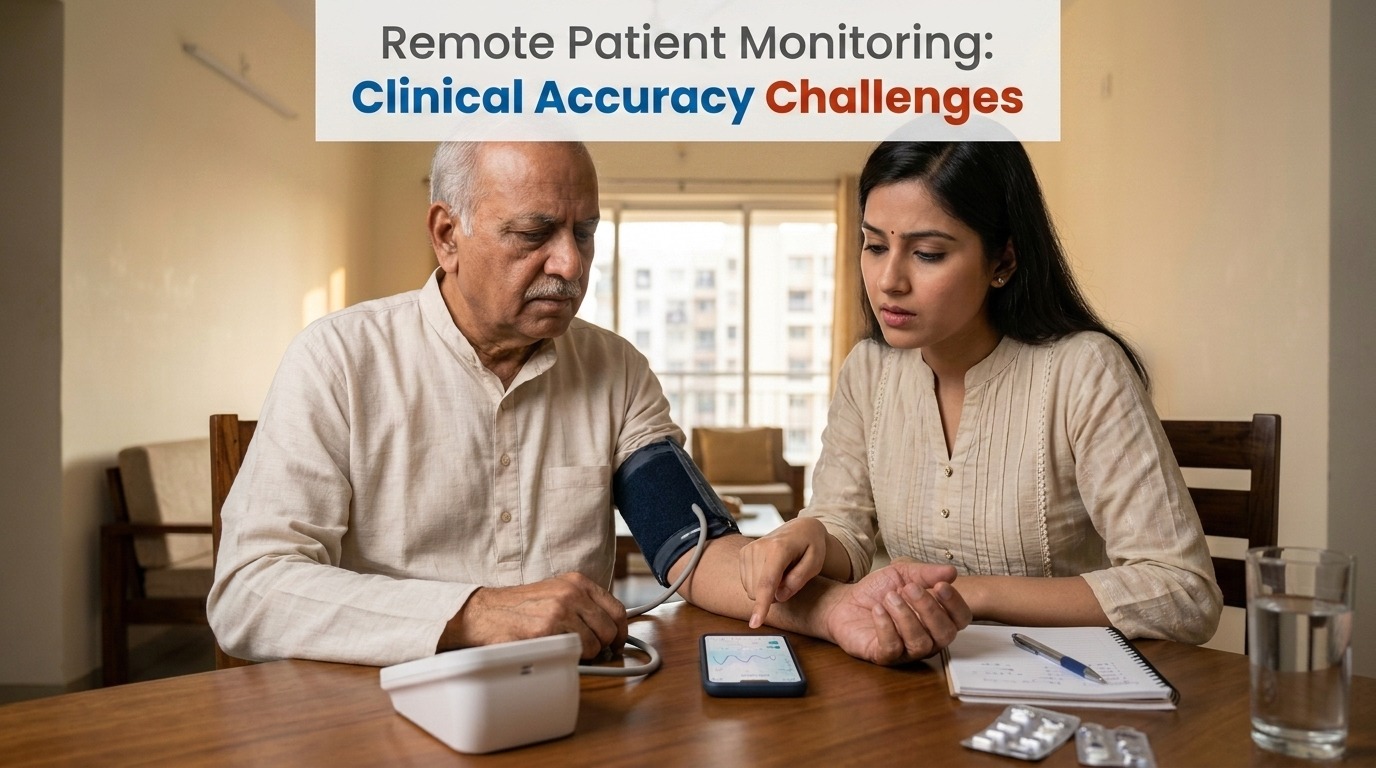
Case Study 1: Inconsistent Blood Pressure Readings
A patient using home monitoring for hypertension reported fluctuating readings that did not align with clinical measurements. Upon review, it was found that the device was not being positioned correctly during use.
The system itself was functioning, but user behavior introduced variability. Once corrected, the readings became more consistent, highlighting how small factors influence accuracy.
Case Study 2: Data Gaps In Chronic Care
In a remote monitoring program for diabetes, gaps in data transmission led to incomplete records over several days. This made it difficult for clinicians to assess trends accurately.
The issue was traced to connectivity problems rather than device failure. It showed how infrastructure plays a role in maintaining reliable monitoring.
Case Study 3: Overinterpretation Of Irregular Data
A patient’s wearable device recorded irregular heart rate spikes, leading to concern. However, further evaluation showed that the spikes were linked to device sensitivity rather than an actual clinical issue.
This case reflected the importance of clinical validation when interpreting remote data.
Mistakes To Avoid In Remote Monitoring Systems
To improve accuracy, certain common mistakes should be avoided:
- Using non-clinical devices for medical decision-making
- Ignoring proper device usage instructions
- Relying solely on data without clinical validation
- Overlooking connectivity and data transfer issues
- Failing to train patients on correct usage
Addressing these areas can significantly improve the reliability of remote patient monitoring systems.
FAQs
1. What is remote patient monitoring in simple terms?
What is remote patient monitoring refers to tracking patient health using digital devices outside hospitals and sharing that data with doctors.
2. How does remote patient monitoring work?
How does remote patient monitoring work involves collecting health data through devices, sending it to healthcare providers, and using it for clinical decisions.
3. What are the benefits of remote patient monitoring?
The benefits of remote patient monitoring include continuous tracking, reduced hospital visits, and better chronic disease management.
4. What are the disadvantages of remote patient monitoring?
The disadvantages of remote patient monitoring include device inaccuracies, user errors, and data transmission issues.
5. Is remote patient monitoring accurate?
Accuracy depends on device quality, correct usage, and proper clinical interpretation.
6. What do remote patient monitoring statistics show?
Remote patient monitoring statistics show increasing adoption due to convenience and improved access to care.
7. Can remote monitoring replace hospital visits?
It can reduce visits but cannot fully replace clinical evaluations.
8. How is remote patient monitoring used for chronic diseases?
Remote patient monitoring for chronic diseases helps track long-term conditions like diabetes and hypertension.
9. What devices are used in remote monitoring?
Wearables, blood pressure monitors, glucose meters, and mobile apps are commonly used.
10. Who benefits the most from remote monitoring?
Patients with long-term conditions and limited access to healthcare benefit the most.
Conclusion
Remote care systems are becoming an essential part of modern healthcare, but their effectiveness depends on accuracy as much as accessibility. While remote patient monitoring offers clear advantages, its limitations must be understood and managed carefully. With the right balance between technology and clinical judgment, it can support better outcomes without replacing the human element of care.
 Team Healthvoice
#RemotePatientMonitoring #DigitalHealth