Documentation Gaps That Increase Medico-legal Risk in Private Practice
Meticulous documentation serves as a vital legal shield for private practitioners. By recording clinical narratives, informed consent dialogues, and negative findings, doctors protect their professional reputation against increasing medico-legal scrutiny.
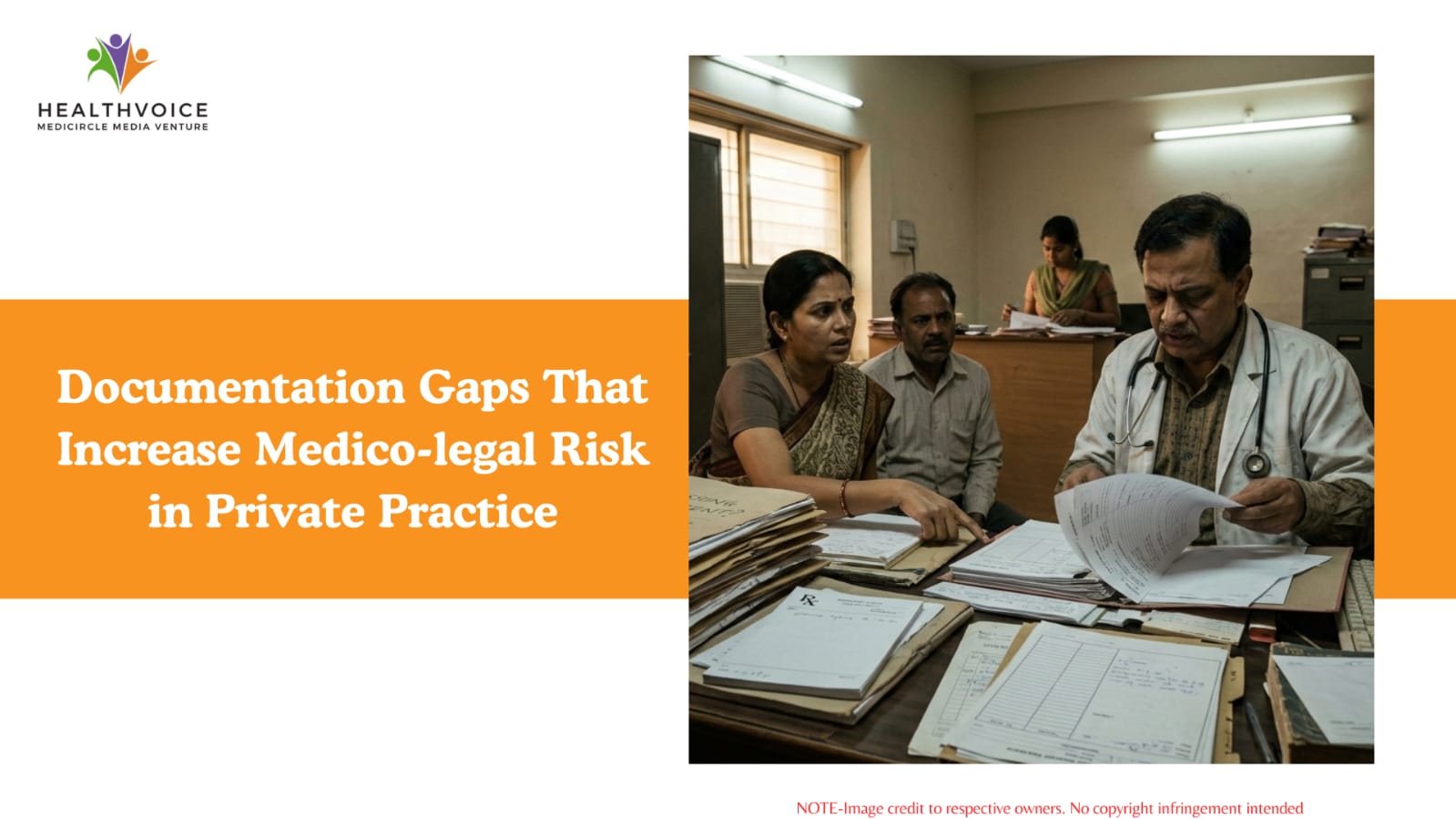
In the high pressure environment of an Indian private clinic, the clinical outcome often feels like the only thing that matters. If a patient recovers, the doctor feels they have succeeded. However, the legal landscape operates on a different set of rules. In a courtroom or before a medical commission, there is a fundamental maxim: if it was not written down, it did not happen. A patient medical file is much more than a collection of clinical observations; it is the most powerful shield a healthcare provider possesses against medico-legal challenges.
Legal Risks of Incompleteness:
Many legal battles in the Indian healthcare sector do not actually arise from medical errors. Instead, they stem from a documentation deficit, which is an inability to prove that the standard protocol was followed. In a busy solo practice, time is a luxury. Doctors often resort to clinical shorthand or brief summaries that make sense to them but look vague or incomplete to a judicial reviewer.
A solid medical record must function as a narrative. It should clearly outline the initial symptoms of the patient, the physical findings, and the thought process behind a specific diagnosis. When these connective tissues of the clinical story are missing, it becomes remarkably easy for a legal challenge to question why a specific drug was prescribed or why a surgical route was chosen over a conservative one.
Beyond the Consent Signature:
A common misconception in many clinics is that a signature on a standard form equals consent. In reality, the National Medical Commission and Indian courts view consent as a dialogue rather than a clerical task. For consent to be legally informed, the notes must reflect that the patient understood the risks, the benefits, and the alternatives in their own language.
If a known complication occurs, a legal expert will immediately check if that specific risk was discussed. Simply writing that consent was taken is often insufficient. Documenting that the family was briefed, or noting a specific question the patient asked, provides concrete evidence that a genuine conversation took place. This level of detail can be the deciding factor in a medico-legal defense.
Value of Negative Findings:
Most practitioners naturally focus on recording what is wrong with a patient. However, documenting what is not wrong, often referred to as negative findings, is just as critical. For example, if a patient presents with a headache, noting the absence of neck stiffness proves that the doctor actively screened for serious conditions like meningitis.
Without these recorded observations, an opposing counsel can claim that a vital sign was overlooked because it was never checked. In the rapid fire setting of private practice, these brief notes serve as proof of a thorough and systematic clinical examination.
Closing Communication Gaps:
In India, the doctor and patient relationship is built on trust, but that trust is tested when expectations are not met. Some of the most dangerous documentation gaps occur during discharge or follow up. If a patient is verbally told to return if they develop a specific symptom, but that instruction is missing from the discharge summary, the doctor may be held responsible for any subsequent delay in care.
Furthermore, it is vital to record instances where a patient chooses to ignore medical advice or refuses a diagnostic test. These non-compliance notes are essential for establishing that the actions of the patient played a role in the eventual clinical outcome.
Adopting Defensive Documentation:
Improving documentation is not about creating more paperwork; it is about ensuring that the quality of work is accurately represented. Adopting digital health records or using standardized templates can help ensure that no critical information is missed.
As patient awareness grows and legal scrutiny intensifies, meticulous record keeping becomes the ultimate tool for professional safety. Taking an extra minute at the desk after each consultation ensures that clinical excellence is backed by legal security. This practice allows doctors to do what they do best by caring for their patients with the peace of mind that their professional reputation is well protected.
 Team Healthvoice
#MBBSLife #MedicalTraining #MedicalDocumentation #MedicoLegal #HealthcareLaw #MedicalRecords #ClinicalDocumentation #PatientSafety #MedicalEthics #HealthcareIndia #InformedConsent #MedicalPractice #HealthcareCompliance #healthvoice
