Invalid Certificates, Valid Doctors: A Ruling That Divides the Medical Fraternity
The two students will enter the medical profession carrying both a degree and a reminder of controversy. They will have to earn trust through their practice
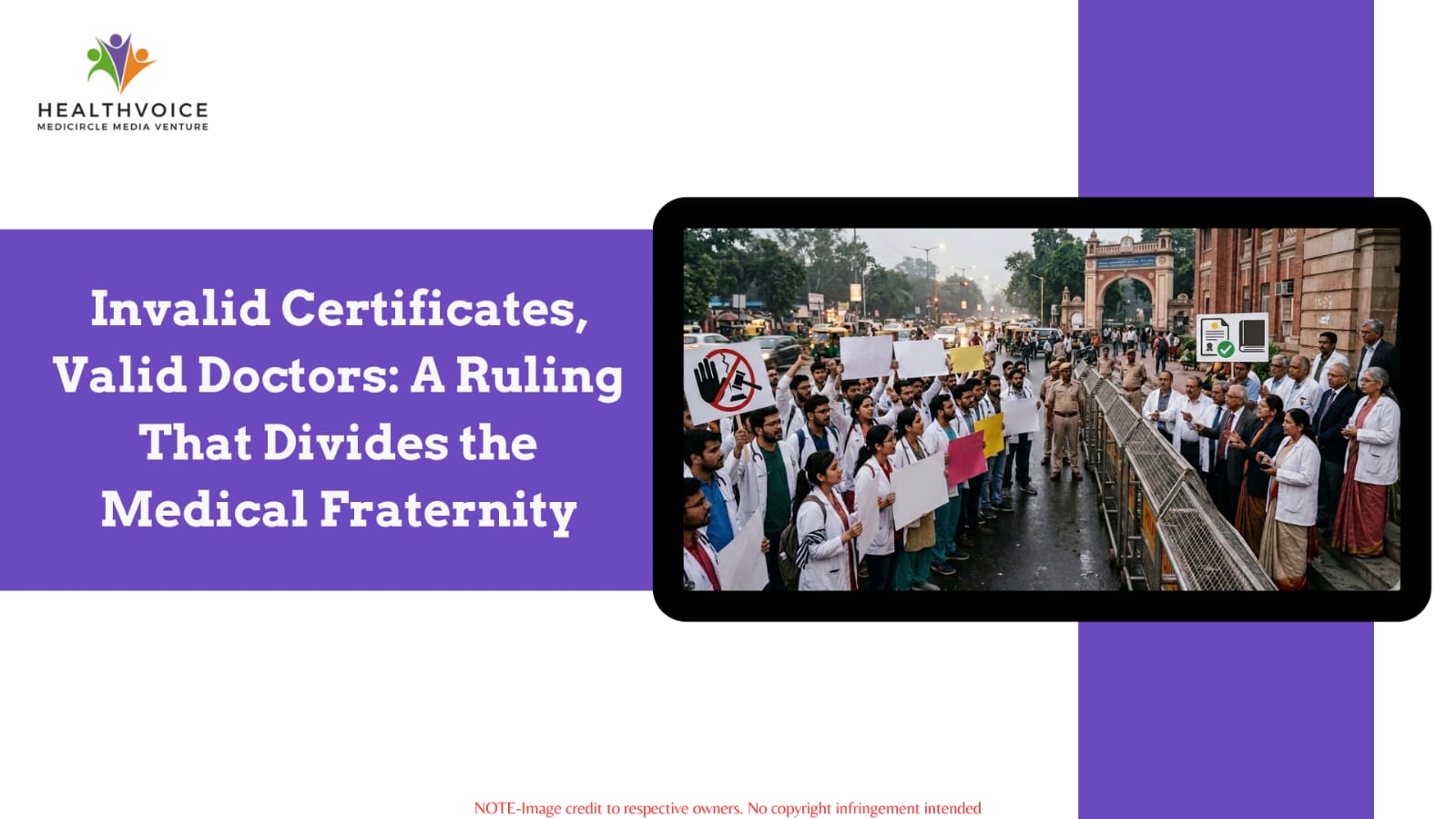
A medical degree is never just a certificate. It represents sleepless nights in wards, hours in anatomy halls, the first nervous patient interaction, and the long discipline of training under watchful mentors. It is a passport to a profession that carries power, trust, and social responsibility. So when the validity of that passport is questioned after the journey is complete, the consequences are not merely academic they are deeply human and profoundly systemic.
A recent decision of the Supreme Court of India has brought this tension into sharp focus. Two medical students from Maharashtra had gained entry into their courses under a reserved category by presenting tribe certificates. Years later, those certificates were declared invalid by the competent scrutiny authority. By that time, the students had completed their education and cleared their examinations. The university, bound by law and earlier judicial findings, could not issue their degrees. The matter ultimately reached the country’s highest court.
What followed was not a simple affirmation or rejection. Instead, the Supreme Court carved out a narrow and carefully conditioned relief. The students were allowed to receive their medical degrees, but only after depositing a substantial monetary amount with the university within a specified time. The court further directed that this sum be disbursed to candidates who had lost the opportunity to secure admission because the seats were occupied. The students also gave an undertaking that they would not claim any future reservation benefit based on the cancelled certificates. Importantly, the court clarified that this order was made in the peculiar facts of the case and should not be treated as a general rule.
For the medical community, this judgment sits at the intersection of medical education, constitutional law, social justice, and public health policy. It demands a deeper reflection than a headline can offer.
On one hand lies the principle of fairness in admissions. Reservation in medical colleges is not a charity; it is a constitutional instrument designed to correct historical disadvantage and ensure representation in professional spaces. For many students from Scheduled Tribe communities, these reserved seats are a gateway to education that might otherwise remain inaccessible. When someone secures such a seat through an invalid claim, the harm is not abstract. It displaces a deserving candidate whose future may have changed forever. The loss of that opportunity cannot be undone easily.
Critics of the Supreme Court’s approach may argue that allowing the students to retain a medical degree weakens the deterrent against misuse of reserved category certificates. Admission obtained on faulty documentation is, in legal terms, defective from the beginning. If consequences are softened after years of study, does that not risk sending a signal that irregularities can be cured later? In a system already grappling with document fraud and verification delays, strict enforcement is often seen as essential to protect the integrity of medical admissions in India.
There is also a moral dimension. Medicine demands honesty from its practitioners. If entry into the profession is clouded by questionable credentials, some may wonder whether the ethical foundation is compromised. Trust in the healthcare system depends on transparency at every stage, from admission to licensing to practice.
The other side of the debate is equally compelling. Medical education in India is demanding, expensive, and long. By the time the invalidity of the certificates was confirmed, the students had already completed the curriculum and passed their examinations. There was no allegation that they had cheated in exams or failed to meet academic standards. They had studied, trained, and demonstrated competence like any other candidate. To discard that training entirely would mean erasing years of effort and wasting scarce educational resources.
India continues to face a shortage of qualified doctors, particularly in rural and underserved areas. Discussions around doctor-patient ratio, primary healthcare strengthening, and expansion of medical seats dominate healthcare policy forums. Each new MBBS graduate represents potential relief for an overburdened system. In this context, the court appeared to consider whether society benefits from denying the country two trained doctors whose knowledge and skills are already acquired.
The bench chose what it described as a practical approach. It did not ignore the illegality in the admission process. Instead, it imposed a financial consequence and ensured compensation to those who might have been deprived. By requiring a significant deposit and an undertaking renouncing future reservation claims, the court attempted to balance accountability with social utility.
Supporters of this reasoning may view it as a humane application of constitutional power. The Supreme Court has, in rare situations, exercised its authority to mould relief in order to achieve what it considers complete justice. In this case, the judges seem to have weighed the long-term value of allowing trained professionals to serve patients against the rigid application of a rule that would permanently invalidate their degrees.
At the same time, the ruling exposes systemic weaknesses. Why are certificate verifications often concluded so late that students complete entire courses before clarity emerges? Delayed scrutiny creates uncertainty for students and institutions alike. It burdens universities with legal dilemmas and forces courts into difficult balancing acts. A more robust pre-admission verification mechanism could prevent such situations from arising in the first place.
Medical universities and regulatory bodies may now feel renewed pressure to strengthen admission governance. Digital integration of caste and tribe validation records, time-bound scrutiny processes, and tighter coordination between admission authorities and scrutiny committees are essential. Prevention is always preferable to post-facto correction.
The case also prompts reflection within the medical fraternity. Admission to MBBS programs is fiercely competitive. Thousands of aspirants compete for limited seats each year. When a seat is secured on the basis of incorrect documentation, the ripple effect extends beyond one individual. It touches families, communities, and careers. Doctors, who stand as custodians of ethics in society, must also engage in conversations about integrity at the entry level of the profession.
Yet compassion, too, is a core medical value. Many clinicians might quietly ask whether it is just to nullify a degree after a student has proven academic capability and completed training. The tension between law and equity is not new. Courts often confront situations where strict application of rules leads to harsh outcomes. The challenge lies in ensuring that flexibility does not become the norm, but remains reserved for exceptional cases.
The financial component of the order is also significant. By directing compensation to those who were denied admission, the court acknowledged that harm had occurred. Whether monetary payment can truly compensate for a lost educational opportunity is debatable, but it reflects an attempt to address competing equities. The message appears to be clear: relief will come at a cost.
The explicit clarification that the order should not serve as a precedent is equally important. It limits the scope of the decision and signals that future cases will be examined on their own facts. For medical colleges across India, this means that admission norms remain strict, and invalid certificates cannot be treated lightly.
The broader debate touches upon the evolving landscape of medical education in India. The expansion of medical colleges, regulatory reforms, and the push for transparency have transformed the sector in recent years. With rising public scrutiny and media attention on healthcare governance, cases like this attract intense discussion. They test the resilience of institutions and the adaptability of legal frameworks.
In the end, the two students will enter the medical profession carrying both a degree and a reminder of controversy. They will have to earn trust through their practice. The candidates who lost admission opportunities may feel that justice, even with compensation, remains incomplete. Institutions may re-examine their processes. Lawmakers may debate reforms.
The Supreme Court’s intervention does not close the conversation; it opens it. It forces the healthcare community to confront uncomfortable truths about verification systems, fairness in reservation, and the cost of procedural lapses. It also reminds us that the ultimate goal of medical education is service to society. When rules collide with that goal, the path forward is rarely simple.
Between strict legality and societal benefit, the court chose a narrow bridge. Whether history will judge that bridge as wise or flawed will depend on how institutions respond in the years to come. For now, the decision stands as a powerful example of how medical admissions, constitutional law, and public health realities intersect sometimes uneasily but always significantly
 Team Healthvoice
#SupremeCourt #SupremeCourtOfIndia #MedicalEducation #MBBS #ReservationPolicy #HealthcareIndia #MedicalEthics #LegalDebate #HealthcarePolicy #EducationLaw #JusticeSystem #healthvoice
