Health Policy in the Age of Artificial Intelligence
Artificial intelligence is reshaping health policy design, resource allocation, and governance in India, demanding active participation from doctors, medical associations, and policymakers to ensure equitable and accountable adoption.
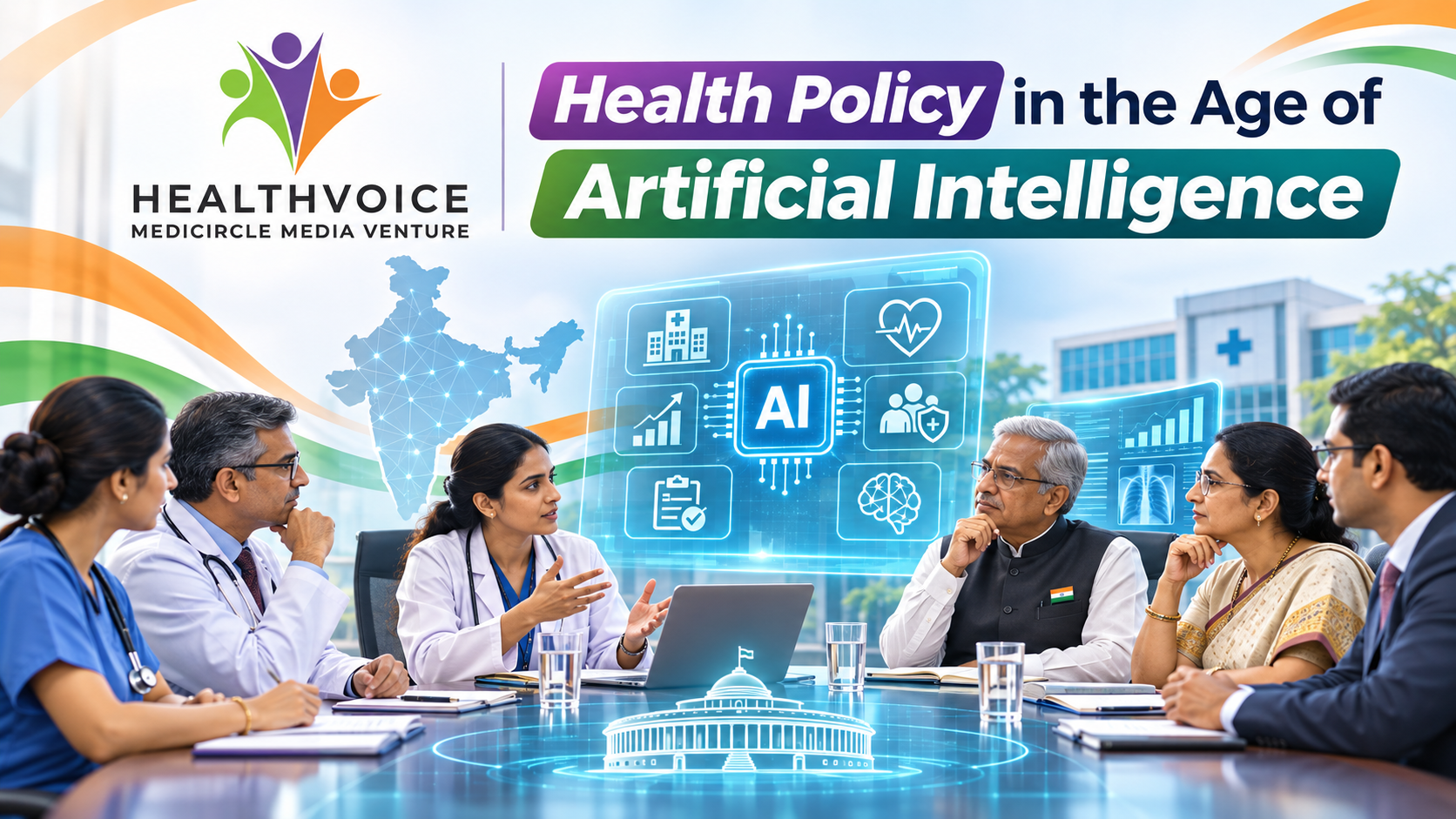
Health Policy in the Age of Artificial Intelligence: What It Means for India
Introduction
Across the world, governments and health ministries are facing a question they cannot avoid any longer: how should health policy be designed when artificial intelligence is becoming as fundamental to healthcare as the stethoscope once was? In India, this question carries particular weight. With over 1.4 billion people, a staggering burden of non-communicable and infectious diseases, a persistent shortage of trained healthcare professionals, and a rapidly expanding digital health infrastructure, the intersection of artificial intelligence and health policy is not a distant future concern. It is a present-day governance challenge.
The Indian government has made significant strides through initiatives such as the Ayushman Bharat Digital Mission (ABDM), the National Health Policy 2017, and various NITI Aayog frameworks on AI adoption. Yet the policy ecosystem around AI in healthcare remains fragmented, underexplored, and in urgent need of coherent direction. For doctors, medical associations, healthcare institutions, and policymakers, understanding how AI is reshaping health governance is no longer optional. It is a professional responsibility.
Understanding AI in the Healthcare Policy Context
Artificial intelligence in healthcare refers broadly to the use of machine learning, deep learning, natural language processing, and predictive analytics to assist in clinical decisions, public health planning, disease surveillance, drug discovery, and health system management. Within a policy context, AI touches almost every layer of how healthcare is organised, delivered, and evaluated.
It is important to distinguish between AI as a clinical tool and AI as a policy instrument. As a clinical tool, AI assists doctors in diagnosing conditions, interpreting imaging, predicting patient deterioration, or personalising treatment protocols. As a policy instrument, AI helps governments and health authorities analyse population data, forecast disease burden, model the impact of health interventions, allocate resources, and monitor the performance of health programs.
India's National Health Authority has already begun integrating data analytics into the management of Ayushman Bharat. The ABDM framework, which creates a unified digital health identity for every Indian citizen, is designed in part to generate health data at scale. That data, when processed responsibly through AI tools, has the potential to transform how India plans and delivers public health interventions.
How AI Is Reshaping Health Policy Design
Data-Driven Policymaking
Traditionally, health policy in India has been shaped by periodic surveys, population census data, and reporting from state health departments. These processes are slow, often incomplete, and prone to underreporting, particularly in rural and tribal areas. AI changes this dynamic substantially.
Machine learning models can analyse real-time data from multiple sources, including hospital records, pharmacy dispensing data, insurance claims, mobile health applications, and even social media signals, to detect disease trends far earlier than conventional surveillance systems. During the COVID-19 pandemic, several Indian states piloted AI-driven surveillance tools to predict hotspot emergence and healthcare capacity requirements. These pilots, while imperfect, demonstrated that AI-informed policymaking can be both faster and more precise than older methods.
The implications for India's National Health Mission and state-level public health programs are significant. AI-driven analytics can help health departments identify underserved populations, optimise the placement of primary health centres, predict seasonal disease surges, and design targeted outreach programs with far greater accuracy than was previously possible.
Resource Allocation and Health Equity
One of the most consequential applications of AI in health policy is in the area of resource allocation. India faces deep regional inequities in healthcare access. States like Kerala and Tamil Nadu have health indicators that compare favourably with middle-income countries, while states like Uttar Pradesh, Bihar, and Madhya Pradesh continue to struggle with high maternal mortality, poor child health outcomes, and inadequate healthcare infrastructure.
AI models can help policymakers understand where healthcare resources are most critically needed, model the impact of different investment strategies, and forecast outcomes based on historical data. This kind of analytical support, if used responsibly, can support more equitable distribution of doctors, medical equipment, medicines, and financial resources under schemes like Ayushman Bharat Pradhan Mantri Jan Arogya Yojana (AB-PMJAY).
However, this potential comes with a critical caveat. AI models are only as unbiased as the data they are trained on. If historical health data reflects decades of systemic neglect toward certain communities, the AI systems built on that data risk perpetuating rather than correcting existing inequities. This is one of the most pressing challenges policymakers in India must address.
Regulatory and Governance Challenges
The Gap in India's AI Health Regulatory Framework
Despite the rapid growth of AI-based health technology companies in India, a dedicated regulatory framework for AI in clinical and public health settings does not yet exist in a comprehensive form. The Central Drugs Standard Control Organisation (CDSCO) has begun examining AI-based medical devices and software as medical devices (SaMD), but regulatory clarity remains limited.
NITI Aayog's 2021 report on responsible AI for all outlined broad principles including safety, explainability, inclusivity, privacy, and accountability. These principles are important, but they are not binding policy. The National Medical Commission (NMC) and the Indian Council of Medical Research (ICMR) have issued some guidance on digital health tools, but the oversight of AI systems used directly in patient care or population health management remains a grey area.
For the medical community, this regulatory gap creates genuine uncertainty. When an AI diagnostic tool produces an incorrect output that contributes to a patient harm event, questions of liability, accountability, and clinical responsibility remain unresolved. These are not hypothetical concerns. They are practical governance problems that the intersection of AI and health policy must urgently address.
Data Privacy and Patient Rights
India's Digital Personal Data Protection Act, 2023 provides a foundational legal framework for how personal data, including health data, should be collected, stored, processed, and shared. However, the specific application of this law to health AI systems, which often require large volumes of sensitive patient data for training and operation, requires further detailed policy guidance.
The ABDM ecosystem, while promising in its ambition to create interoperable health records, also creates substantial data aggregation at a population scale. The question of who can access this data, for what purposes, and under what oversight mechanisms is a matter of active policy debate. Medical associations and civil society organisations have raised legitimate concerns about the commercialisation of health data and the adequacy of consent mechanisms under the current framework.
The Role of Doctors in an AI-Shaped Health System
Clinical Autonomy and AI-Assisted Decision Making
A concern that surfaces frequently in medical community discussions is whether AI systems will eventually erode the clinical autonomy of doctors. This concern, while understandable, reflects a misreading of how well-designed health AI actually functions. AI tools in clinical settings are designed to augment, not replace, the physician's judgment. They surface information, flag risk factors, suggest differential diagnoses, and highlight anomalies, but the final clinical decision remains with the qualified medical professional.
That said, the increasing reliance on AI outputs does create new professional responsibilities. Doctors who use AI-assisted diagnostic tools must understand the limitations of those tools, the nature of their training data, and the conditions under which their outputs may be unreliable. This requires a new dimension of AI literacy in medical education, something that the NMC and medical colleges must begin incorporating into undergraduate and postgraduate curricula in a structured way.
Doctors as Policy Stakeholders
Health policy that incorporates AI cannot be designed by technologists and administrators alone. Doctors are the primary interface between health systems and patients. Their frontline experience, clinical expertise, and understanding of patient behaviour, local health challenges, and care delivery realities are indispensable inputs for designing AI systems and governance frameworks that actually work in practice.
Medical associations in India have a critical role to play here. By actively engaging in consultations on AI health policy, contributing to the development of ethical guidelines for AI use in clinical settings, and advocating for robust regulatory frameworks that protect both patient safety and professional accountability, the medical community can shape the trajectory of AI adoption in Indian healthcare rather than simply reacting to it.
Platforms like HealthVoice exist precisely to facilitate this kind of professional engagement, giving doctors and medical associations a credible, organised space to make their voices heard on issues that will determine the future of healthcare in India.
Prevention, Public Health, and the AI Opportunity
AI's potential contribution to preventive health and public health in India is particularly compelling. India carries a disproportionate burden of preventable diseases. Diabetes, hypertension, tuberculosis, and cardiovascular disease together account for a vast proportion of the country's disease burden and healthcare costs.
Predictive AI models, integrated with data from ABDM health records, wearable devices, and population health surveys, could identify high-risk individuals for preventive intervention before clinical disease develops. Early identification and targeted outreach could reduce the downstream burden on secondary and tertiary healthcare facilities, which are already stretched in most Indian states.
Community health workers under programs like ASHA and ANM could be equipped with AI-assisted tools on mobile devices to conduct preliminary risk screening during home visits, referring at-risk individuals for further evaluation. This kind of AI-augmented primary healthcare could be transformative for India's rural and semi-urban populations, where specialist access remains limited.
Key applications of AI in India's preventive health landscape include:
- Predictive screening tools for non-communicable disease risk in community settings
- AI-enabled tuberculosis detection from digital chest X-rays, already being piloted in several states
- Automated analysis of maternal and child health data to identify at-risk pregnancies
- Disease outbreak prediction and early warning systems integrated with IDSP reporting
Conclusion
Artificial intelligence is not a disruption arriving from outside India's health system. It is already embedded within it, reshaping how data flows, how decisions are made, and how health programs are planned and evaluated. The policy question before India is not whether to adopt AI in healthcare, but how to do so in a manner that is equitable, safe, accountable, and genuinely aligned with the health needs of its population.
This requires a collaborative effort. Policymakers must develop robust, enforceable regulatory frameworks. Doctors and medical associations must engage actively in shaping those frameworks. Healthcare institutions must invest in AI literacy and responsible implementation. And digital health platforms must create the spaces where this professional dialogue can happen with clarity, credibility, and purpose.
The age of AI in health policy is not approaching. It is already here. The only question remaining is whether India's medical community will be architects of this transformation or observers of it.
Frequently Asked Questions
Q1: How is artificial intelligence changing health policy in India?
AI is influencing health policy in India by enabling data-driven decision-making, improving disease surveillance, strengthening the ABDM framework, and helping policymakers allocate healthcare resources more efficiently across diverse and underserved populations.
Q2: What are the risks of AI in healthcare governance?
Key risks include algorithmic bias rooted in historically skewed health data, data privacy concerns under evolving legal frameworks, lack of regulatory clarity for AI-based medical devices, infrastructure limitations in rural India, and the possibility of reduced human oversight in time-sensitive clinical decisions.
Q3: Is there a regulatory framework for AI in Indian healthcare?
India is in the process of developing a comprehensive AI regulation framework. The National Health Policy, ABDM guidelines, and NITI Aayog's responsible AI principles provide some direction, but a dedicated and binding AI-in-healthcare regulatory body with enforcement authority is still under active deliberation.
Q4: Can AI replace doctors in India?
No. AI is designed to support and augment the work of doctors, not replace them. Clinical judgment, patient empathy, contextual reasoning, and ethical responsibility remain irreplaceable human qualities in medical care. AI tools are decision-support systems, not decision-makers.
Q5: What role do doctors play in shaping AI health policy?
Doctors are essential stakeholders in AI health policy. Their clinical expertise, frontline insights, and understanding of patient care realities are critical to designing AI tools and governance frameworks that are ethical, safe, operationally sound, and genuinely effective for Indian patients.
Resources
- Indian Council of Medical Research (ICMR): Guidelines and research publications on digital health, AI in medicine, and evidence-based health policy for India.
- NITI Aayog: Reports and policy papers on responsible AI adoption in India, including the National Strategy for Artificial Intelligence and the Responsible AI for All framework.
- Ayushman Bharat Digital Mission (ABDM): Official documentation on India's digital health infrastructure, health ID framework, and interoperability standards.
- World Health Organization (WHO): Global guidance on ethics and governance of artificial intelligence in health, including the WHO AI Ethics and Governance Framework for Health.
- National Medical Commission (NMC): Regulatory updates and guidelines relevant to medical education, professional practice standards, and emerging healthcare technologies in India.
Interlinking Keywords
AI in health policy India, artificial intelligence in Indian healthcare, ABDM digital health, health policy governance India, AI regulation healthcare India, predictive analytics public health, AI medical diagnosis India, digital health infrastructure, NMC medical regulation, health equity India AI, AI disease surveillance, responsible AI healthcare
Last reviewed by:
Dr. Manthan Tripathi, HealthVoice Editorial and Medical Advisory Team, November 21, 2026.
Disclaimer
The information presented in this article is intended for general awareness, professional education, and public health communication purposes only. It does not constitute medical advice, clinical guidance, or legal counsel. Readers are advised to consult qualified healthcare professionals and relevant regulatory bodies for guidance specific to their clinical or organisational circumstances. HealthVoice makes every effort to ensure content accuracy and currency, but cannot be held responsible for decisions made based solely on the information provided herein.
 Dr. Manthan Tripathi
#AIinHealthcare #HealthPolicy