Doctor-Led Policy Advocacy in India: The Road Ahead
Doctor-led policy advocacy in India is evolving through stronger associations, digital platforms, and structured policymaker engagement, offering a credible foundation for equitable, physician-informed healthcare reform.
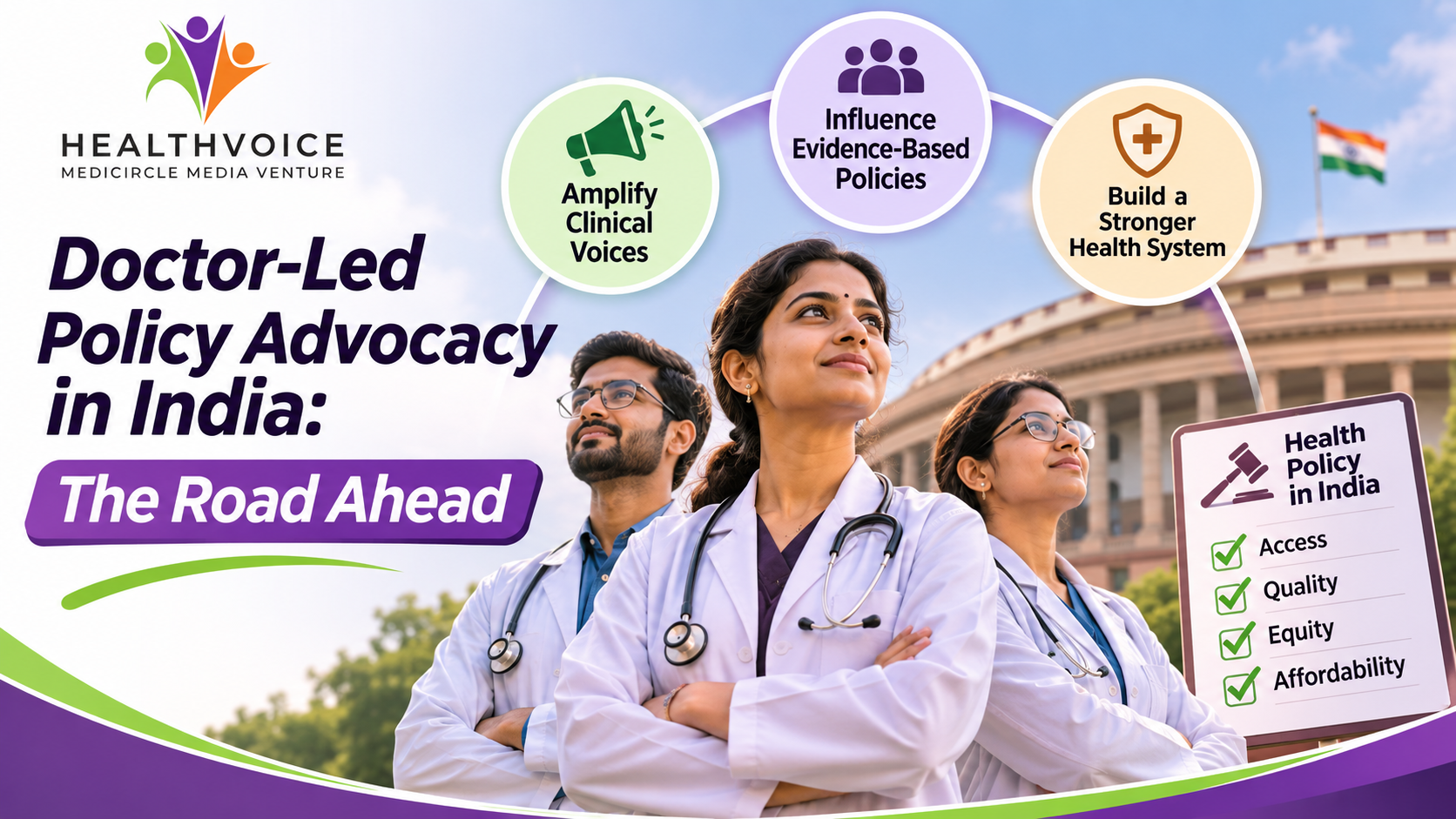
The Future of Doctor-Led Policy Advocacy in India
Introduction
India's healthcare system is undergoing a profound transformation. From the rollout of Ayushman Bharat and the Ayushman Bharat Digital Mission (ABDM) to sweeping reforms in medical education under the National Medical Commission (NMC), the policy landscape is shifting faster than at any other point in the country's post-independence history. At the center of this transformation, however, there remains a critical gap: the voices of the doctors who actually deliver care at the bedside, the clinic, and the community level are not yet systematically integrated into the policymaking process.
Doctor-led policy advocacy is not a new idea in India. The Indian Medical Association (IMA) has been engaging with Parliament, state governments, and regulatory bodies for decades. Medical associations, specialty societies, and professional bodies have submitted memoranda, organized delegations, and participated in legislative consultations over the years. What is new, however, is the scale, the urgency, and the opportunity that the current moment presents.
As India aspires toward Viksit Bharat 2047 and positions itself as a global leader in digital health, the question of who shapes healthcare policy has never been more consequential. This article examines the current state of doctor-led advocacy in India, the structural challenges that limit its effectiveness, and the emerging pathways through which physician communities can build a more organized, credible, and impactful presence in healthcare policymaking.
The Current State of Physician Advocacy in India
India produces over 1.1 lakh medical graduates annually, making it one of the world's largest pipelines of trained medical professionals. With approximately 13.86 lakh registered allopathic doctors as of April 2025, according to the Ministry of Health and Family Welfare, the country has a substantial professional base. Yet the translation of this clinical workforce into an organized advocacy force has remained inconsistent and fragmented.
The IMA, as the largest voluntary organization of modern medicine practitioners in India, remains the most prominent vehicle for doctor-led advocacy. It has been active across seven key policy domains: violence against doctors, regulation of the private healthcare sector, restriction of traditional medicine, professional authority and autonomy for physicians, publicly funded health insurance, medical ethics, and partnership in healthcare governance. In early 2024, the IMA unveiled a comprehensive health manifesto and engaged with over 60 Members of Parliament to discuss critical issues including the National Exit Test (NExT), bond policy, and mental health frameworks.
More recently, the IMA released its policy document "IMA's Blueprint for a Healthier India," which is being shared with Members of Parliament to push for significant policy changes, including stricter regulation of foreign direct investment in healthcare and the creation of a National Healthcare Fund.
These are meaningful steps. However, a May 2026 scoping review published in Health Policy and Planning noted that while the IMA is an influential actor in India's health policy processes, the degree of its influence raises a need for more inclusive and equitable representation in policymaking. This observation points to a central challenge: advocacy that is concentrated in a single body, however capable, cannot adequately represent the full diversity of India's medical community.
Why Doctor-Led Advocacy Matters for Healthcare Reform
The importance of physician voices in policymaking goes beyond professional interest. It is fundamentally about the quality and relevance of the policies that emerge. Doctors bring ground-level clinical experience, epidemiological awareness, and practical understanding of how health systems function (or fail to function) for real patients in real settings. Without structured physician input, policies risk being designed on assumptions that do not hold in the field.
Consider the current debate around India's public health spending. India's overall health expenditure stands at approximately 1.5 percent of GDP, a figure that IMA leadership has publicly criticized as deeply inadequate for a country of India's size and health burden. Rural areas face a doctor density of just 3 per 10,000 people compared to 13 per 10,000 in urban centers, a disparity that shapes the daily realities of hundreds of millions of Indians. These are not abstract statistics for doctors; they are the lived context of their professional practice.
Physicians also carry a unique form of institutional credibility. When doctors speak collectively on issues such as antibiotic stewardship, maternal mortality, non-communicable disease burden, or the safety of practitioners under threat of violence, policymakers are compelled to pay attention in ways that other stakeholders cannot always achieve. The challenge is to organize that credibility into a durable, structured, and representative advocacy architecture.
Key Areas Where Doctor-Led Advocacy Is Gaining Momentum
Several policy domains are witnessing increasing physician engagement, reflecting both the breadth of issues facing the medical community and the growing awareness among doctors that professional silence is no longer tenable.
Healthcare Financing and Public Investment
The IMA has warned that chronic underfunding, insurance-led price controls, and unregulated foreign investment are actively weakening India's model of affordable and accessible care, particularly for the network of neighborhood clinics and small to medium hospitals that form the backbone of community healthcare. Doctor organizations have been vocal in calling for a shift away from insurance-led models that risk replicating high-cost, inequitable care systems seen elsewhere.
Medical Education and Workforce Policy
The NMC's introduction of competency-based medical education, the redesign of postgraduate training pathways, and the contested rollout of the NExT examination have made medical education a flashpoint for advocacy. Resident doctor associations, national federations, and specialty societies have engaged directly with the NMC to present clinical education perspectives that institutional administrators and bureaucratic planners may not fully appreciate.
Doctor Safety and Medico-Legal Reform
The safety of medical professionals remains one of the most urgent advocacy concerns. Violence against doctors in clinical settings, the criminalization of medical negligence, and the expansion of POCSO provisions to healthcare contexts have all generated significant professional mobilization. These are issues where organized medical advocacy has the potential to directly influence legislative outcomes.
Digital Health Governance
Greater focus is being placed on digital health integration, telemedicine standards, policy advocacy, and strengthening primary healthcare systems. As ABDM scales nationally and telemedicine becomes a permanent feature of Indian healthcare delivery, doctors have both a right and a responsibility to shape the regulatory frameworks that govern these transitions.
The Role of Digital Platforms in Enabling Physician Advocacy
One of the most significant developments reshaping doctor-led advocacy in India is the emergence of dedicated digital platforms that connect physicians, associations, and healthcare communities at scale. Digital platforms are democratizing access to trusted medical expertise by enabling doctors in smaller cities to participate in the same scientific conversations as peers from leading institutions.
This democratization has direct implications for advocacy. A specialist in a district hospital in Jharkhand and a senior consultant at a tertiary center in Mumbai can now engage with the same policy debates, respond to the same consultation drafts, and add their professional voices to the same advocacy campaigns. The geographical and institutional hierarchies that previously concentrated advocacy in metropolitan medical establishments are beginning to break down.
Platforms built specifically for the medical community, such as HealthVoice, are playing an important role in this shift. By giving doctors and medical associations a credible, organized digital presence, these platforms help translate individual professional opinion into collective advocacy. Association announcements, policy position papers, expert commentaries, and community discussions can reach their intended audiences quickly and reliably when the communication infrastructure is designed with the medical community in mind.
The National AI Doctors Mission (NAIDM), launched at Health AI Con 2026, has articulated a clear principle that AI in healthcare must be doctor-led, ethically guided, and clinically grounded. This kind of mission-driven initiative illustrates how the medical community is beginning to move from reactive advocacy to proactive leadership, not simply responding to policies after the fact but helping to define the terms on which new technologies and frameworks are introduced.
Structural Challenges That Must Be Addressed
Realizing the full potential of doctor-led advocacy in India requires an honest acknowledgment of the structural barriers that currently limit its effectiveness.
Fragmentation remains the most significant obstacle. India has hundreds of specialty societies, state-level medical associations, hospital associations, and professional bodies, many of which operate in silos without coordinated advocacy strategies. This fragmentation dilutes the collective voice of the profession and allows policymakers to engage selectively with whichever body is most convenient for a given agenda.
Representation gaps also persist. Young doctors, women physicians, rural practitioners, and specialists from non-metropolitan regions are underrepresented in formal advocacy structures. The IMA's policy stances have at times been narrowly focused on protecting the dominance and ideology of biomedicine and protecting the interests of physician groups rather than reflecting the full range of healthcare perspectives. Broadening the base of advocacy to include the full diversity of India's medical community is essential for building the legitimacy and reach that effective policy influence requires.
There is also a skills gap. Effective policy advocacy requires competencies in legislative processes, communication strategy, stakeholder engagement, and evidence translation that medical training does not provide. Building these capacities within medical associations and equipping individual doctors to participate meaningfully in policy discussions is a long-term investment that the profession must make deliberately.
Building the Future: What Organized Doctor-Led Advocacy Looks Like
The vision for doctor-led policy advocacy in India is not simply about doctors having a louder voice in existing processes. It is about building a mature, institutionalized, and credible advocacy infrastructure that can sustain meaningful engagement with government bodies, regulatory authorities, and the public over the long term.
Several elements are essential to this vision:
- Unified national frameworks that bring together specialty societies, hospital associations, and regional bodies around shared policy priorities without erasing their individual mandates
- Structured engagement pathways with the Ministry of Health and Family Welfare, the NMC, the ICMR, and parliamentary health committees, ensuring that physician input is invited, documented, and responded to in formal policymaking processes
- Investment in advocacy capacity building through training programs, fellowship opportunities, and institutional support for doctors who want to specialize in health policy and systemic reform
- Digital communication infrastructure that allows associations to mobilize members quickly, disseminate evidence-based positions clearly, and maintain sustained engagement with both policymakers and the public
- Transparent, inclusive governance within medical associations that reflects the demographic and geographic diversity of India's physician workforce
Platforms like HealthVoice are designed to support exactly this kind of architecture. By connecting doctors, associations, healthcare brands, and institutional stakeholders in a single trusted digital community, HealthVoice enables the kind of organized, credible, and impact-oriented professional communication that effective advocacy demands.
Conclusion
The future of doctor-led policy advocacy in India is not a distant aspiration. It is a present necessity. As the country navigates the complexity of healthcare financing reform, digital health governance, medical education restructuring, and the persistent inequities of its health system, the organized voice of the medical community is one of the most valuable and underutilized resources available to policymakers.
India's doctors have the expertise, the credibility, and the professional motivation to shape healthcare policy in ways that are grounded in clinical reality and committed to patient welfare. What they need is the institutional infrastructure, the digital platforms, and the collective professional culture to do so consistently and effectively. The organizations, platforms, and initiatives that support doctor-led advocacy today are not just serving professional interests. They are building the foundation for a healthier, more equitable, and more accountable healthcare system for every Indian.
Frequently Asked Questions
Q1: What is doctor-led policy advocacy in India?
Doctor-led policy advocacy in India refers to the active participation of physicians and medical associations in shaping healthcare legislation, public health programs, and systemic reforms through organized engagement with policymakers, government bodies, and regulatory authorities.
Q2: What role does the IMA play in health policy in India?
The Indian Medical Association is one of the largest physician bodies in the world. It engages with Parliament, submits policy documents, publishes health manifestos, and advocates on issues such as healthcare funding, medical education reform, doctor safety, and telemedicine standards.
Q3: How are digital platforms changing doctor advocacy in India?
Digital platforms are enabling doctors across India, including those in Tier 2 and Tier 3 cities, to participate in policy discussions, amplify professional voices, engage with associations, and contribute to healthcare reform conversations in real time, breaking down earlier geographical and institutional barriers.
Q4: What are the key barriers to effective doctor-led advocacy in India?
Key barriers include fragmented representation across associations, limited structured engagement with government bodies, underrepresentation of specialists and young doctors in advocacy processes, and inadequate digital infrastructure for unified professional communication.
Q5: Why is doctor-led advocacy important for India's healthcare future?
Doctors bring frontline clinical experience and evidence-based insight to policy discussions. Their active involvement ensures that healthcare reforms remain practical, patient-centered, and aligned with ground-level realities across diverse Indian healthcare settings.
Resources
- Indian Medical Association (IMA): National physician advocacy body representing modern medicine practitioners and engaging with health policy at central and state levels.
- National Medical Commission (NMC): Regulatory authority for medical education and professional standards, a primary stakeholder in medical workforce and education policy.
- Ministry of Health and Family Welfare (MoHFW): Central government body responsible for healthcare policy, public health programs, and national health schemes including Ayushman Bharat.
- World Health Organization India Country Office: Provides global evidence frameworks and country-level technical support for health policy, advocacy, and systemic health reform.
- Indian Council of Medical Research (ICMR): India's apex biomedical research body, providing evidence that underpins clinical and public health policy advocacy.
Interlinking Keywords
Doctor-led policy advocacy, physician advocacy India, IMA health policy, medical associations India, healthcare reform India, NMC medical education policy, doctor voice healthcare, Ayushman Bharat reform, digital health governance India, medical community engagement, HealthVoice India, healthcare policymaking, clinical advocacy India
Last reviewed by:
Dr. Manthan Tripathi, HealthVoice Editorial and Medical Advisory Team, November 19, 2026.
Disclaimer
The content published on HealthVoice is intended for informational and professional engagement purposes only. It does not constitute medical advice, clinical guidance, or legal counsel. Readers are encouraged to consult qualified healthcare professionals and refer to official government and regulatory sources for specific medical or policy decisions. HealthVoice makes every effort to ensure accuracy and credibility in all published content, drawing on reputable sources including government bodies, peer-reviewed research, and recognized professional organizations.
 Dr. Manthan Tripathi
#DoctorLedAdvocacy #HealthPolicy