Why Interoperability Is More Than a Technology Problem
Interoperability in Indian healthcare demands governance coherence, clinical trust, semantic standardisation, and human-centred design, extending well beyond the technical infrastructure ABDM has built.
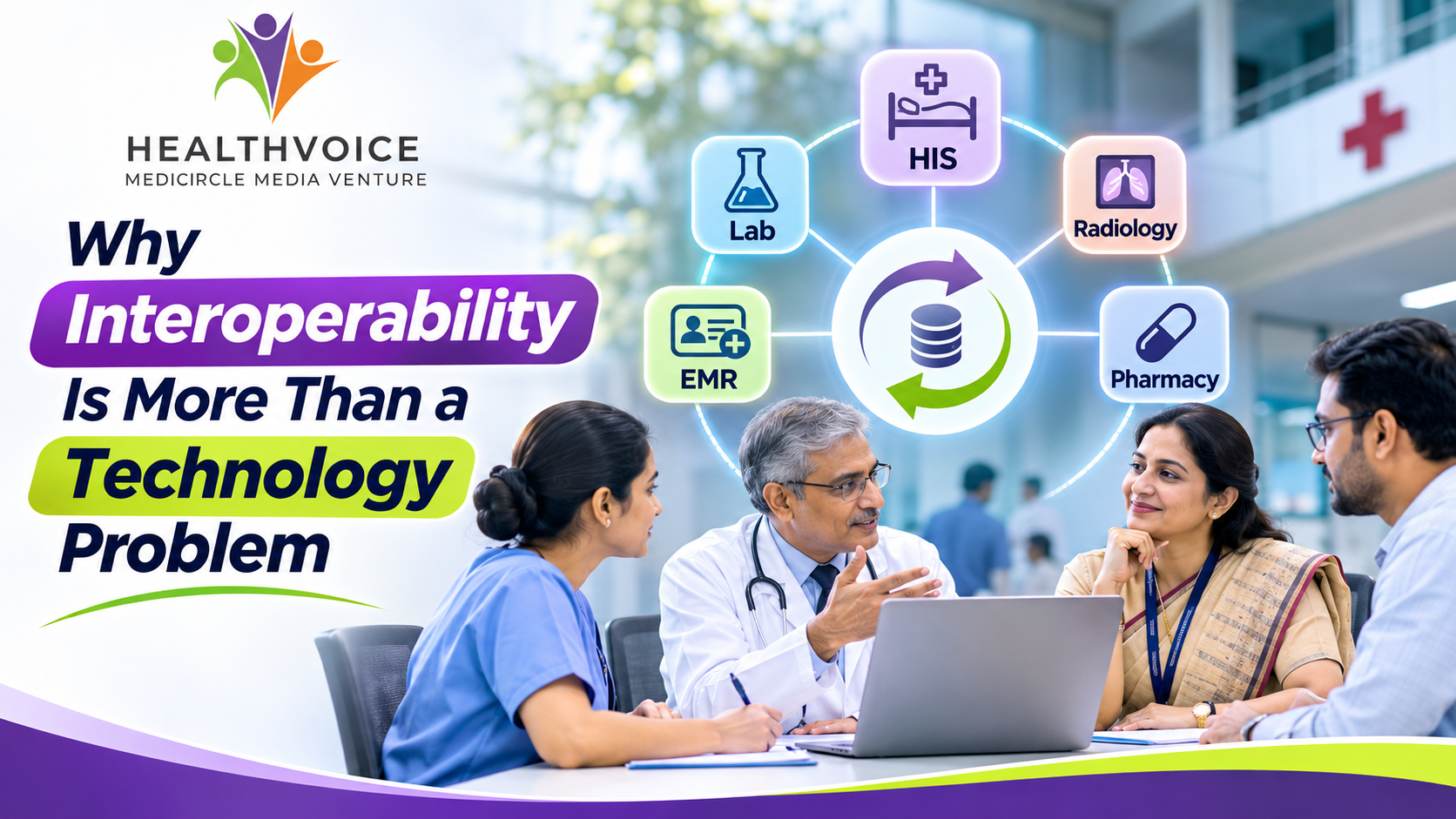
Why Interoperability Is More Than a Technology Problem: The Human, Governance, and Trust Dimensions India Must Address
Introduction
India is building one of the most ambitious digital health ecosystems the world has seen. The Ayushman Bharat Digital Mission has achieved a major milestone, with over 100 crore health records now linked and a rapidly growing network connecting patients, providers, insurers, and healthcare facilities under one interoperable framework. These numbers are genuinely significant. They reflect years of policy effort, infrastructure investment, and institutional commitment.
Yet a persistent question follows every celebration of this progress: why does interoperability still feel incomplete on the ground? Why do patients continue to carry physical reports from one hospital to another? Why do doctors in many parts of the country remain uncertain about how to use digital health identifiers effectively? Why does the experience of truly connected healthcare remain distant for a large section of India's population?
The honest answer is that interoperability was never purely a technology problem. It is a governance problem, a human behaviour problem, a trust problem, and a policy problem. Technology is a necessary foundation, but it is not sufficient on its own. This distinction matters enormously for how India builds its next phase of digital health, and for the medical community that sits at the centre of that effort.
Understanding Interoperability Beyond the Technical Definition
The standard definition of interoperability describes the ability of different health information systems to access, exchange, interpret, and use data cooperatively. At the technical level, this involves standards such as HL7 FHIR, application programming interfaces, and data exchange protocols. India's national digital health architecture has made real progress on this technical layer. HL7 FHIR has emerged as the leading framework for health information exchange in India, underpinning key national programmes including ABDM and the National Health Claims Exchange.
However, technical conformance with a standard does not automatically produce meaningful interoperability in practice. National adoption of FHIR does not automatically produce meaningful interoperability. The critical transition is from standards adoption to implementation maturity, requiring implementers to have the incentives, tools, governance pathways, terminology services, validation infrastructure, and workforce capacity needed to actually use FHIR effectively.
This is not a minor distinction. A hospital may integrate technically with ABDM's sandbox environment, pass the required validation tests, and receive production credentials, while still operating in a way that creates no meaningful improvement in patient experience or clinical outcomes. The technical box is ticked, but the deeper purpose of interoperability, which is continuity of care and informed clinical decision-making, remains unfulfilled.
Healthcare interoperability must therefore be understood across four dimensions, not just one:
- Technical interoperability: The ability of systems to exchange data using common standards and protocols.
- Semantic interoperability: The ability of systems to interpret that data in a consistent, meaningful way.
- Process interoperability: The alignment of clinical and administrative workflows to actually use shared data.
- Organisational interoperability: The governance, policy, and institutional frameworks that sustain data exchange across legal, geographic, and institutional boundaries.
As defined by HIMSS, organisational interoperability encompasses the policies, processes, and governance that enable coordinated care across different legal and social entities. This level is frequently the most difficult to achieve. India has invested heavily in the technical layer. The organisational layer remains the unfinished work.
The Governance Gap That Slows Real-World Progress
One of the most persistent barriers to interoperability in India is not a missing technology. It is fragmented and inconsistent governance. A mixed-methods landscape assessment conducted in late 2025 identified 21 barriers to FHIR adoption across institutional, technical, and operational domains. Among the most prominent were weak incentives, fragmented and rigid governance, limited validator and tooling infrastructure, terminology gaps, and workforce constraints. Lack of funding or business incentives appeared among the top three barriers for nearly two-thirds of survey respondents.
Governance in this context means more than regulatory oversight. It means clarity on who is responsible for ensuring that standards are followed beyond large public hospitals. It means coherent enforcement mechanisms that extend to private providers, diagnostic laboratories, and health insurance companies. It means creating incentive structures where following interoperability standards generates genuine value for providers rather than adding administrative burden.
Successfully implementing interoperability across clinics, hospitals, laboratories, and pharmacies requires more than technology. Governance, policy, and regulatory frameworks are foundational. The real challenge lies in structuring systems for interoperability through strong governance and cohesive regulations, particularly for private sector compliance.
India's private healthcare sector is not a peripheral concern in this discussion. It delivers the majority of outpatient and specialist care in urban India. Without genuine private sector participation in interoperable data exchange, any national interoperability architecture will remain incomplete. Interoperability becomes meaningful only when it extends beyond government platforms. By May 2026, more than 450 public and private HealthTech solutions had integrated with the ABDM ecosystem. This is progress, but integration at the application level does not guarantee consistent, high-quality data exchange at the clinical level.
The Human Dimension: Doctors, Workflows, and Daily Clinical Reality
Interoperability ultimately depends on what happens in the consultation room, the ward, and the outpatient department. It depends on whether a doctor can quickly access a patient's previous records from another facility, whether a nurse has the digital literacy to use an integrated system efficiently, and whether the technology reduces the burden of documentation rather than adding to it.
The average Indian doctor sees 40 to 60 patients a day, leaving little time for uploading patient data themselves. Doctors are expected to participate in digital health data systems, but the structural conditions of practice in India make this expectation difficult to meet without serious workflow redesign.
This is not a matter of doctors being unwilling to embrace digital health. Survey responses show that resistance arises from coordination gaps across clinical, operational, and managerial layers rather than any single group. The friction is systemic. When a digital system requires a clinician to spend additional time on data entry without offering a visible improvement in patient care, the rational response is to minimise engagement with that system.
The starting point for any successful digital health initiative must be a deep understanding of the problem, existing workflows, and the needs of the people who ultimately use and experience the solution. Technology should then be selected and tailored to address those needs, not the other way around.
This insight from ground-level implementation experience in Maharashtra, Andhra Pradesh, and Odisha carries a direct message for the broader interoperability effort: clinical workflows must be redesigned alongside the introduction of new digital standards, not after them. Resistance among clinicians is not binary. It spans a spectrum from those who are highly motivated but difficult to train, to those who are easy to train but difficult to motivate. Building a culture of digital health participation requires strategies that address both ends of this spectrum.
Trust, Data Privacy, and Patient Participation
Interoperability is not only a provider-side challenge. Patients must also participate, and their participation depends on trust. For ABDM to be widely adopted, people must believe that their data is secure and will not be misused. Moving beyond technology-first thinking to embrace a people-first, system-aware approach is essential to unlock the full potential of digital health infrastructure.
Trust in this context means several things. It means confidence that health data shared for one purpose will not be used for another without consent. It means assurance that private health records will not reach insurance companies, employers, or other parties without explicit patient authorisation. It means understanding, in plain language, what sharing a health record actually entails.
Patients and some providers remain cautious about submitting or sharing health records digitally, often because of concerns about privacy, data misuse, or simply a lack of familiarity with how digital systems work. Building trust is critical for adoption. Trust cannot be engineered by deploying a consent mechanism in an application. It is built through transparency, demonstrated accountability, meaningful patient education, and a track record of responsible data stewardship.
India's Digital Personal Data Protection Act represents an important legislative step in establishing the legal framework for data trust. However, law and policy are only part of the answer. The lived experience of patients interacting with digital health systems must reinforce rather than erode confidence in how their data is handled.
Semantic Gaps and the Unfinished Work of Standardisation
Even where technology and governance frameworks are in place, a subtler problem persists: the gap between structural interoperability and semantic interoperability. A system may successfully transmit a patient's health record from one provider to another, but if the receiving system interprets clinical terms, diagnosis codes, or medication names differently, the transferred data may be misleading or clinically unusable.
The persistent missing piece in ABDM's interoperability story is end-to-end semantic mapping across India's fragmented legacy EMR vendors and local language clinical records. While structural FHIR standards exist, consistent terminology adoption and high-quality mappings remain uneven, causing partial semantic interoperability despite strong API conformity.
This matters enormously in a country as linguistically and clinically diverse as India. While urban doctors may attribute heart disease to cardiovascular issues, rural doctors may see it linked to rheumatic heart disease, leading to biases in data sets and in the downstream recommendations generated from that data. Interoperability that ignores clinical and linguistic context does not simply fail to add value. It risks actively distorting the clinical picture.
Addressing this requires investment in Indian clinical terminology standards, local language support in digital health tools, and ongoing education for frontline providers about how data quality affects the shared clinical record.
What Meaningful Progress Looks Like
None of this is an argument against digital health or against the ambition of building a fully interoperable healthcare system in India. The goal is right. The infrastructure is real. The challenge is ensuring that the work of building a connected health ecosystem does not stop at the technical compliance layer.
Digital health is not necessarily about digital. It is about health. The four dimensions that must be addressed are people, process, technology, and business model. Capacity building and awareness are as central to success as the architecture itself.
Meaningful interoperability will look like a patient seen by a specialist in a tier-two city who can access their primary care records without being asked to carry a folder of printed reports. It will look like a doctor who has reliable, structured clinical information from a previous provider before a consultation begins. It will look like an insurance claim processed without manual re-entry of data because the systems involved speak a common clinical language.
Getting to that reality requires the following:
- Participatory governance structures that bring together public institutions, private providers, medical associations, patient groups, and technology developers around shared standards and enforcement mechanisms.
- Clear and meaningful incentives for private hospitals and clinics to integrate with interoperable platforms, not just large tertiary centres.
- Digital literacy investments for frontline clinicians and health workers, tailored to the actual constraints of their clinical environments.
- Workflow-aware implementation that reduces, rather than increases, documentation burden on doctors.
- Transparent data governance that earns and maintains patient trust over time.
The Role of Medical Communities and Associations
Medical associations, professional bodies, and doctor communities have an essential role that goes beyond policy advocacy. They are trusted voices for clinical professionals navigating unfamiliar digital terrain. When associations actively support and explain the purpose and operation of interoperable systems, adoption accelerates. When they remain distant from the conversation, hesitation and resistance fill the gap.
Healthcare facilities are being encouraged to adopt ABDM-enabled systems and integrate with the National Health Claims Exchange, with the reinforcement that interoperability is the way forward for connecting India's diverse healthcare ecosystem. This message carries greater weight when it comes from within the medical community rather than only from technology developers or government agencies.
Platforms that connect doctors, associations, and healthcare stakeholders have a meaningful contribution to make here. Making the conversation about interoperability visible, grounded, and credible within professional networks helps translate policy ambition into clinical practice.
Conclusion
Interoperability in Indian healthcare is an achievement in progress, not a problem already solved. The technical foundations built through ABDM, FHIR standards, and the national digital health architecture are genuinely impressive. India is ahead of many comparable health systems in its institutional ambition and digital public infrastructure.
The work ahead lies in the dimensions that technology alone cannot address: governance coherence, clinical workflow alignment, semantic standardisation, trust-building with patients, and the genuine engagement of medical professionals as partners rather than compliance subjects. The Ayushman Bharat Digital Mission acknowledges that health data is not just a technical asset but a public good, and that achieving its full potential requires moving beyond technology-first thinking to embrace a people-first and system-aware approach.
The question for India's healthcare leadership, medical associations, and digital health community is not whether interoperability is worth building. It clearly is. The question is whether the commitment to build it properly extends to every layer of the challenge: human, institutional, cultural, and clinical. When it does, the vision of genuinely connected healthcare for 1.4 billion people becomes not just technically possible, but practically real.
Frequently Asked Questions
Q1: What is healthcare interoperability and why does it matter in India?
Healthcare interoperability is the ability of different health information systems to access, exchange, and use data cooperatively across providers and care settings. In India, it matters because patients consult multiple providers across fragmented public and private health systems, often with no continuity of records. Without interoperability, patients repeat tests, carry physical documents, and experience gaps in care quality. Building interoperability is fundamental to improving clinical outcomes and health system efficiency at scale.
Q2: What is the role of ABDM in building interoperability in India?
ABDM provides the foundational digital public infrastructure for health data interoperability through ABHA health identities, the Healthcare Professional Registry, the Healthcare Facility Registry, and FHIR-based data exchange standards. It creates a consent-based, federated framework where health records can be shared securely across providers. By May 2026, the system had linked over 100 crore health records and registered more than 10.50 lakh healthcare professionals, establishing the structural layer of a connected health ecosystem.
Q3: Why do doctors resist adopting interoperable digital health systems?
Resistance among doctors is not primarily attitudinal. It arises from high patient volumes, limited consultation time, inadequate training in digital tools, friction between existing clinical workflows and new data-entry requirements, and genuine concerns about data accuracy and privacy. The average Indian doctor sees 40 to 60 patients a day, making additional digital documentation burdensome without workflow support. Addressing resistance requires workflow redesign, digital literacy programmes, and technology that reduces rather than increases the administrative load on clinicians.
Q4: What is FHIR and how is it used in Indian healthcare?
FHIR, or Fast Healthcare Interoperability Resources, is an international standard developed by HL7 International for structuring and exchanging electronic health information between different systems. In India, it is the core technical standard for ABDM and the National Health Claims Exchange. FHIR enables structured data exchange using modern web technologies, making it possible for different hospital management systems, insurance platforms, and digital health applications to share and interpret clinical data in a consistent format.
Q5: What must change for interoperability to succeed fully in India?
Achieving genuine interoperability requires action across multiple dimensions simultaneously. Governance structures must become more participatory and enforceable, particularly for private sector providers. Incentive frameworks must make integration worthwhile for small and mid-sized facilities. Semantic standardisation must address the gaps in clinical terminology that persist despite technical FHIR conformance. Digital literacy investments must reach frontline clinicians and health workers. And patient trust must be earned through transparent, accountable, and consent-driven data governance rather than assumed.
Resources
- Ayushman Bharat Digital Mission (ABDM), National Health Authority: The official source for India's digital health infrastructure standards, ABHA registration data, interoperability frameworks, and policy documentation.
- Ministry of Health and Family Welfare, Government of India: Central repository of national health policy, the National Digital Health Blueprint, and regulatory frameworks governing digital health implementation across India.
- World Health Organization (WHO) India Country Office: Guidance on digital health strategy, health information systems, and interoperability frameworks relevant to low- and middle-income country contexts.
- Indian Council of Medical Research (ICMR): Authoritative source for evidence-based guidance on health data standards, clinical research, and public health policy in India.
- National Resource Centre for EHR Standards (NRCeS): The body responsible for India-specific FHIR implementation guides that underpin ABDM's technical architecture and semantic standards.
Interlinking Keywords
Healthcare interoperability India, ABDM digital health, FHIR standards India, health data exchange, National Health Authority, digital health governance, clinical workflow digitisation, ABHA health identity, interoperability challenges, semantic interoperability, electronic health records India, NHA certification, digital health trust, medical data privacy, health information exchange India
Last reviewed by:
Dr. Manthan Tripathi, HealthVoice Editorial and Medical Advisory Team, November 20, 2026.
Disclaimer
This article is intended for informational and professional awareness purposes only. It does not constitute medical advice, clinical guidance, or a substitute for consultation with a qualified healthcare professional. The information presented reflects publicly available policy documents, research publications, and expert perspectives as of the date of publication. Readers are advised to refer to official sources, including the National Health Authority, the Ministry of Health and Family Welfare, and relevant regulatory bodies for the most current guidelines and standards.
 Dr. Manthan Tripathi
#HealthcareInteroperability #ConnectedHealthcare